

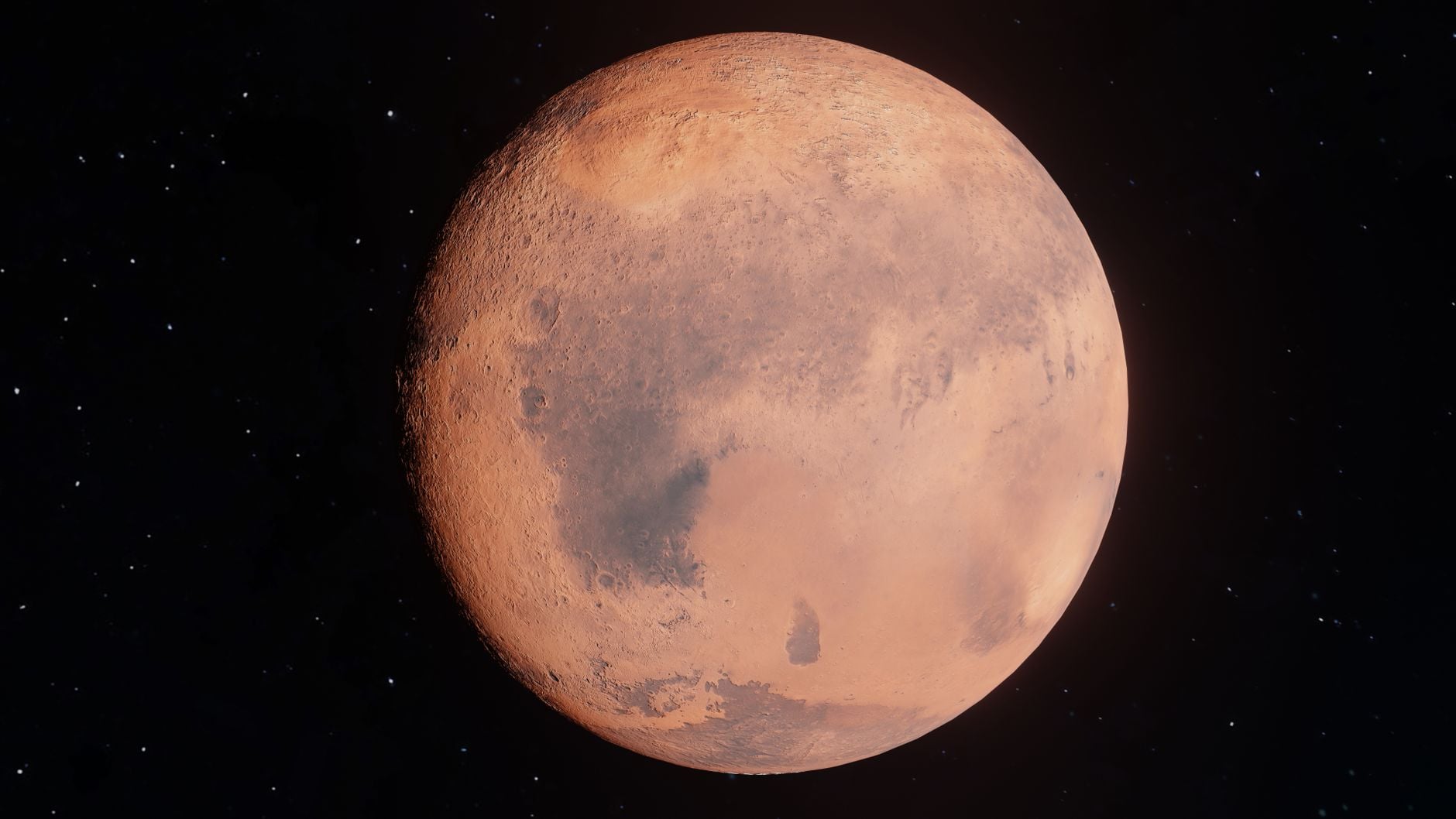
A piece of Mars found on Earth can collect four different labels during one journey. The object begins as Martian rock. Once an impact launches it into space, it is a meteoroid. Its bright passage through Earth’s atmosphere is a meteor. If some of it reaches the ground, that surviving piece is a meteorite.
It is not a comet, and the object that hits Mars to start the journey is not the same object that eventually lands here. The impactor may be an asteroid or comet. The Martian meteorite is debris excavated from the planet by that collision.
The vocabulary can sound needlessly fussy, but each term describes a different physical stage. Keeping the names straight makes the much stranger fact easier to see: Earth already holds samples of Mars that arrived without a spacecraft.
An asteroid impact can launch Mars into space
Mars has enough gravity that ordinary debris falls back to the surface. To escape, a fragment must be accelerated beyond the planet’s escape velocity, roughly five kilometres per second, without being completely melted or vaporised.
A sufficiently energetic impact can produce a small amount of fast-moving ejecta. Some fragments leave Mars, enter independent orbits around the Sun and later cross Earth’s path. The transfer is not a direct shot from one planet to the other. A rock can circle the Sun for a long time before an encounter sends it into our atmosphere.
NASA’s Jet Propulsion Laboratory defines a meteoroid as a small chunk of material that can come from a comet, asteroid or planetary-impact ejecta. Martian fragments fall into that third category.
The meteor is the flash, not the rock on display
When the meteoroid enters Earth’s atmosphere at high speed, compressed air around it becomes hot and luminous. That visible event is the meteor. Calling a stone in a museum a meteor is therefore technically wrong, because the meteor was the brief atmospheric phenomenon.
If the incoming object is entirely destroyed, no meteorite remains. If part of it survives and reaches the surface, that material becomes a meteorite. NASA’s summary of the terminology puts it neatly: meteoroids are in space, meteors occur in the atmosphere, and meteorites hit the ground.
A comet is different. It is a body rich in ice and dust orbiting the Sun, sometimes producing a coma and tail as sunlight heats it. Comets can release meteoroids, and comet debris produces many familiar meteor showers. A rock excavated from Mars does not become a comet merely because it travels through interplanetary space.
“Asteroid” is also generally the wrong word for the Martian fragment. NASA uses asteroid for a comparatively larger inactive rocky body orbiting the Sun, while meteoroid covers smaller material. The size boundary is not perfectly sharp in every technical context, but Martian meteorite samples are discussed as planetary ejecta and meteoroids rather than as named asteroids.
The gas inside the rock identifies Mars
Finding an unusual dark stone on Earth does not reveal its home world by appearance alone. Researchers use mineralogy, rock chemistry and gases trapped in tiny pockets inside the material.
The strongest evidence came from comparing those gases with direct measurements of the Martian atmosphere. NASA’s Viking landers measured that atmosphere in 1976. Some candidate meteorites contained noble gases with the same distinctive chemical and isotopic pattern.
NASA’s Curiosity rover later made a more precise measurement of argon isotopes on Mars. Its Sample Analysis at Mars instrument measured a ratio of 4.2 atoms of argon-36 for each atom of argon-38, matching the range found in gas bubbles inside the meteorites. JPL described the result as the most definitive confirmation of their Martian origin at the time.
The rocks also show igneous processing consistent with a differentiated planet rather than a small primitive body. NASA describes identification as a combined case based on rock chemistry, noble gases and mineralogy, not one magical marker.
Researchers are now connecting samples to individual craters
Knowing a meteorite came from Mars is not the same as knowing where on Mars it formed. A 2024 paper in Science Advances combined crater ages, remote sensing, impact modelling and the exposure histories of meteorites to propose source craters for several groups.
The study estimated that roughly 200 known Martian meteorites came from about ten ejection events. It linked five groups to five craters and concluded that most of the known samples came from volcanic regions in Tharsis and Elysium. The full peer-reviewed paper is available through PubMed Central.
Space Daily covered that mapping work when it appeared, including why assigning a source crater gives a sample geological context. The important distinction here is that crater mapping refines an origin already established through chemistry and trapped atmosphere. It does not turn an ordinary meteorite into a Martian one.
So the shortest accurate answer is chronological. An asteroid or comet may strike Mars. Martian rock escapes as a meteoroid. It produces a meteor while crossing Earth’s atmosphere. The piece recovered from the ground is a Martian meteorite, carrying a small sample of another planet inside it.