

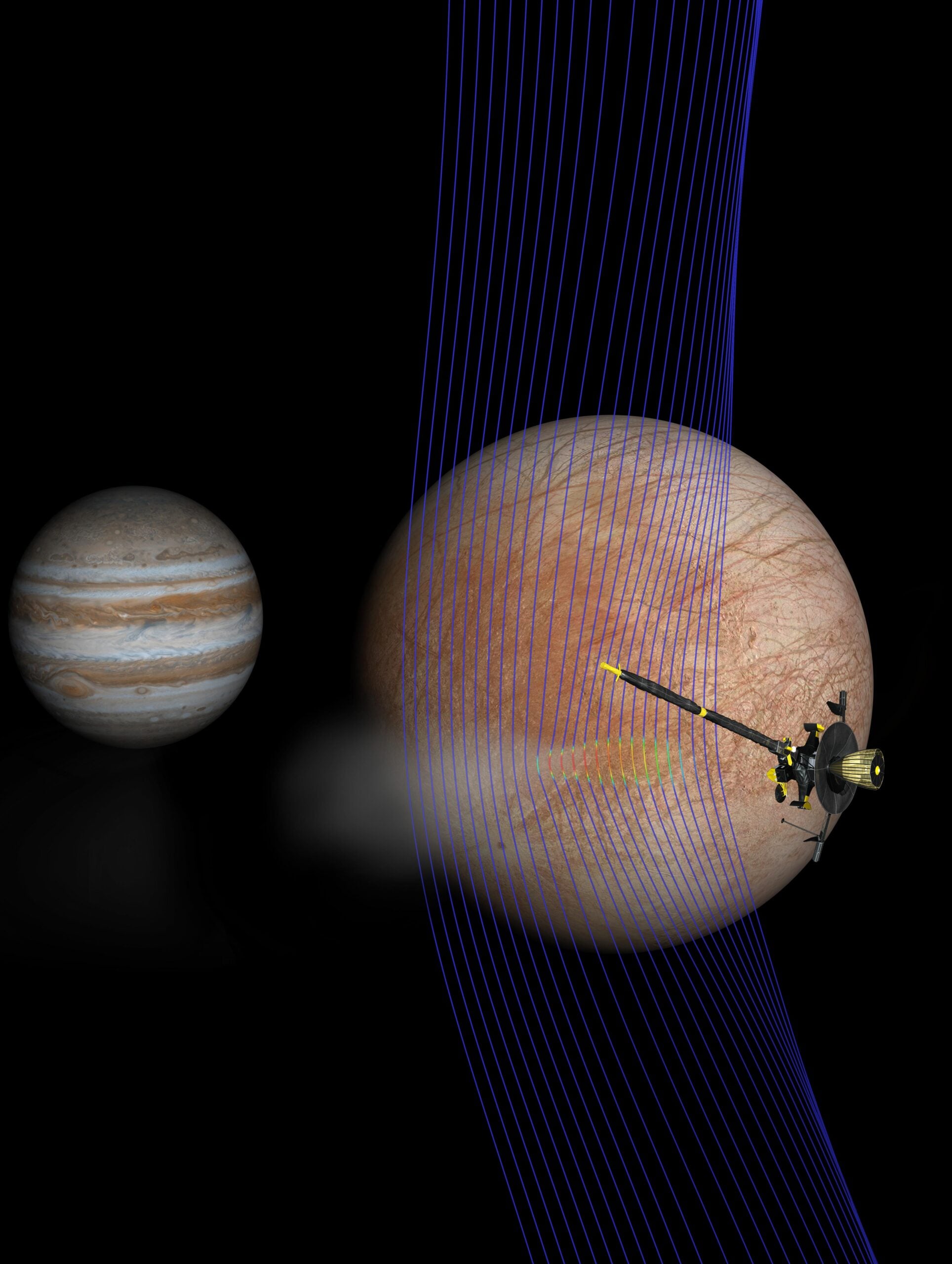
Galileo’s last journey was planned, not accidental. On 21 September 2003, the orbiter entered Jupiter’s atmosphere at 48.2 kilometres per second, nearly 108,000 miles per hour. NASA chose that ending while the spacecraft could still be directed reliably, removing the possibility that a powerless Galileo might later collide with Europa.
The concern was biological contamination. Galileo had been built to investigate Jupiter and its moons, not to land on a potentially habitable world, so it had not undergone the stringent sterilisation required for some missions. No one had shown that viable Earth microbes remained aboard after years in space, but NASA could not exclude the possibility.
Europa made that residual uncertainty important. Galileo’s images and magnetic observations helped turn an ice-covered moon into one of the Solar System’s leading candidates for a deep, salty ocean. The evidence was indirect, and it did not establish that Europa hosts life, but it was strong enough to change how the ageing spacecraft was disposed of.
A commanded ending, not a navigation accident
“Drove” does not mean controllers steered Galileo through Jupiter’s clouds with a joystick. Mission planners used earlier flybys and course corrections to place the orbiter on an impact trajectory. By the final day, Galileo was following that commanded path while returning measurements. NASA’s end-of-mission press kit described the collision course as a deliberate safeguard for Europa.
Propellant was the limiting resource. Galileo needed fuel to turn itself, keep its antenna pointed and adjust its trajectory. Once too little remained, controllers could no longer guarantee the spacecraft’s orientation or future path. Disposal while control remained available closed that uncertainty before it became permanent.
The chosen target was Jupiter itself. The giant planet offered an unambiguous graveyard away from Europa’s ice, and its atmosphere would destroy the spacecraft. The familiar word “impact” is useful shorthand, but Jupiter has no accessible solid surface. Galileo entered the atmosphere, heated, broke apart and disappeared.
Why Europa changed the disposal plan
When Galileo was designed, Europa was an intriguing icy satellite, not yet the flagship ocean world it would become. The spacecraft’s 1989 launch also predated the close reconnaissance that reshaped the target’s scientific standing. The NASA mission record now describes the final plunge as protection for one of Galileo’s own discoveries.
Surface images showed ridges, bands and disrupted blocks in terrain with relatively few large impact craters. The geology suggested a mobile ice shell and a surface renewed in geologically recent times. Those features were consistent with liquid water at depth, although pictures of the surface could not by themselves establish a global ocean.
That distinction matters. Europa remains potentially habitable, not known to be inhabited. Habitability means that conditions may permit life, perhaps through liquid water, usable chemistry and energy. It is not a claim that organisms have been detected. Galileo carried no experiment capable of sampling the buried ocean.
What Galileo actually showed about the ocean
The magnetometer added the most influential evidence. During close passes, Galileo measured changes in Europa’s magnetic environment that varied with Jupiter’s field. A global layer of electrically conducting fluid could generate such an induced magnetic response, and salty liquid water beneath the ice is the leading explanation.
NASA’s current summary of the evidence for Europa’s ocean combines that magnetic signature with the moon’s geology and other observations. The evidence is strong, but it remains inferential. No spacecraft has drilled through Europa’s ice, directly measured the ocean or returned a water sample.
Important details are still open: the ice shell’s thickness, the ocean’s depth and salinity, and whether material is exchanged between the water and surface. Reports of possible water plumes have also required careful reanalysis. None of those uncertainties erases the ocean case, but they define its limits.
The contamination risk was uncertain, not observed
Spacecraft can carry microorganisms from construction and handling unless special measures reduce them. Galileo was clean enough for its intended orbital mission, but it had not been subjected to the rigorous sterilisation associated with missions that face stricter biological controls. That did not mean the orbiter was visibly dirty or known to harbour living microbes.
Fourteen years of vacuum, radiation and temperature extremes would have been hostile to many organisms. Yet exposure in space was not a validated sterilisation procedure, and shielded microbes or spores could not simply be declared impossible. The JPL account published after the mission ended explicitly tied the disposal decision to both Europa and Galileo’s lack of rigorous sterilisation.
A Europa collision was not imminent on the final day. The risk was longer term: once propellant ran out, operators would lose the ability to point, communicate and correct the orbit. Gravitational encounters could then alter the abandoned craft’s path. Planetary protection did not require proof that contamination would occur; it called for eliminating an avoidable pathway while that was still possible.
What happened in the final minutes
Galileo continued transmitting measurements during its approach. Radio signals took about 52 minutes to cross the distance to Earth, so the control room received each report well after the corresponding event at Jupiter. The expected disappearance of the carrier signal marked the mission’s end for the team on Earth.
The quoted 48.2 kilometres per second, or nearly 108,000 miles per hour, is the speed relative to a hypothetical observer at Jupiter’s cloud tops. Atmospheric heating and mechanical forces destroyed the orbiter rapidly. Galileo did not survive as an intact vehicle somewhere deep inside the planet.
This was the main spacecraft’s 2003 ending, separate from Galileo’s atmospheric probe. The orbiter released that probe in July 1995; it entered Jupiter in December of that year and sent direct atmospheric measurements while Galileo relayed them. Confusing the two descents obscures both a pioneering experiment and the later planetary-protection decision.
A precedent for missions to ocean worlds
Galileo launched in 1989 and began orbiting Jupiter in December 1995. It completed the first sustained orbital reconnaissance of the Jovian system despite its high-gain antenna failing to unfold fully. Engineers recovered much of the mission by rewriting software and compressing data, a story examined in this account of Galileo’s antenna failure.
Space Daily has previously covered Galileo’s disposal. The crucial refinement is that the concern was possible biological forward contamination, not evidence of surviving organisms aboard, and the ocean itself was supported by multiple indirect observations rather than seen directly.
The technical logic was therefore restrained. Strong evidence made Europa scientifically valuable. Limited propellant made Galileo’s future control uncertain. A commanded Jupiter entry removed the possibility that an unsterilised, abandoned spacecraft might eventually strike a world whose chemistry and possible biology scientists wanted to study without terrestrial interference.
Galileo’s last act did not prove Europa is inhabited, and it did not prove Earth microbes were alive on the orbiter. It demonstrated a practical principle: once a mission reveals a potentially habitable environment, protecting that environment and the integrity of future measurements can become part of completing the original mission responsibly.