

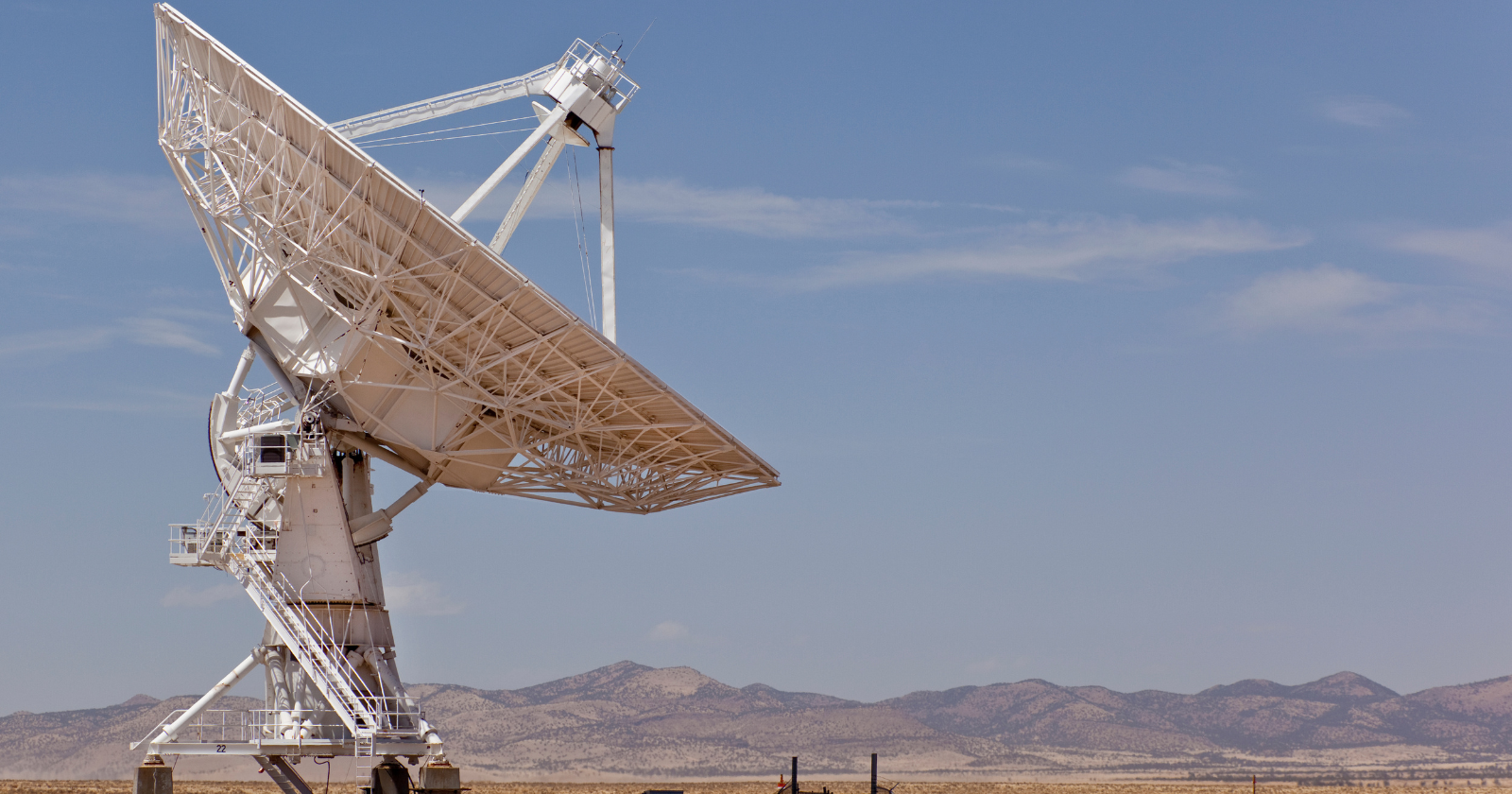
A telescope with no moving parts, stationed in the mountains of British Columbia, has produced the largest single accounting of fast radio bursts ever assembled. The Canadian Hydrogen Intensity Mapping Experiment (CHIME) and its FRB collaboration have released a second catalog logging 4,539 fast radio bursts from 3,641 distinct sources, drawn from more than five years of continuous sky-watching between July 25, 2018, and September 15, 2023.
The result, posted to arXiv in January 2026 and published in The Astrophysical Journal Supplement Series, supersedes the collaboration’s first catalog, which covered a single year of observations ending in mid-2019 and recorded 536 bursts. The new release spans roughly five times the observing period and delivers more than eight times as many detected events, cementing CHIME’s role as the dominant instrument for cataloging these millisecond-long flashes of radio energy.
A telescope that cannot look anywhere else
CHIME’s design is unusual for an instrument that has become the world’s leading fast radio burst detector. Located at the Dominion Radio Astrophysical Observatory near Penticton, British Columbia, it consists of four stationary half-pipe reflectors, each 100 meters long and 20 meters wide, laid side by side and oriented north-south. ICHIME has no moving parts at all — unlike dishes that swivel to track a target. Each cylinder’s focal line is strung with 256 dual-polarization antennas, for 1,024 across the array, feeding a digital signal-processing system that forms 1,024 beams electronically rather than through any physical steering.
That fixed geometry means CHIME cannot be aimed at a particular patch of sky the way a conventional radio dish can. Instead, it watches a roughly 200-square-degree strip of sky directly overhead and lets Earth’s rotation carry the rest of the northern sky through its field of view over the course of a day. The technique, known as transit observing, trades the ability to target specific objects on demand for near-continuous coverage of a wide swath of sky, night and day — precisely the kind of monitoring that catching rare, unpredictable millisecond bursts requires.
What changed since the first catalog
The collaboration’s first catalog, released in 2021, logged just over 500 bursts from a single year of data. That release established CHIME as a serious FRB survey instrument and provided the first large, uniformly selected sample for statistical study. The new catalog is a different scale of effort entirely: it folds in more than four additional years of observing time, past the original one-year window, and pushes the source count past 3,600 — a population increase that lets researchers move from spotting a phenomenon to characterizing it as a class.
Fast radio bursts are intense pulses of radio waves lasting typically a few milliseconds, first identified in archival data in 2007 and confirmed as an astrophysical population in the years since. Most detected bursts appear to flash once and never repeat from the same location, but a minority repeat, sometimes many times, from sources that can be pinpointed to host galaxies. Among the 4,539 bursts in the new catalog, 981 come from 83 known repeating sources, while the remainder appear as one-off events, at least within the observing window. That repeater fraction, drawn from a sample nearly nine times larger than before, gives researchers a substantially firmer basis for comparing the properties of repeating and apparently non-repeating bursts, including their durations, frequency structure, and the dispersion imposed on the signal as it crosses intervening plasma on its way to Earth.
Why the larger sample matters
The physical origin of fast radio bursts remains only partly settled. Magnetars — neutron stars with extraordinarily strong magnetic fields — are the leading candidate source for at least some bursts, following the 2020 detection of a burst from a magnetar inside the Milky Way. But the diversity of burst durations, brightness, and repetition behavior recorded across thousands of events suggests more than one physical mechanism, or more than one class of source, may be responsible. Larger, more uniform catalogs let researchers test that diversity statistically rather than relying on a handful of well-studied individual sources.
Because each burst’s radio signal is dispersed — delayed by different amounts at different frequencies as it passes through free electrons in space — the catalog also functions as a probe of matter distributed between galaxies. That diffuse, low-density gas is difficult to detect by any other means, and a sample of thousands of bursts at known or estimated distances allows astronomers to map its distribution across large volumes of the universe, an application sometimes described as using fast radio bursts to weigh the cosmos.
The catalog paper reports each burst’s arrival time, dispersion measure, scattering timescale, and flux density, along with a dynamic spectrum across the 400–800 megahertz band CHIME observes, at just under a millisecond time resolution. That level of detail, applied uniformly across thousands of bursts rather than compiled from disparate instruments and detection methods, is what distinguishes a catalog release from a series of individual discovery announcements.
What comes next
CHIME/FRB’s outrigger stations — companion antenna arrays built at separate sites across North America — extend the core telescope’s ability to localize individual bursts to their host galaxies with far greater precision than CHIME alone can achieve, a capability that has already been applied to a subset of local-universe bursts drawn from the same multi-year dataset. As those outriggers accumulate their own detections alongside the main array, the size and precision of future catalogs are expected to grow further, sharpening the statistical picture the second catalog has already begun to draw.