

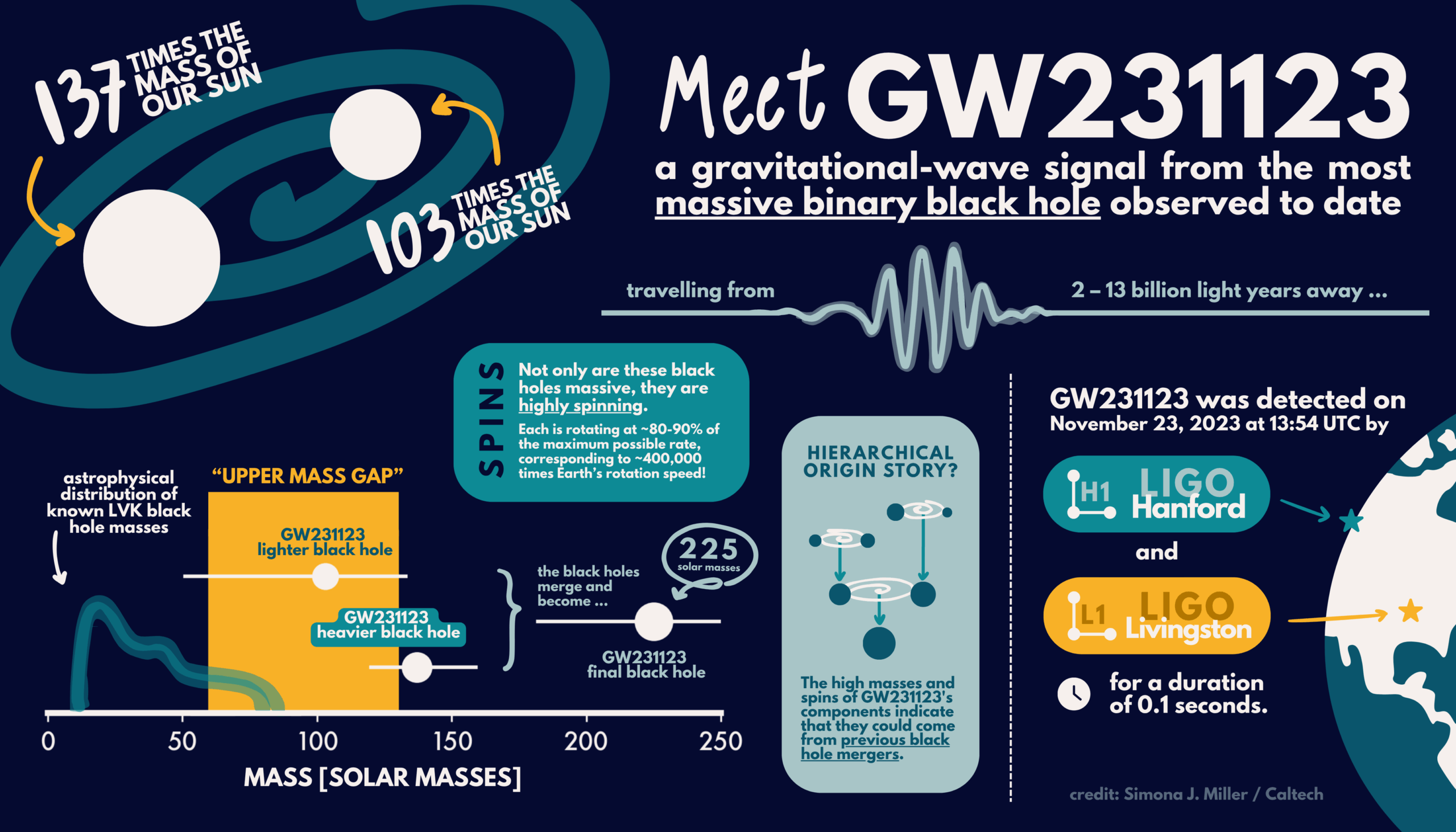
GW231123 was announced as the heaviest binary black-hole merger yet detected through gravitational waves. Standard analyses placed the two components near 137 and 103 times the mass of the Sun, with a combined source-frame mass between 190 and 265 solar masses.
A new analysis offers a substantially different reading. It proposes that a foreground galaxy magnified the signal while a smaller object within that gravitational field diffracted it. If that model is right, the merger occurred farther away and at a higher cosmological redshift than the standard analysis inferred. Its true combined mass would be about 100 to 180 Suns.
This is a peer-reviewed interpretation of one unusually short signal, not a new observation or a confirmed correction to the LIGO-Virgo-KAGRA result. No gravitational-wave event has yet been unambiguously identified as lensed. The useful question is therefore not whether GW231123 has been demoted, but why the lens model changes its inferred mass and what evidence could decide between the competing accounts.
The original analysis produced an exceptional binary
The LIGO detectors at Hanford and Livingston recorded GW231123 on 23 November 2023 during the first part of the network’s fourth observing run. According to the LVK science summary, the signal lasted only about one tenth of a second but appeared coherently in both instruments. Statistical checks placed the chance of terrestrial noise producing a comparable event at less than once in 10,000 years.
The reality of the signal is not the disputed part. The difficulty lies in extracting the properties of its source from a handful of gravitational-wave cycles. Comparing the data with several unlensed waveform models gave component masses of about 137 and 103 solar masses. With the reported uncertainties included, their total source-frame mass lay between 190 and 265 solar masses. Both black holes also appeared to be spinning close to the theoretical limit.
Those properties made GW231123 hard to fit into ordinary stellar evolution. Current models predict a relative shortage of black holes born directly from stars between roughly 60 and 130 solar masses. In sufficiently massive stellar cores, energetic photons can produce electron-positron pairs. The resulting loss of radiation pressure can trigger repeated mass-shedding pulses or a pair-instability supernova that disrupts the star without leaving a black hole.
The boundaries are not universal constants. They move with assumptions about stellar composition, mass loss, rotation and nuclear reaction rates. Even so, the LVK analysis placed the lighter component inside the expected gap with an 83 per cent probability and the heavier one there with a 26 per cent probability.
Why magnification can inflate a source mass
Gravitational-wave observatories do not weigh distant black holes directly. They measure changing strain in the detectors and compare its amplitude and frequency evolution with predicted waveforms. The frequencies reveal a combination of intrinsic mass and cosmological redshift, often described as redshifted or detector-frame mass.
Distance helps separate the two. A merger farther away usually produces a weaker signal, while a gravitational lens can magnify that signal. If the analysis assumes there is no lens, the extra amplitude makes the source appear closer than it really is. A smaller inferred distance implies a lower redshift. Dividing the detector-frame mass by that underestimated redshift factor then makes the source-frame black holes appear too heavy.
Magnification alone changes amplitude. The new analysis also invokes diffraction by a more compact object within the larger lensing environment. Tiny path-length differences produce overlapping copies of the wave that interfere with one another. This wave-optics effect changes the signal with frequency and can imitate features otherwise attributed to the merger, including unusually high spins.
The new model combines two lensing scales
Srashti Goyal, Hector Villarrubia-Rojo and Miguel Zumalacárregui developed a model containing a compact point-like lens embedded in an external gravitational potential. The larger field supplies substantial magnification, as a galaxy could, while the compact object produces the frequency-dependent diffraction pattern.
Their paper in The Astrophysical Journal Letters reports that this lensed model is favoured over an unlensed one. The authors give a conservative false-alarm probability below one per cent for the observed model preference, equivalent to about 2.6 sigma. That is evidence worth following, but it falls short of the conventional threshold used for a discovery claim.
Under the lens interpretation, the binary lies at a redshift between about 0.7 and 2. Its combined source-frame mass shifts to 100 to 180 solar masses, centred around roughly 140 rather than 230. The reconstructed compact lens has a mass between about 190 and 850 solar masses. The revised binary parameters also remove the need for both components to have spins near the Kerr limit.
The open manuscript record makes another limitation clear: the inferred distance and projected lens density remain partly interchangeable, a problem known as the mass-sheet degeneracy. The quoted redshift and magnification therefore require an additional assumption about the galaxy-scale lens.
Why the result is not confirmation
GW231123 is difficult precisely because it is so brief. Only a few gravitational-wave cycles are available to distinguish the source’s own motion from changes imposed during propagation. The size of the lensing preference varies between waveform families, showing that imperfections in the merger models still matter.
An earlier LVK search for lensing in the O4a catalogue also singled out GW231123 as its strongest candidate. Simulated unlensed events in that study did not reproduce the same level of support for an isolated point-mass lens. Yet the collaboration explicitly stopped short of a confident conclusion, citing the signal’s short duration, waveform differences and the uncertain astrophysical probability of the required alignment.
The new embedded-lens calculation addresses one weakness of the isolated model. A compact object is more naturally found inside a galaxy or another larger structure than floating alone. But it also introduces more structure that must be inferred from the same limited data. A better fit is meaningful only after accounting for the additional freedom and the prior assumptions assigned to it.
The lens itself is another open problem. The Max Planck Institute’s account of the study notes that individual compact lenses of 100 to 1,000 solar masses should be exceedingly rare. An extended object such as a globular cluster, or a field of lighter stars and remnants, might create related effects, but those possibilities require further modelling.
A lower mass would not make the event ordinary
Reducing the total from 190–265 to 100–180 solar masses removes much of the original extremity. It does not turn GW231123 into a routine binary or establish a conventional stellar origin. The interval is a posterior range conditional on the lens model, and it does not by itself specify how the mass was divided between the two components.
Other explanations remain available. One or both black holes could have been built by earlier black-hole mergers in a dense stellar environment. An eccentric orbit could leave features absent from the nearly circular templates used in standard analyses. Primordial black holes and more exotic sources have also been discussed, though LVK regarded those alternatives as less probable than hierarchical formation when announcing the event.
The wider O4 catalogue already contains systems that may have formed through earlier mergers. Space Daily examined that population when a ten-month observing run added 161 gravitational-wave detections. GW231123 sits at the difficult edge of the same effort to distinguish unusual formation histories from limitations in current models.
A second image could test the lens
A galaxy-scale lens can send multiple copies of the same gravitational wave along different paths. The copies arrive at different times and with different magnifications. Under a simple galaxy model, Goyal and colleagues estimate about a 55 per cent probability that GW231123 should produce an additional detectable image.
Finding a later or earlier signal with matching intrinsic parameters would provide powerful evidence for strong lensing. Not finding one would constrain the proposed geometry, although it would not rule out every lens configuration. Searches can also look for the subtler diffraction patterns expected from a field of stars and remnants rather than one compact lens.
Improved waveform calculations are equally important. If an unlensed model cannot reproduce the merger accurately, the residual mismatch can be mistaken for a propagation effect. More sensitive detectors will record longer and cleaner signals, making it easier to tell where a distortion entered.
The record has not yet been withdrawn
The standard LVK analysis still makes GW231123 the heaviest binary black-hole merger detected through gravitational waves. The new paper supplies an alternative set of source parameters conditional on a particular lensing model. It does not establish that the official masses were errors.
That distinction is more than caution over wording. Mass, spin, distance and lensing are all inferred together from the waveform. The data are fixed; the physical history used to explain them is not. Under an unlensed history, GW231123 remains a 190–265-solar-mass outlier. Under the magnified and diffracted history, it becomes a 100–180-solar-mass system seen through an unusual foreground lens.
The coming test is observational. A matching macro-image, a consistent pattern across improved waveform models, or similar events found at the predicted rate would strengthen the lensing case. Until then, GW231123 is best described as the strongest current gravitational-wave lensing candidate, not the first confirmed one.