
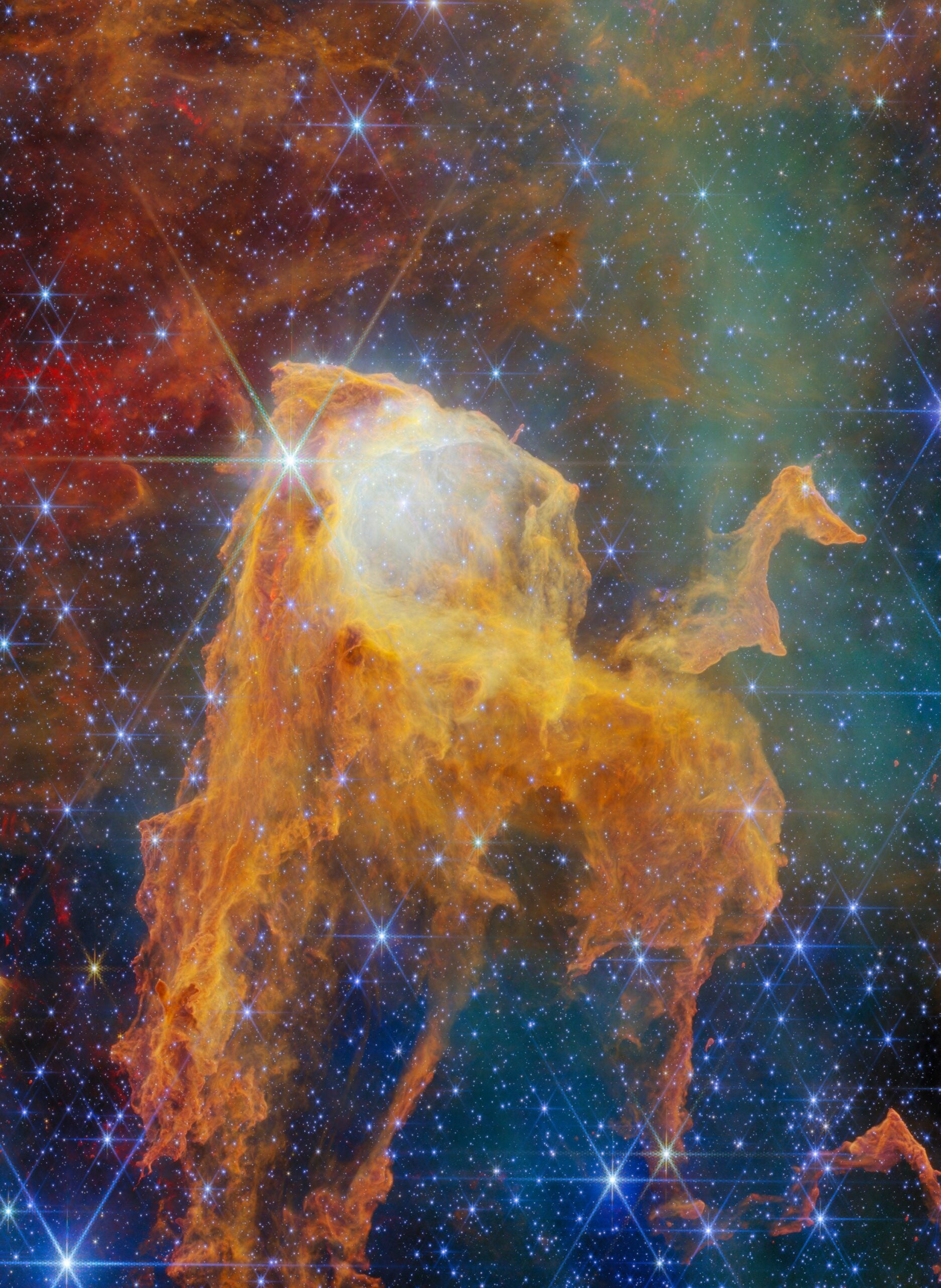
About 70 young stars are packed inside a single dark knot of gas and dust in the Carina Nebula, some 7,500 light-years away — and the brightest of them is a rare O-type star weighing roughly 19 times as much as the Sun. That knot is the Treasure Chest, a cometary globule imaged by the NASA/ESA/CSA James Webb Space Telescope’s Near-Infrared Camera and released on 6 August 2026 as ESA/Webb’s Picture of the Month. The credit line reads ESA/Webb, NASA & CSA, M. Reiter, with an acknowledgement to M. H. Özsaraç, and the full-resolution frame runs 8,200 × 11,220 pixels — enough room to resolve a cluster that, at visible wavelengths, largely hides behind its own birth cloud. Live Science featured the image as its Space photo of the week, framing it around that scarce, massive star buried inside the globule.
The nickname belongs to the cloud, not the star. The Treasure Chest is the globule; the O-type star is the most massive member of the cluster inside it. Keeping those straight matters, because nearly everything interesting in this frame comes from the interaction between the two.
A dark head, a swept tail, and a lid that appears to be open
A cometary globule is an isolated cloud of gas and dust with a dense, dark head and a tail that sweeps away from it — a shape that has nothing to do with actual comets and everything to do with being stood in the path of something powerful. The dense head resists; the thinner material behind it gets pushed and stretched, trailing off in the direction the pressure is heading. In wide-field views of Carina, such globules read as small dark commas against a much larger glow.
Webb’s NIRCam changes what the head looks like. The image was assembled from filters at 1.62 µm and 1.64 µm (Fe II), plus 4.44 µm and 4.7 µm (molecular hydrogen) — a combination tuned to shocked iron and warm hydrogen, the fingerprints of gas being hit and heated rather than sitting quietly. Near-infrared light also penetrates dust that stops optical photons cold, so the cluster embedded in the globule’s head shows through as a scatter of point sources inside a cavity, with the cloud’s denser walls curving around them. The result is the visual pun in the name: a dark box that appears to be lifting open, with the light inside spilling out over the rim.
The Carina Nebula itself spans roughly 260 light-years and sits in the southern constellation Carina, the Keel. It is the nearest high-mass star-forming region, which is the practical reason astronomers keep returning to it — the full range of star formation, from the most massive stars down to much smaller ones, is available at a distance where individual objects can be separated rather than blurred into a single bright smear.
Seventy stars, one O-type, and a cluster still wearing its cocoon
Researchers estimate about 70 stars inside the Treasure Chest. The most massive is that O-type star at roughly 19 solar masses — a genuinely rare class, both because high-mass stars are uncommon to begin with and because they burn through their lives quickly, leaving a narrow window in which to catch one still sitting in its natal cloud.
The cluster’s age is likely around 1.3 million years, according to the ESA/Webb release, which notes that earlier estimates ran as young as about 100,000 years. Either way, this is a system caught early. The stars remain deeply embedded in the gas and dust that formed them, and many of them show evidence of circumstellar discs — the flattened reservoirs of material from which planets, where they form at all, are assembled. A massive O star inside a cluster of disc-bearing young stars is a specific and useful configuration: its radiation is precisely the kind that erodes discs, and here the erosion, if it is happening, is happening at close range and in a frame Webb can resolve.
That proximity cuts the other way too. The embedded cluster is eating the cloud from within, carving out the cavity that gives the globule its open-chest look, even as the same cloud continues to shield it from view at shorter wavelengths.
Feedback from 39 light-years away, and what programme #5408 is asking
The Treasure Chest’s outward shape is credited largely to forces from beyond it — the radiation and winds of Eta Carinae, about 39 light-years to the northwest on the sky, together with the nearby cluster Trumpler 16. That external pressure is the sculptor of the tail; the internal cluster is the excavator of the head.
Which came first is not settled. The ESA/Webb release presents the likeliest scenario as one in which the cluster formed first, inside a larger cloud, and external feedback then stripped away the less dense gas around it, leaving the dense pocket behind as the cometary shape seen today. The alternative ordering — pressure first, collapse second — is the kind of question these images are meant to constrain rather than close.
The observations come from programme #5408, with Reiter as principal investigator, aimed at how young stars in Carina collect gas and then expel it again through outflows. That accretion-and-ejection cycle is why the filter set leans on Fe II and molecular hydrogen: those lines trace the shocked gas where outflows slam into their surroundings, which is how outflows are detected when the driving stars themselves are still hidden.
As a Picture of the Month, potm2607a functions less as a portrait than as an instrument window. One dark knot, about 70 stars, one 19-solar-mass O-type star, 7,500 light-years off — high-mass star formation at the closest range the galaxy offers, held still long enough to count.