

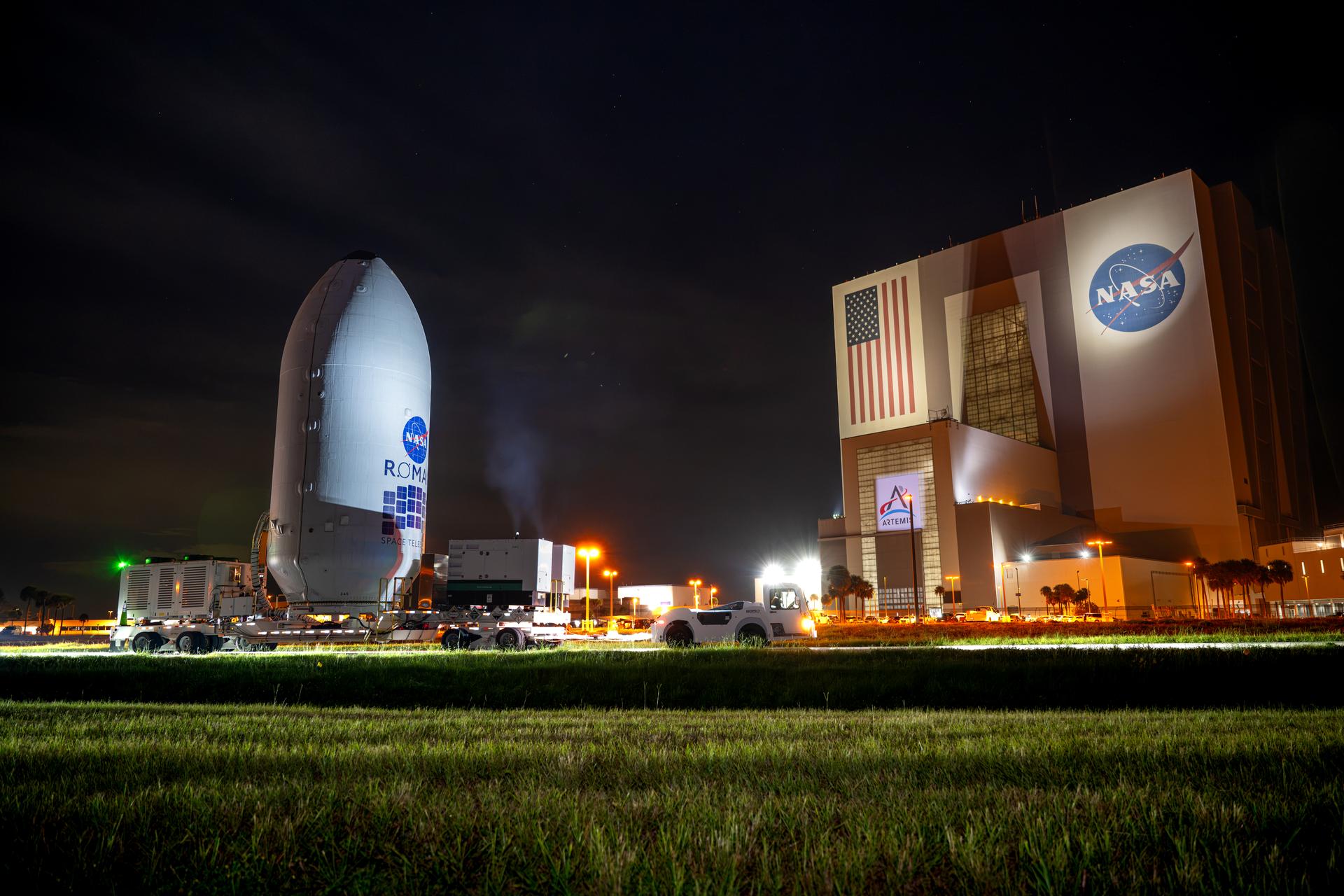
NASA’s Nancy Grace Roman Space Telescope has reached a place that once looked far from guaranteed. It is enclosed inside a 13-metre SpaceX payload fairing at Kennedy Space Center, mated for a Falcon Heavy launch and cleared by the final launch readiness review.
Liftoff is targeted for 7:26 am EDT on Sunday, 30 August 2026. If it occurs on that schedule, Roman will leave Earth after surviving three White House requests for outright termination and a fourth request that would have sharply reduced funding during the closing stretch of its development.
The simple version says President Donald Trump tried to kill the telescope four times and Congress saved it four times. The documentary record broadly supports that account, but the details matter. The first three episodes were zero-dollar termination proposals. The fourth was a 61.6 percent reduction from Roman’s fiscal 2024 operating-plan level, not a formal cancellation. None of the four presidential requests was itself a cancellation order.
What happened was a recurring contest between the executive branch’s budget priorities and Congress’s constitutional control of appropriations. Roman remained alive because lawmakers repeatedly placed money back into the annual spending bills.
A president’s budget does not spend the money
The distinction is basic but important. A presidential budget request is an administration’s proposal to Congress. It can shape agency planning, reveal priorities and create immediate uncertainty, but it does not become law merely because the White House publishes it.
Congress writes the appropriations that permit federal agencies to spend. The president can sign or veto the resulting legislation. Roman was not cancelled four times and revived four times. It was targeted in four budget cycles, then protected through the appropriations process.
Attributing those requests to Trump is fair in the ordinary political sense. They were his administrations’ formal budgets. It is still worth remembering that each document was produced through the Office of Management and Budget, NASA leadership and a large executive-branch process rather than by one person typing a line into a spreadsheet.
The effect inside a project can nevertheless be serious. NASA cannot simply assume that Congress will reverse a proposed cut. Managers must consider contracts, staffing, schedule reserve and what work can legally continue under the funding actually available.
Attempt one: fiscal 2019
The first explicit termination proposal arrived on 12 February 2018. Roman was then known as the Wide Field Infrared Survey Telescope, or WFIRST.
In NASA’s statement accompanying the fiscal 2019 request, acting administrator Robert Lightfoot called the proposed cancellation a hard decision and said the resources would be redirected to other agency priorities. The government’s budget volume cited higher NASA priorities and the telescope’s increasing cost.
That cost concern was not invented for the proposal. WFIRST had grown beyond the roughly 1.5-metre mission recommended in 2010 after NASA adopted a donated 2.4-metre telescope assembly. The larger aperture and a coronagraph technology demonstration greatly expanded its possibilities, but National Academies reviews also warned that cost growth could unbalance the wider astrophysics portfolio.
Congress rejected termination and supplied $312.2 million for fiscal 2019. A NASA astrophysics budget presentation recorded the contrast plainly: the administration request was zero; the appropriation was $312.2 million.
Protection did not mean a blank cheque. Congress attached a $3.2 billion cap to formulation and development and required NASA to provide a credible multi-year funding profile. The political message contained both support and restraint: continue the top-ranked mission, but do not allow it to consume the rest of space astronomy.
Attempt two: fiscal 2020
The next White House request again supplied no money for WFIRST. By then the dispute was no longer hypothetical. Teams were designing hardware, maturing detectors and preparing the mission for its formal commitment review.
Congress again chose continuity. The explanatory statement for the fiscal 2020 appropriations act included $510 million. The Government Accountability Office’s 2020 assessment explicitly noted both sides of the decision: NASA had requested no funding, while Congress provided the project with $510 million.
Annual zero-dollar requests do more than produce dramatic headlines. A flagship observatory is a network of long-lead components, specialist teams and contracts. Interrupting that network can create costs that are not recovered merely by restoring the same nominal amount later.
That does not prove the second request would have destroyed every piece of work immediately. Agencies have carryover balances, contract mechanisms and legal constraints that complicate any simple countdown to closure. It does mean the mission’s planned funding stream once again depended on Congress declining the administration’s proposal.
Attempt three: fiscal 2021
On 10 February 2020, the administration’s fiscal 2021 budget proposed terminating WFIRST for a third consecutive year. The timing was striking. NASA was approaching the decision that would move the observatory from formulation into implementation.
Congress responded with $505.2 million. The final congressional agreement published in December 2020 named the amount specifically for the Nancy Grace Roman Space Telescope.
The change in name had occurred between the request and the appropriation. On 20 May 2020, NASA renamed WFIRST for Nancy Grace Roman, its first chief astronomer and a central advocate for developing observatories above Earth’s atmosphere.
The telescope’s identity changed, but the budget pattern did not. For three consecutive fiscal years, the White House proposed zero and Congress wrote the project back into the federal budget.
Attempt four was a cut, not a zero
The fourth episode came after Trump returned to office. This one needs different language because the fiscal 2026 proposal did not terminate Roman on paper.
NASA’s fiscal 2026 technical supplement requested $156.6 million for the telescope. Roman’s fiscal 2024 operating plan had allocated $407.3 million. Measured against that published level, the request was $250.7 million lower, a reduction of about 61.6 percent.
The document said NASA was evaluating cost-saving strategies and schedule optimisation while continuing integration and testing. That wording matters. It did not say work would stop. It also did not demonstrate that the observatory could absorb such a reduction without consequence during its final assembly and launch campaign.
Late development does not necessarily require the same annual spending as peak construction, so comparing two years cannot by itself prove the exact size of a funding shortfall. Even so, $156.6 million was far below the programme’s previous profile at a stage when environmental testing, launch-site work and ground-system readiness still had to be completed.
Congress provided $300 million instead. The final fiscal 2026 appropriations summary described the money as funding to complete Roman, while the accompanying agreement instructed NASA to finish the necessary work and launch at the earliest feasible date.
That amount was not a return to $407.3 million, nor did it need to be interpreted that way. A project’s annual requirement normally falls as fabrication ends. The defensible conclusion is narrower: Congress almost doubled the administration’s $156.6 million request and protected the final path to launch.
Why Congress kept protecting Roman
Roman possessed something unusually valuable during repeated budget fights: an independent priority established before any of them began.
The National Academies’ 2010 astronomy and astrophysics decadal survey ranked WFIRST first among proposed large space activities. That is more precise than calling it the single highest priority in all of astronomy. Decadal surveys balance projects by scientific value, cost and programme scale, and rank activities within categories.
Congress could therefore defend Roman as the astronomy community’s leading large space recommendation, not merely as a project an agency office wanted to preserve. The endorsement also survived later scrutiny. Reviews questioned scope and cost, but the scientific case remained strong enough that lawmakers coupled continued funding with a development cap.
There was a practical argument too. Roman’s capabilities are not a small variation on Hubble. Its 2.4-metre primary mirror supports very similar near-infrared sharpness, while its wide-field camera captures at least 100 times more sky in a single image.
Space Daily’s account of Roman’s inherited mirror explains the hardware history behind that combination. NASA received valuable, flight-qualified telescope parts from the National Reconnaissance Office in 2012, not two finished observatories. Everything needed to turn one mirror into Roman still demanded years of engineering and billions of dollars.
A separate Space Daily comparison of Roman and Hubble shows why the larger field matters. Survey speed comes from width, detector area, observing strategy and the optical system around the mirror. Roman is not simply a faster Hubble, and its speed does not mean every exposure reaches 1,000 times deeper.
The science Congress preserved
Roman’s wide surveys are designed to trace the distribution of galaxies and matter across large fractions of the sky. Multiple measurement methods will test how cosmic expansion changed over time and how dark matter shaped large-scale structure.
That independent survey is why Roman matters to the dispute over the universe’s expansion rate. It will not automatically solve the Hubble tension, but it can test distance and structure measurements using a different instrument, survey design and set of systematic errors.
The telescope will also search for planets through microlensing and transits, while its coronagraph demonstrates technologies for suppressing starlight and imaging faint nearby planetary systems. Forecasts vary with the observing programme and detection thresholds.
Space Daily’s audit of the planet forecasts found that NASA’s headline figure of roughly 100,000 worlds refers mainly to expected transit detections. Simulations range from about 60,000 to 200,000, with microlensing expected to add more than 1,000 planets. Those are forecasts, not discoveries already banked.
Congress was therefore preserving a general-purpose observatory as well as a defined set of flagship surveys. Roman’s archive is intended to support research far beyond its central dark-energy and exoplanet programmes, just as broad Hubble surveys have outlived the questions used to justify them.
What “nine months early” actually compares
NASA’s 25 August launch update said Roman was launching nine months ahead of schedule. The reference point is the formal May 2027 launch-readiness date established in the mission’s replanned baseline, not every earlier schedule Roman ever carried.
The arithmetic appears straightforward if 30 August is compared with the end of a May 2027 commitment window. Yet NASA has also described Roman as eight months ahead of its required date in other recent material. That is not evidence of a hidden schedule change. May 2027 was a commitment month rather than a public appointment at a specific hour, and the agency has rounded the interval in different ways.
The GAO’s July 2026 project assessment supplies the cleanest context. Roman’s pandemic-era replan set a $4.316 billion life-cycle cost and a May 2027 launch-readiness date. The current August 2026 target is also two months earlier than the project’s original October 2026 launch target.
Roman is thus early against both the pre-pandemic working date and the later formal commitment, but by different amounts. “Nine months early” is defensible as NASA’s own current shorthand. It should not be read as evidence that the entire programme was completed nine months faster than originally conceived.
Funding continuity helped, but it did not build Roman by itself
There is a tempting straight line from Congress restoring money to Roman arriving early. The relationship is real but not sufficient on its own.
Stable funding allowed NASA to retain specialist teams, place contracts, order long-lead hardware and keep integration moving. Repeated interruptions would have made an early launch less likely. But the schedule result also reflects thousands of engineers and technicians, parallel construction of major elements, disciplined testing and schedule margin that survived technical problems and the pandemic.
GAO notes that Roman’s integration and test activities received excepted status during the 2025 lapse in appropriations, allowing work to continue. The observatory completed full environmental testing in April 2026 and shipped to Kennedy in June.
On 19 July 2022, NASA awarded SpaceX a launch-services contract worth approximately $255 million, including the launch and related mission costs. The original Falcon Heavy contract announcement specified an October 2026 target from Launch Complex 39A.
The earlier opportunity eventually became 30 August. Roman was encapsulated on 21 August, moved to the SpaceX hangar on 25 August and passed its launch readiness review on 28 August.
A launch target is still a target
NASA’s latest status is “go” for launch, not “launched”. The 28 August readiness update reported a 60 percent probability of favourable weather. Range conditions, a rocket issue or a late spacecraft concern can still move the attempt.
After launch, Roman must travel roughly 1.5 million kilometres to a quasi-halo orbit around the second Sun-Earth Lagrange point. Deployment, cooling, optical alignment, calibration and commissioning remain between separation from Falcon Heavy and routine science.
Nor will surviving a budget threat guarantee scientific success. The observatory must operate reliably, control subtle detector and optical effects, deliver calibrated data and sustain the survey strategy on which its forecasts depend.
Those cautions do not diminish the history. They locate the present moment honestly. A telescope can survive politics, finish early and still face the ordinary risks of launch and commissioning.
The mission that annual politics could not quite stop
Roman’s path to Pad 39A is a particularly American institutional story. A US intelligence agency supplied the telescope hardware from which its primary mirror came. A National Academies process supplied the scientific priority. NASA, universities and contractors supplied the design and hardware. Three Trump budgets proposed termination, a fourth proposed a severe cut, and successive Congresses maintained the funding. SpaceX now supplies the rocket.
No single participant can claim the observatory. The executive branch proposed it, tried repeatedly to remove or reduce it, managed its construction and now promotes its launch. Congress protected it while also constraining its cost. Engineers converted those often contradictory instructions into an object that could be tested, transported and placed inside a fairing.
The striking image is not Roman against a field of galaxies. That image does not exist yet. It is a white payload fairing moving at night towards a Falcon Heavy hangar, carrying a telescope that repeatedly disappeared from presidential budget requests but never disappeared from the appropriations Congress enacted.
Roman has not escaped uncertainty. It has simply reached the point where the next decisive test belongs to the rocket rather than the budget.