
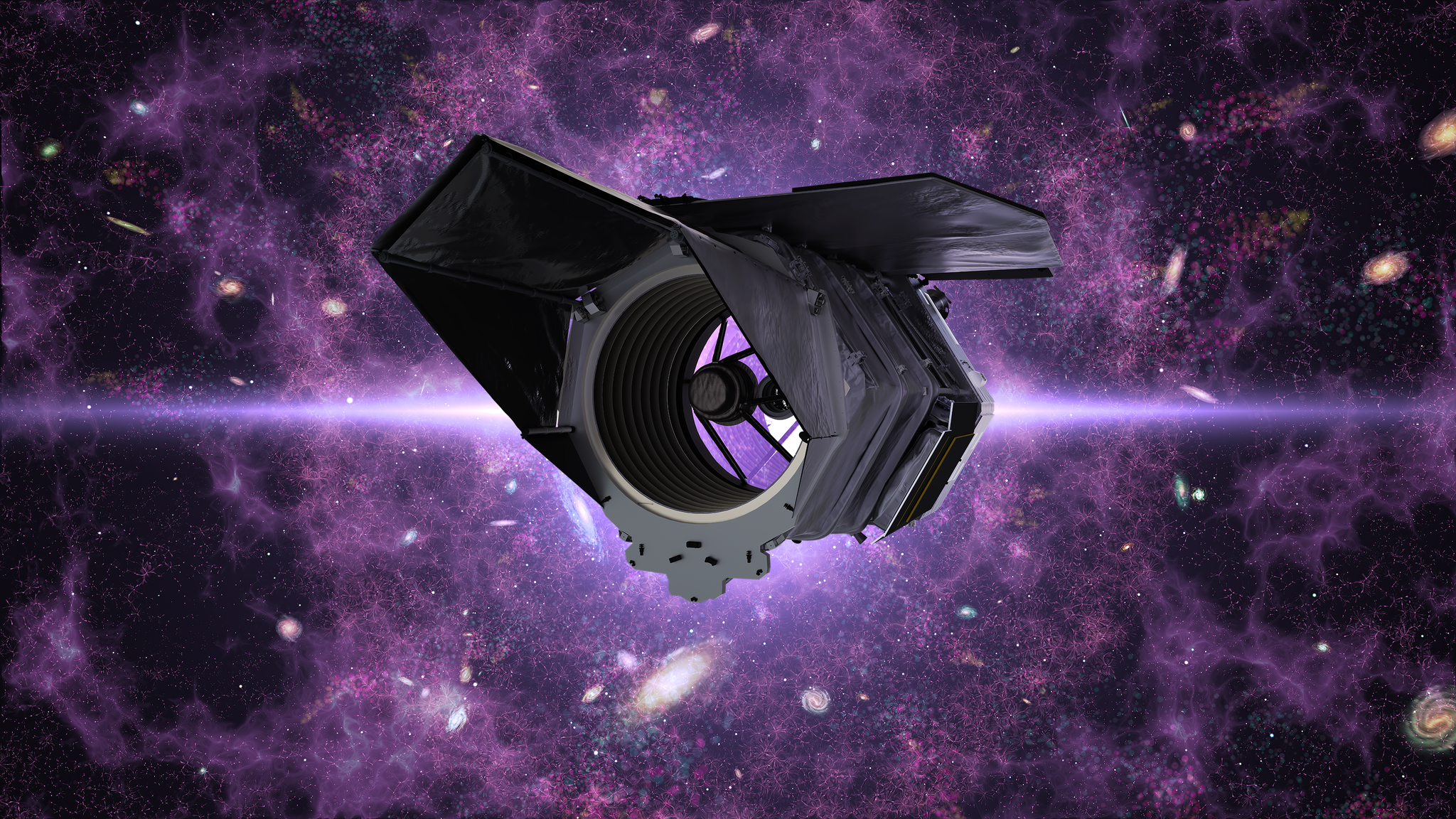
Three days before NASA’s current launch target, the Nancy Grace Roman Space Telescope is no longer an observatory waiting in a clean room. It has been fuelled, enclosed inside a Falcon Heavy payload fairing and moved into the final launch campaign at Kennedy Space Center.
NASA lists liftoff for 7:26 am EDT, or 11:26 UTC, on 30 August 2026 from Launch Complex 39A in Florida. The date remains a target until the rocket actually leaves the pad. Weather, a technical concern or range readiness can still move it.
If the schedule holds, Roman will soon head toward the Sun-Earth L2 point, roughly 1.5 million kilometres from Earth. There it will begin a five-year primary mission with an unusual assignment: survey such large pieces of the infrared sky, so repeatedly and so consistently, that some of cosmology’s most stubborn ambiguities have nowhere comfortable left to hide.
The timing is unusually good. The universe appears to be expanding about nine percent faster in direct observations of its recent neighbourhood than the best standard model predicts from conditions soon after the Big Bang. The uncertainties quoted by the two camps are far smaller than that gap.
This is the Hubble tension. It may be evidence that a measurement has fooled cosmologists. It may be evidence that the standard model is incomplete. It may contain smaller problems on both sides. After years of increasingly precise work, nobody has demonstrated which explanation is right.
Roman will not settle that argument with a single number. Its more important contribution is a network of observations that approach expansion through exploding stars, gravitational time delays, a fossil ruler in galaxy clustering and the growth of cosmic structure. Each method depends on different measurements and carries different weaknesses.
The Hubble constant is not the acceleration of the universe
The Hubble constant, usually written H0, describes the present relationship between a galaxy’s distance and the rate at which cosmic expansion carries it away. In the smooth Hubble flow, more distant galaxies recede faster.
Its awkward unit is kilometres per second per megaparsec. One megaparsec is about 3.26 million light-years. If H0 is 73.5 kilometres per second per megaparsec, adding one megaparsec of separation adds about 73.5 kilometres per second to the expected recession speed. At 100 megaparsecs, the expansion component is about 7,350 kilometres per second.
That value is a slope, not a universal speed assigned to every galaxy. Nearby objects also have their own motions under local gravity. And over the greatest distances, cosmologists must use general relativity rather than extending the simple multiplication without limit.
It is also not the same quantity as cosmic acceleration. The Hubble constant describes the expansion rate now. Acceleration describes how expansion has changed with cosmic time. Dark energy is relevant to both, but saying “the universe expands faster than expected” in the Hubble-tension context does not mean astronomers have simply remeasured the acceleration discovered in the late 1990s.
SpaceDaily’s earlier explanation of the visible universe, dark matter and dark energy followed this distinction to the largest observable scales. Space can expand in a way that produces enormous recession rates without galaxies locally breaking the speed limit.
The disagreement is now written as 73.50 against 67.24
In April 2026, an international collaboration called the Local Distance Network reported a direct local result of 73.50 plus or minus 0.81 kilometres per second per megaparsec. Its quoted precision was 1.09 percent.
For the early-universe comparison, the same consensus report used 67.24 plus or minus 0.35 kilometres per second per megaparsec from cosmic microwave background observations interpreted with a flat Lambda cold dark matter model. The difference was 7.1 standard deviations under the paper’s statistical treatment.
The central values differ by 6.26 kilometres per second per megaparsec, or about 9.3 percent relative to the early value. That may sound small next to the scale of the cosmos. It is enormous compared with uncertainties below two percent.
A second early-universe route, combining Big Bang nucleosynthesis with baryon acoustic oscillation results from DESI, gave 68.51 plus or minus 0.58 in that comparison. Its difference from the local network was five standard deviations. The tension is therefore not simply one Hubble instrument arguing with one Planck satellite.
Statistical significance is not a probability that new physics is real. It says how difficult the observed separation would be if the stated model, uncertainties and correlations were complete. A shared systematic error, an underestimated covariance or a model assumption can make a formally large sigma value misleading.
The local number is a network of distances
No telescope watches space stretch and reads 73.50 from a dial. The local determination is assembled by comparing objects whose distances can be established with objects that reach farther into the smooth cosmic flow.
The classic distance ladder begins with geometry. Parallax measures the tiny apparent shift of a nearby star as Earth changes position around the Sun. Water masers orbiting black holes and detached eclipsing binary stars provide other geometric anchors. These calibrate objects whose luminosity can be inferred from an observable property.
Cepheid variable stars are the best-known middle rung. Their pulsation periods reveal their intrinsic luminosities. Compare that luminosity with how bright a Cepheid appears and its distance follows. Cepheids in galaxies that have hosted Type Ia supernovae then calibrate those much brighter explosions.
Type Ia supernovae are not perfectly identical candles. Astronomers standardise them using the shapes and colours of their light curves. Once calibrated, they can be seen far enough away that local gravitational motions become small beside the recession produced by cosmic expansion.
The 2026 network went well beyond a single Cepheid-to-supernova chain. It connected parallaxes, detached eclipsing binaries and masers to Cepheids, the tip of the red giant branch, Mira variables, carbon-rich J-region asymptotic giant branch stars and other distance indicators. It also included Type II supernovae, surface-brightness fluctuations and relations linking a galaxy’s luminosity to its rotation or internal motions.
Removing the Cepheid route or the red-giant-tip route barely shifted the network centre. Replacing Type Ia supernovae with galaxy-scale indicators changed H0 by less than 0.1, though it roughly doubled the uncertainty. The point of the network is not that every method is perfect. It is that no one familiar rung has to carry the full result.
Direct still does not mean assumption-free
The local network can be direct in a cosmological sense and still contain difficult astrophysics. Parallax zero points must be calibrated. Unresolved neighbouring stars can make a Cepheid appear brighter. Dust dims and reddens light. The metal content of a star can alter the relation used to infer its luminosity.
Supernova standardisation has its own dependencies. Host-galaxy mass, stellar population, dust and the way a survey selects events can all influence the inferred distances. Nearby galaxies also move toward and around concentrations of matter. Their peculiar velocities must be separated from the average expansion.
Webb’s sharp infrared vision has directly tested one prominent concern: whether crowding in Hubble images created enough Cepheid bias to explain the discrepancy. The largest Webb cross-checks have not found the required offset. SpaceDaily covered how the Hubble and Webb measurements agreed in overlapping galaxies.
That is not proof that every local systematic has vanished. Different indicators sometimes prefer different centres when their samples are still small. Several ostensibly independent routes also share supernovae, galaxies, calibrations or statistical choices. Independence comes in degrees.
The honest conclusion is narrower: simple Cepheid crowding is now a poor explanation for the full gap, and a growing collection of local routes clusters toward a higher Hubble constant. A subtle common error remains possible because subtle common errors are exactly what precision astronomy must keep testing.
The early number is a model carried across cosmic time
The cosmic microwave background is light released when the universe was about 380,000 years old. Before that time, electrons scattered photons continually through a hot plasma. As the universe cooled and neutral atoms formed, the photons began travelling freely. They now arrive as microwave radiation from every direction.
The mottled temperature and polarisation patterns in that radiation preserve pressure waves in the early plasma. Gravity pulled matter inward while photon pressure pushed outward. The resulting acoustic pattern had a physical scale called the sound horizon.
Satellites such as Planck measured the apparent angular size of that pattern with extraordinary precision. But an angle alone does not state today’s Hubble constant. Cosmologists fit a model that specifies the contents and geometry of the universe, calculates the physical sound horizon and evolves the cosmos forward to the present.
Under the six-parameter flat Lambda CDM model, Planck’s final analysis inferred H0 of 67.4 plus or minus 0.5. The updated comparison value used by the Local Distance Network, 67.24 plus or minus 0.35, combines early-universe information more broadly.
Planck did not measure a nearby supernova and obtain 67. The early number is an inference. If the sound horizon was smaller than Lambda CDM predicts, the same microwave-background angle could coexist with a higher present expansion rate.
This model dependence is not a weakness hidden in the method. It is the point of the test. The microwave background supplies a remarkably precise initial condition. The question is whether the standard model can correctly carry that condition through almost the whole age of the universe.
Why Lambda CDM has earned the benefit of serious doubt
Lambda CDM is often called the standard cosmological model. Lambda represents a cosmological constant, the simplest form of dark energy. CDM stands for cold dark matter, an invisible component that moves slowly enough in the early universe to build the cosmic web. Ordinary matter, radiation and neutrinos complete the basic inventory.
With only six base parameters, the model reproduces the detailed peaks in the microwave background, the abundance of light elements, the broad distribution of galaxies and much of the history of expansion. It is not a loose story designed to explain one number.
That breadth matters. A disagreement in H0 does not mean the entire model has plainly collapsed. Any replacement must retain the successes while fixing the mismatch. Many proposed solutions raise the inferred Hubble constant but damage the fit to another part of the microwave background or cause structure to grow incorrectly.
There are also other tensions in cosmology, including disagreement over how clumpy matter should be at late times. It is tempting to ask one new ingredient to solve them all. In practice, a model that improves H0 can worsen the structure-growth problem.
Lambda CDM therefore deserves neither blind loyalty nor casual dismissal. It deserves tests precise enough to force a specific failure.
The most direct new-physics ideas change the early sound horizon
One family of proposed solutions briefly changes the energy budget before the microwave background formed. “Early dark energy” is a generic name for a component that contributes for a limited period and then fades. By making the young universe expand faster, it can leave less time for pressure waves to travel and produce a smaller sound horizon.
A smaller ruler changes the inferred distance scale. The same observed microwave-background pattern and later galaxy clustering can then point to a higher H0.
Other possibilities add extra relativistic particles, alter neutrino behaviour, introduce interactions within the dark sector or modify the history of recombination. Late-time proposals allow dark energy to evolve or gravity to depart from general relativity over enormous distances.
The difficulty is not inventing a component that moves one parameter. The difficulty is preserving the heights and spacing of the microwave-background peaks, primordial element abundances, galaxy-clustering distances, gravitational lensing and structure growth at the same time.
Recent DESI results illustrate that discipline. As SpaceDaily’s account of the evolving-dark-energy hint explained, DESI’s galaxy map by itself did not overthrow Lambda CDM. The preference appeared in particular combinations with microwave-background and supernova data, changed with the supernova compilation, and weakened in parts of the evidence updated in 2026.
An evolving late-time dark energy component is also not automatically a solution to H0. Much of the discrepancy is encoded in the early sound-horizon calibration. A successful model must connect the early and recent universe rather than improving one plot in isolation.
Roman reaches the pad with a Hubble-sized mirror and a far wider view
Roman’s primary mirror is 2.4 metres across, essentially Hubble’s diameter. Its Wide Field Instrument uses a 300-megapixel detector array and sees a patch of sky at least 100 times larger than Hubble can capture at comparable sharpness.
That combination turns space-quality imaging from a narrow pencil beam into a survey instrument. According to NASA’s current technical description, Roman is designed to downlink about 11 terabits of data per day. Eight imaging filters, a prism and a slitless spectroscopic grism allow it to measure shapes, colours, brightness changes and redshifts across immense samples.
SpaceDaily has already examined how Roman combines Hubble-class resolution with a field roughly 100 times wider. The consequence for cosmology is not merely “more galaxies.” It is the ability to observe large samples with one stable instrument and repeat those observations over years.
Many current cosmological compilations join surveys taken from the ground and space, at different wavelengths, with different detector responses and selection rules. Each join is a possible calibration seam. Roman cannot remove astrophysical uncertainty, but it can make a far more homogeneous data set.
The observatory’s current launch status is unusually concrete. NASA reported that teams encapsulated it on 21 August, after fuelling and flight-readiness work. SpaceDaily previously followed Roman’s arrival at Kennedy and the advance to the August target. It is a real flight article now, though launch and deployment risks remain.
Roman’s supernova survey will trace the expansion history
Type Ia supernovae reveal relative distances across cosmic time. They are thought to occur when a white dwarf is pushed into a thermonuclear disruption, though the detailed progenitor routes are not all identical. Their light curves can be standardised well enough for precision cosmology.
Roman’s high-latitude time-domain survey is designed to return to the same deep fields repeatedly. A NASA simulation projected about 27,000 Type Ia supernovae among roughly 100,000 explosive transients that one survey design could reveal. These are forecasts, not guaranteed yields, and the final usable cosmology sample will be smaller after classification and quality cuts.
The size still changes the problem. Current supernova compilations combine instruments and surveys with different calibrations. Roman can follow many explosions with the same near-infrared detector system across a long span of redshift.
Near-infrared observations help see through dust and capture comparable parts of a supernova’s emitted spectrum as cosmic redshift stretches the light. Repeated measurements reveal the rise and fade of each event. Host-galaxy images provide environmental information that may help correct population differences.
The supernovae will primarily trace the shape of the distance-redshift relation, revealing how expansion changed while matter gave way to dark-energy domination. They do not automatically set the absolute distance scale. To obtain H0, their luminosities still need an anchor or must be combined with other geometric information.
Roman will also inherit genuine systematic limits: photometric calibration, dust laws, supernova evolution, host correlations, incomplete classification and selection effects. Tens of thousands of events can make statistical error tiny while leaving a shared calibration error untouched. Large samples make systematics more visible, not magically absent.
Lensed supernovae provide clocks instead of a brightness ladder
Gravitationally lensed supernovae offer one of Roman’s most interesting independent routes to H0. If a massive foreground galaxy sits near the line of sight to a distant explosion, its gravity bends spacetime and can create several images of the same supernova.
The light in those images follows different paths. Each path has a different length and passes through a different gravitational potential. A flare may therefore appear in one image, then repeat days, weeks or months later in another.
Those time delays, combined with the image geometry, encode a combination of angular-diameter distances that depends strongly on H0. The method is sometimes called time-delay cosmography. It is geometric in a different sense from parallax and does not require the ordinary Cepheid-supernova brightness ladder.
Roman’s wide field, sharp resolution and repeated cadence make it well suited to discover such events and record them early enough for follow-up. NASA described the method in its plan to use rare lensed supernovae to calculate cosmic expansion.
At the time of that 2024 assessment, only eight lensed supernovae were known and only two had been useful for H0. Roman should expand the sample, but rarity will remain important. A large transient catalogue is not the same thing as a large set of clean, multiply imaged supernovae.
This method has its own central difficulty: the foreground lens must be modelled. Stars, dark matter and nearby structures all contribute to the gravitational potential. Microlensing by individual stars can alter the apparent images and light curves. An incorrect mass profile can bias the inferred distance.
That is precisely why the method is useful. A bias caused by lens modelling is unlikely to mimic a Cepheid metallicity error or a supernova parallax calibration in exactly the same way. Agreement would be powerful; disagreement would tell researchers where to look.
Galaxy clustering supplies a ruler left by sound
The same acoustic physics seen in the microwave background left a faint preferred separation in the later distribution of galaxies. This feature is called baryon acoustic oscillation, or BAO.
It is not a line of galaxies arranged like marks on a ruler. Across millions of galaxy pairs, there is a slightly elevated probability of finding two objects separated by a characteristic comoving scale, now roughly 150 megaparsecs. Measuring that scale across and along the line of sight yields distances and expansion rates at successive redshifts.
Roman’s wide survey will obtain images and slitless spectra for enormous galaxy samples. NASA forecasts spectra for around 20 million galaxies, creating a three-dimensional map extending across much of the era when dark energy became important.
BAO connects Roman directly to the early ruler involved in the Hubble tension. That makes it powerful, but not wholly independent of early-universe physics. To turn the observed clustering feature into an absolute distance, cosmologists need the physical sound-horizon scale or a combination of measurements that solves for it.
Roman can nevertheless test the redshift dependence with one survey. If a new early component changed the sound horizon but the later expansion followed ordinary Lambda CDM, the pattern of residuals should differ from a universe whose dark energy evolves at late times. Mapping many cosmic epochs helps separate those possibilities.
Redshift-space distortions in the same map also contain information about how quickly structure grew. Galaxies fall toward dense regions, adding velocity shifts to the redshift produced by expansion. The statistical anisotropy reveals whether gravity built structure at the rate predicted by the expansion model.
Weak lensing asks whether expansion and gravity tell the same story
Every foreground concentration of matter slightly bends light from background galaxies. Most distortions are far too small to identify in a single object. Averaged over huge samples, however, a coherent shear pattern maps the intervening mass, including dark matter.
Roman is expected to measure sufficiently detailed shapes for hundreds of millions of galaxies. The resulting weak-lensing survey will trace how clumps and filaments developed over time.
This supplies something a pure distance measurement cannot. General relativity links the expansion history to the rate at which matter gathers under gravity. A model of changing dark energy and a model of modified gravity can sometimes reproduce similar distances while predicting different structure growth.
Put more simply, supernovae and BAO ask how the cosmic scale changed. Weak lensing and galaxy motions ask how matter responded. A successful cosmology must answer both with the same parameters.
Weak lensing is exceptionally demanding. A telescope’s point-spread function can imitate a tiny elongation. Detector persistence and charge effects can bias shapes. Background galaxies need accurate redshift distributions, and galaxies can align with their environment before lensing acts on them.
Roman’s stable space platform and sharp infrared images help, while ground-based optical colours from the Vera C. Rubin Observatory and measurements from Euclid can improve redshift estimates and cross-check detector-specific errors. No one survey supplies complete independence, but differently designed observatories can expose each other’s blind spots.
One observatory measuring several probes is both strength and risk
Roman’s supernovae, galaxy clustering and weak lensing will cover overlapping areas and share one instrument. That allows cross-calibration and joint analysis. The same galaxy population can contribute shapes, colours, redshifts and environments rather than being matched after the fact across unrelated catalogues.
Shared hardware also creates correlated errors. A photometric calibration problem could affect both supernova distances and galaxy redshifts. A detector model could influence galaxy shapes and transient measurements. Treating the probes as fully independent would exaggerate their combined precision.
Modern cosmology therefore needs more than smaller error bars. It needs explicit covariance models, blinded analyses, simulated skies and comparisons with Rubin, Euclid, DESI, Webb, Hubble, ground-based supernova programmes and future microwave-background surveys.
The value of Roman is overdetermination, not isolation. It will add several new equations to a problem that currently admits too many explanations. Cross-survey agreement can make a physical interpretation credible; structured disagreement can identify which calibration or model assumption moves which result.
Roman may also strengthen the local network
Roman’s core cosmology surveys concentrate mainly on expansion and growth across a broad range of redshifts. Its open observing programme and huge archive can also improve pieces of the local distance scale.
Wide infrared imaging can identify and measure variable stars in crowded galaxies, compare multiple stellar distance indicators under consistent calibration and find supernova hosts across a larger volume. Repeated fields can reveal transients before their light curves are lost.
Roman will not replace Gaia’s parallaxes or erase the need for Webb’s targeted resolution. Its contribution comes from scale and uniformity. A much larger bridge between nearby calibrators and distant supernovae can test whether the high local value changes with host environment, distance, crowding or indicator choice.
These studies may emerge through community-designed surveys rather than a single prewritten Hubble-tension experiment. That flexibility is important because the most revealing observation may depend on what Roman, DESI, Euclid and Rubin find during their first years together.
Three broad outcomes would mean very different things
The clearest new-physics outcome would be convergence among independent late-universe routes near the higher value, accompanied by an expansion and growth history that flat Lambda CDM cannot fit using the low early value. Lensed-supernova time delays would be especially useful because they bypass the ordinary stellar ladder.
Even then, “new physics” would be a diagnosis, not an identified cause. Researchers would still need to determine whether the missing ingredient belongs before recombination, in the dark sector, in gravity or somewhere else. Roman’s redshift coverage could show when the standard history begins to fail.
A second outcome would be convergence toward roughly 67 to 69, or the discovery of a distance-dependent drift in supernova or stellar calibration. That would strengthen the case that the local network had underestimated a systematic. It would be less dramatic than a new cosmic component and scientifically just as decisive.
A third outcome is messier: Roman’s probes could disagree with one another. Supernovae might prefer one history, lensed events another, and structure growth a third. That would argue against a single clean solution. It could reveal multiple small systematics, an inadequate lens model or a more complicated departure from Lambda CDM.
There is also a possible statistical anticlimax. More data and better covariance estimates may broaden or move the current results until the formal tension falls. That would not mean the effort was wasted. It would show how precision claims failed and leave cosmology with far better surveys.
What Roman cannot reveal immediately
Launch is the beginning of the experiment, not its conclusion. Roman must separate from Falcon Heavy, deploy, communicate, travel to L2 and pass commissioning. Science operations are expected to begin after that work, not on 30 August.
The flagship surveys then need time. Supernova cosmology requires repeated visits. Weak lensing needs calibrated shapes and redshifts across immense catalogues. Lensed supernovae must first occur in Roman’s field, then be recognised, followed and modelled. Galaxy clustering becomes most powerful only after large areas have spectra.
Forecasts such as 27,000 Type Ia supernovae, 20 million galaxy spectra and hundreds of millions of weak-lensing shapes describe plausible survey performance. They are not data already collected, and the subset that survives every cosmology quality cut will be smaller.
Nor can one telescope make theory optional. Every conversion from light to distance, mass or expansion passes through an astrophysical or cosmological model. Roman’s achievement will be to supply enough different conversions that incorrect assumptions produce recognisable contradictions.
“Expose what is wrong” should be understood as a process
The title’s phrase is deliberately stronger than “improve the error bars,” but it needs a careful definition. Roman may expose an offset between detectors, a supernova population change, an inaccurate foreground-lens profile, a mistaken sound-horizon assumption or a mismatch between gravity and expansion.
It may show that there is no single culprit. It may reinforce Lambda CDM by making the high local value move. It may instead make an extra early-universe component increasingly difficult to avoid.
The telescope’s distinctive contribution is not that it is free of assumptions. Nothing in observational cosmology is. Its contribution is that it can measure the universe in several ways, across the same long stretch of history, with a field of view large enough to turn rare objects and subtle distortions into populations.
For now, the Hubble tension remains exactly what the name says: two exceptionally successful approaches held in unresolved strain. The local network has become harder to dismiss as one fragile ladder. The early prediction rests on a model that has passed far more tests than this one dispute.
Roman will not choose between “bad measurement” and “new physics” by authority. It will make both stories predict more things at once. Whichever story cannot survive that added evidence is the one cosmologists will finally be able to leave behind.