

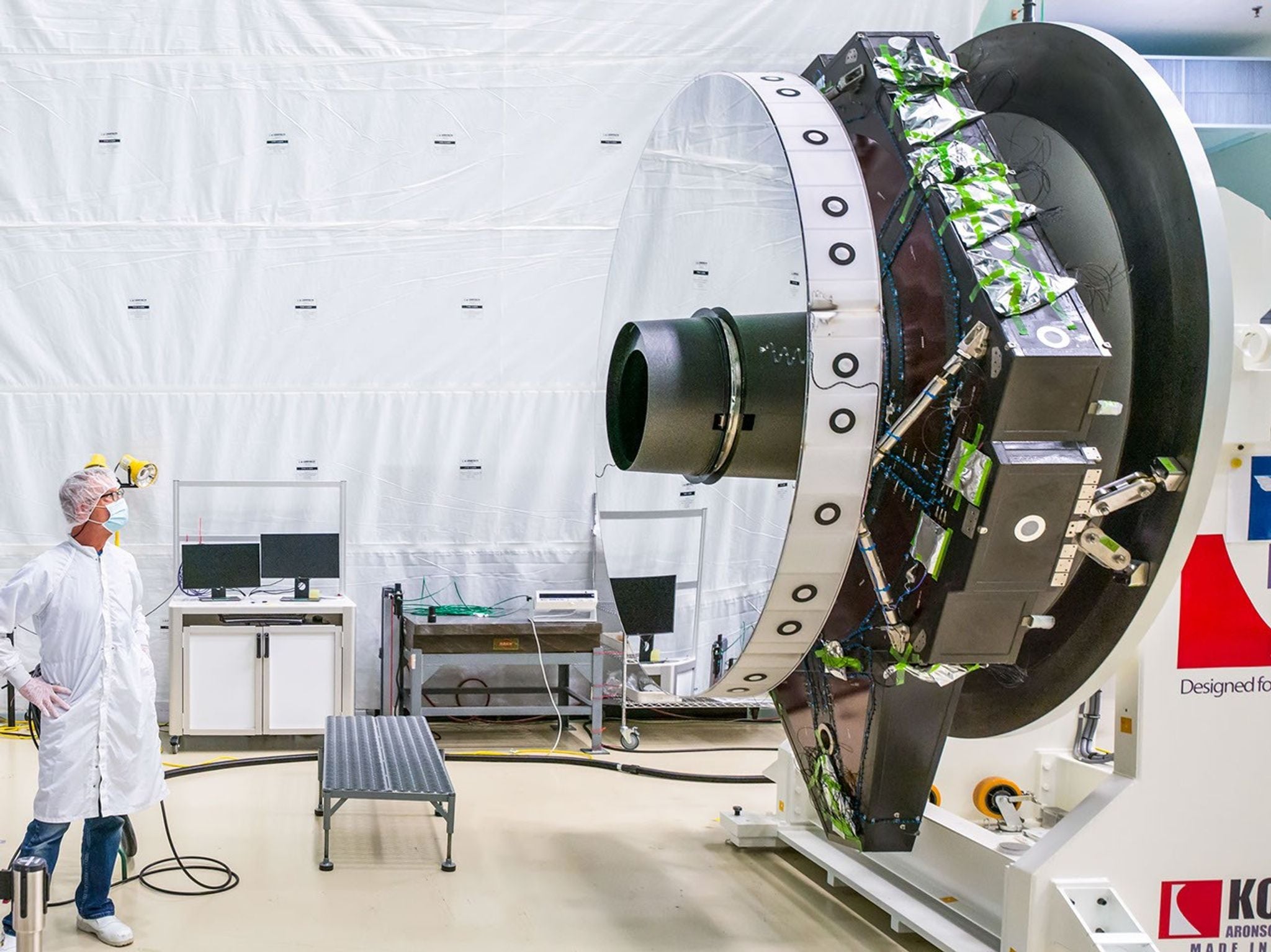
When NASA’s Nancy Grace Roman Space Telescope lifts off, the oldest part of its story will already have spent well over a decade in civilian hands. Its 2.4-metre primary mirror began not as a purpose-built astronomy instrument, but as part of surplus hardware transferred by the National Reconnaissance Office in 2012.
The shorthand version is irresistible: a spy agency gave NASA two spare Hubbles, and one became Roman. The documented history is more instructive. NASA received space-qualified optics, support structures, controllers and baffles for two telescope systems, plus additional parts. It then spent years turning one inherited optical starting point into a complete observatory.
Roman will consequently launch with a mirror the same diameter as Hubble’s and a field of view at least 100 times larger. That does not mean the donated mirror by itself creates the wider view. Roman’s survey power comes from a redesigned optical train, a large infrared detector array, new instruments, a new spacecraft and the work required to make all of those systems operate together.
Fourteen years after the transfer became public, the result is enclosed in a Falcon Heavy fairing at Kennedy Space Center. NASA is targeting 7:26 am EDT on 30 August 2026 for launch. A component once associated with looking down from orbit is about to support an observatory designed to look across billions of galaxies.
The two “telescopes” were collections of flight-qualified parts
The National Reconnaissance Office designs, acquires and operates American reconnaissance satellites. NASA did not disclose the original programme for the transferred hardware, and the telescope assets were declassified with some export-control sensitivities still attached.
The public first learned of the transfer on 4 June 2012. A NASA Astronomy Picture of the Day published six days later described two space-qualified, Hubble-quality telescopes whose ownership had unexpectedly passed to the civil space agency.
That was understandable language, but NASA’s own committee record soon made it more exact. In the minutes of its July 2012 Science Committee meeting, astrophysics director Paul Hertz said the hardware was commonly misstated as “two telescopes”. More accurately, NASA controlled a collection of valuable parts for two systems, plus additional hardware.
The collection included optics, support structures with controllers and a telescope baffle. It had been space-qualified and tested. It was being maintained at the ITT Exelis facility in Rochester, New York, where the systems had already spent time in storage.
NASA did not receive two complete observatories ready for a launch manifest. A telescope still needs science instruments, detectors, thermal control, pointing systems, power, communications, flight software, a spacecraft structure, ground operations and a rocket. Those missing layers explain almost everything that happened next.
WFIRST existed before the gift arrived
Roman was not invented to find a use for surplus intelligence hardware. The 2010 astronomy decadal survey had already ranked the Wide Field Infrared Survey Telescope, or WFIRST, as its highest-priority large space mission.
In its October 2010 call for a WFIRST science definition team, NASA described a roughly 1.5-metre-class near-infrared observatory. The proposed mission would attack dark energy with weak gravitational lensing, galaxy clustering and supernova distances, while using microlensing to survey planetary systems towards the centre of the Milky Way.
The mission therefore already had a scientific purpose. What it lacked was a settled implementation and a funded observatory. The surprise of 2012 was that another government agency possessed optical hardware with a 2.4-metre aperture, substantially larger than the WFIRST concept under discussion.
NASA began studying whether the assets could support a version called WFIRST-AFTA, with AFTA standing for Astrophysics Focused Telescope Assets. A 2.4-metre mirror offered almost three times the collecting area of a 1.5-metre mirror and a finer point-spread function. Its optical geometry also offered a much wider field than Hubble’s.
A 2014 National Academies assessment found that the larger hardware could deliver substantially greater scientific return than the baseline WFIRST concept. It also treated technical complexity and projected cost as central questions. The gift did not make those questions disappear; it changed their shape.
Free hardware did not mean a free observatory
The 2012 committee minutes were unusually candid about the economics. NASA had no budget line for a mission around the equipment. Storage was costing approximately $75,000 to $100,000 a year, and the mirrors would need to be recoated before use.
Hertz also said there was no guarantee that the assets would reduce mission cost. Avoiding fabrication of an optical system could save money, but building a spacecraft and instruments around a larger inherited object could add it back. An apparently free component can alter interfaces, mass, thermal requirements and testing throughout a design.
Roman eventually became a full NASA flagship, not an opportunistic refurbishment. More than a thousand technicians and engineers assembled millions of components, according to NASA. The US Government Accountability Office’s July 2026 assessment lists a replanned life-cycle cost of $4.316 billion.
That number does not prove that accepting the NRO assets was a mistake. Roman is more capable than the smaller concept contemplated in 2010. It does show why the phrase “NASA got a free telescope” is misleading. The agency received valuable hardware and a different route into a mission; it did not receive the mission.
The inherited mirror was physically transformed
The primary mirror now at Roman’s heart is 2.4 metres across, the same nominal diameter as Hubble’s. It weighs about 186 kilograms, less than one-quarter of Hubble’s primary mirror weight.
NASA and its contractors did not simply clean the stored optic. The team modified its shape and surface to meet Roman’s science requirements. The finished mirror carries a silver coating less than 400 nanometres thick, chosen for its near-infrared reflectivity.
Its surface is extraordinarily smooth. NASA says the average bump is about 1.2 nanometres high. If the mirror were enlarged until it matched Earth’s diameter, the average imperfection would stand only about 6 millimetres high.
The mirror is also only the first element in a larger path. NASA’s account of Roman’s construction describes an Optical Telescope Assembly containing the primary plus nine other mirrors, supporting structures and electronics. Light reflects from the primary to a 56-centimetre secondary, then passes through additional optics before it reaches either science instrument.
The precise description is therefore not that an old spy telescope was turned around and aimed at the stars. One inherited primary mirror was modified and embedded within a new ten-mirror astronomical system.
Hubble-sized does not mean Hubble copied
Roman and Hubble share a primary-mirror diameter, which gives the comparison a useful physical basis. Aperture affects how much light a telescope gathers and helps set the finest angular detail it can resolve.
Field of view is a separate property. It depends on focal length, optical layout and the detector behind the telescope. Roman has a much shorter focal length and an instrument designed to record a broad section of sky rather than Hubble’s comparatively narrow view.
NASA’s current Roman and Hubble comparison says the missions will have very similar near-infrared resolution, while Roman’s Wide Field Instrument sees at least 100 times more sky at once. Roman is the wide-angle instrument in this analogy; Hubble is the versatile close observer spanning ultraviolet, visible and near-infrared wavelengths.
Space Daily’s earlier comparison of Roman and Hubble traced the resulting survey speed. Roman can map the sky up to 1,000 times faster at comparable near-infrared sensitivity and resolution, not because every individual exposure is 1,000 times deeper, but because each one covers so much more area.
This is where the reconnaissance heritage and the astronomy mission genuinely meet. A wide optical field is valuable when a system needs to see a broad region with fine detail. Roman redirects that basic advantage towards distant galaxies, stellar fields and changing objects rather than Earth.
Eighteen detectors turn the mirror into a survey machine
The Wide Field Instrument is what converts the incoming image into Roman’s main scientific data. Its focal plane combines 18 infrared detectors into a 288-megapixel array, often rounded by NASA to 300 megapixels.
Each exposure covers about 0.28 square degrees, a patch larger than the apparent full Moon. Hubble could build a comparable mosaic, but it would need many separate pointings and the observing time to collect them.
NASA says the Wide Field Instrument will help Roman image more than 50 times as much sky in five years as Hubble covered in its first 30. The mission is expected to return about 20 petabytes of data during its primary lifetime.
Those numbers describe a survey system, not merely a large mirror. Stable pointing, detector calibration, rapid slews, repeated visits, high-rate communications and a ground pipeline capable of processing the images are all part of the capability. None was sitting in the Rochester storehouse in 2012.
The science case needed populations, not isolated trophies
Roman’s core questions require large statistical samples. Its high-latitude survey will map galaxy shapes and positions across broad areas, helping researchers test how dark matter is distributed and how cosmic structure grew while the universe expanded.
Its time-domain observations will repeatedly revisit fields. That makes supernovae and other changing sources measurable in large numbers. As Space Daily’s account of Roman and the expansion-rate problem explained, those surveys can provide independent checks on measurements that currently disagree.
Towards the Galactic bulge, Roman will monitor more than 100 million stars. Transits should reveal close-orbiting planets, while microlensing will sample planets farther from their hosts and free-floating worlds.
The projected harvest is large, but it remains a forecast. Space Daily’s recent audit of Roman’s planet estimates found that NASA’s headline expectation of about 100,000 refers mainly to transit signals. Detailed simulations span roughly 60,000 to 200,000, with a separate microlensing census expected to add more than 1,000 planets.
Roman also carries a Coronagraph Instrument technology demonstration. It will suppress the light of nearby stars to test components and methods needed for future direct imaging of faint planets and disks. The coronagraph was not part of the NRO gift; it became possible within the expanded WFIRST-AFTA concept and was developed as a separate instrument.
The reconnaissance origin has limits as an explanation
The NRO transfer is public. The precise classified mission lineage of the hardware is not needed to explain Roman’s present design, and NASA has not attached an operational intelligence history to the transferred systems.
It is safe to say what the agency documented: the equipment was residual hardware no longer suitable for future intelligence missions, it was space-qualified, and it included optics with a wide field. It is not safe to reverse-engineer secret capabilities from Roman’s final specifications.
Roman’s mirror coating, optical prescription, instruments, wavelength range and mission environment were selected or modified for astronomy. The finished observatory operates near room temperature and studies visible and near-infrared light. Its science performance is a product of the completed NASA system, not a public specification sheet for whatever the hardware might once have supported.
The distinction is also a useful guard against a false simplicity. Looking down at Earth and looking across the universe are not the same task with the telescope rotated 180 degrees. Target distance, focus, stray light, thermal stability, detector response, calibration and observing cadence all change.
Launch is the next conversion, not the end of the story
NASA and SpaceX are targeting 7:26 am EDT, or 11:26 UTC, on Sunday, 30 August. Roman is enclosed in its payload fairing for launch on a Falcon Heavy from Launch Complex 39A at Kennedy Space Center.
The date and time remain launch targets. Weather, range conditions, the rocket or a late technical finding can still move them.
After separation, Roman must travel to a quasi-halo orbit around the second Sun-Earth Lagrange point, about 1.5 million kilometres from Earth. Commissioning will take roughly three months as teams deploy, align, cool, calibrate and test the observatory.
The primary mission is planned for five years, with a goal of operating for ten. Only then will the inherited mirror’s value be measured in survey completeness, calibration stability and scientific results rather than in diameter or unusual provenance.
The path from a Rochester storage facility to L2 is genuinely extraordinary, but not because NASA found a finished observatory on a shelf. It found a rare piece of capable hardware, matched it to a mission the astronomy community had already prioritised, and rebuilt almost everything around it. The gift supplied Roman’s heart. Fourteen years of engineering made the rest of the body.