

The most important difference between 6,300 and 100,000 is not arithmetic. It is evidence status.
The first number describes planets that have entered a confirmed catalogue after three decades of observations. The second is a forecast of signals NASA’s Nancy Grace Roman Space Telescope may reveal by repeatedly watching a crowded region of the Milky Way. Those signals will begin as candidates, not as 100,000 finished entries in an archive.
Roman could still transform exoplanet astronomy on the scale suggested by the comparison. Its wide infrared camera will monitor more than 100 million stars towards the Galactic bulge, searching the same images for planets through two almost opposite changes in brightness. Transits make a star slightly dimmer. Gravitational microlensing temporarily makes a background star brighter.
NASA’s working estimate is around 100,000 transiting planets plus more than 1,000 found through microlensing. A detailed simulation has placed the transit range anywhere from roughly 60,000 to 200,000. Understanding that spread is the difference between reading the number as publicity and reading it as a testable forecast.
The historical count is a moving total
The NASA Exoplanet Archive listed 6,324 confirmed planets in its 16 July 2026 update. New worlds enter on a rolling basis, so “roughly 6,300” is a dated benchmark rather than a permanent milestone.
The field began with planets around the pulsar PSR B1257+12 in 1992. The 1995 discovery of 51 Pegasi b established the first planet around a Sun-like star and exposed a type of world nobody had expected to dominate early catalogues: a Jupiter-mass planet circling its star in only a few days.
Since then, radial-velocity surveys, Kepler, TESS, ground-based transit searches, microlensing programmes and direct imaging have built a catalogue containing rocky planets, hot Jupiters, mini-Neptunes, circumbinary worlds and planets orbiting stellar remnants.
Confirmation means that a signal has survived specified tests. Some planets have independent mass and radius measurements. Others are statistically validated because detailed analysis makes astrophysical false positives sufficiently unlikely. The catalogue is not a list of every dip or wobble ever reported.
August 30 remains a launch target
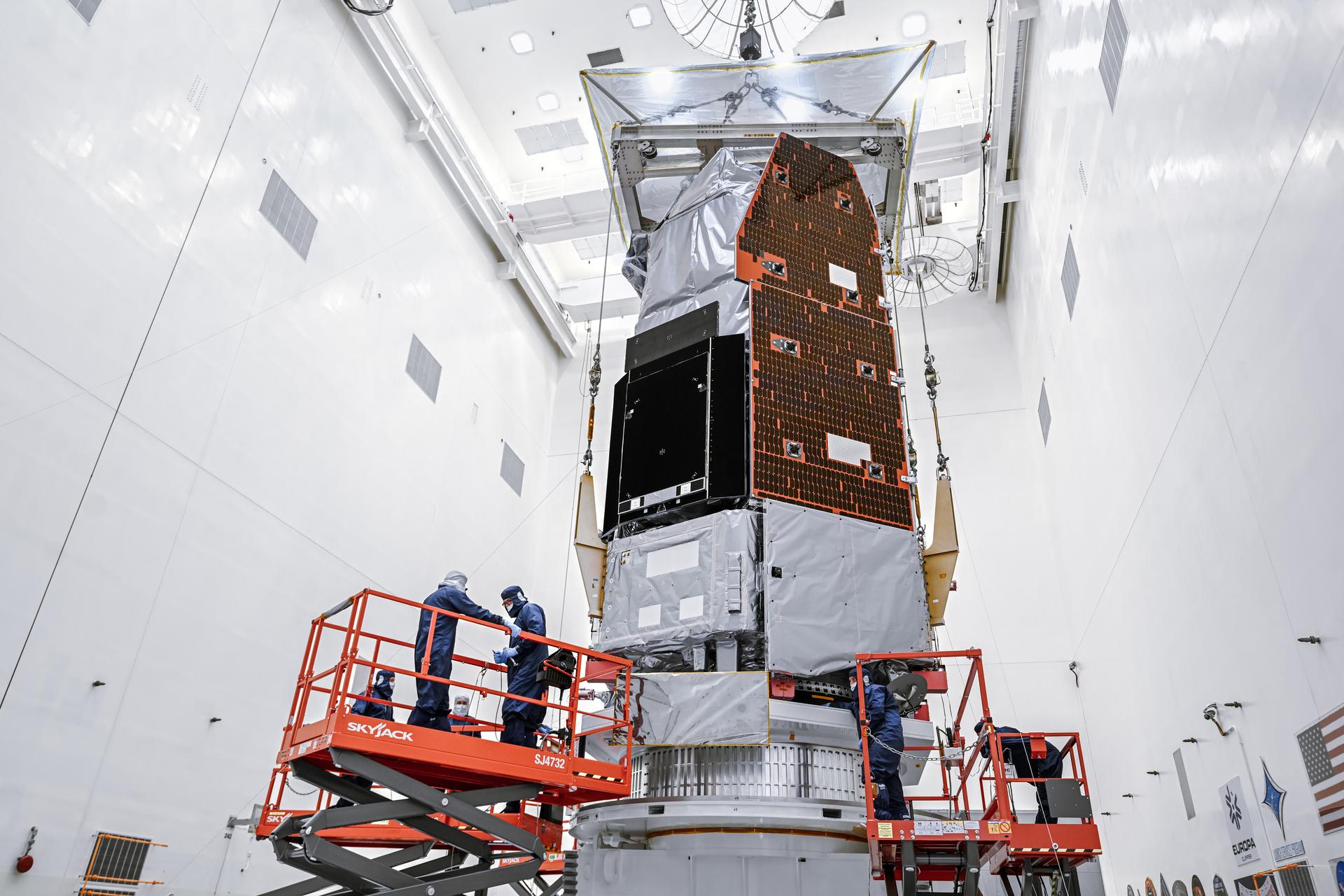
NASA is targeting 7:26 am EDT on 30 August 2026 for liftoff on a SpaceX Falcon Heavy from Launch Complex 39A at Kennedy Space Center. The telescope was encapsulated in its payload fairing on 21 August.
A target can still move because of weather, the rocket, range conditions or a late technical issue. The headline date should therefore not be read as a launch that has already happened. Roman must then travel to a quasi-halo orbit around the second Sun-Earth Lagrange point, roughly 1.5 million kilometres from Earth.
Deployments, calibration and commissioning will occupy about three months after launch. The primary mission is planned for five years, with a five-year extension possible. Fuel is the principal expendable.
SpaceDaily’s earlier overview of Roman’s planet yield and wide camera explained the hardware behind the scale. The present question is narrower: what must be assumed to turn those images into 100,000 worlds?
One survey produces two different planet censuses
Roman’s Galactic Bulge Time-Domain Survey will point towards dense star fields near the centre of the Milky Way. Current technical plans call for six high-cadence seasons, three early and three late in the mission, with images taken about every 12.1 minutes.
The survey occupies less than a quarter of Roman’s five-year observing time. Yet the planned cadence and stellar density create millions of closely sampled light curves, records of how each star’s brightness changes.
A transit occurs when a planet crosses the face of its host star from the telescope’s viewpoint. The planet blocks a small fraction of the light. Repeated, evenly spaced dips provide an orbital period, while the depth helps estimate the planet’s size relative to the star.
Microlensing works differently. A foreground star and its planets bend and magnify light from an unrelated background star during a chance alignment. The resulting brightening usually does not repeat. This method is sensitive to planets farther from their stars and to free-floating planets that do not transit any host.
The 100,000 is mainly a transit forecast
NASA’s May 2026 mission forecast said Roman should reveal around 100,000 worlds. Its current frequently asked questions assign that large number to planets crossing their host stars in the bulge survey.
Microlensing adds a much smaller raw count, generally described by NASA as more than 1,000 planets. That does not make it a lesser scientific channel. It samples wide orbits, low masses and Galactic distances that transit and radial-velocity surveys have explored poorly.
The Coronagraph Instrument offers a third route, directly suppressing starlight to study a limited set of nearby giant planets and disks. It is a technology demonstration and does not supply the six-figure forecast.
Adding all three methods without labels would be misleading. Most of Roman’s numerical harvest should be close-orbiting transit candidates. Its smaller microlensing sample may carry more leverage on planetary systems resembling the outer parts of the Solar System.
Why one simulation reaches 200,000
Robert Wilson and colleagues built a pixel-level model of the bulge survey to ask how many transits could survive realistic crowding and noise. Their 2023 simulation study produced a range of roughly 60,000 to 200,000 detected transiting planets.
The upper number did not come from simply doubling NASA’s preferred estimate. The researchers generated synthetic stellar fields, placed planetary systems around simulated stars, modelled Roman images and ran detection tests. Different assumptions about the Galaxy and survey changed how many signals cleared the threshold.
Most predicted detections were giants larger than four Earth radii on orbits smaller than 0.3 astronomical units. Large planets block more starlight. Short periods let Roman record several transits within a season, making the repeating pattern easier to establish.
The study forecast about 7,000 to 12,000 planets smaller than four Earth radii. “Small” in this definition spans a broad range and does not mean all are rocky Earth analogues. A planet near four Earth radii is usually more comparable to Neptune than Earth.
The Milky Way model controls part of the answer
The researchers found that transit yield depended sensitively on the assumed metallicity distribution of stars in the Milky Way. In astronomy, metallicity measures the abundance of elements heavier than hydrogen and helium. Giant-planet occurrence is strongly associated with metal-rich host stars.
Change the proportion and location of metal-rich stars in the synthetic bulge and the expected number of close-orbiting giants changes too. Roman will therefore test not only planet occurrence but the Galactic model used to predict its own harvest.
Cadence and season duration also mattered. Modest changes could alter the smaller-planet yield by roughly 10 to 20 percent. The number of visits determines whether a shallow transit occurs often enough, and with enough samples during each event, to rise above noise.
The range should not be treated as an error bar with a central value guaranteed to lie inside it. It belongs to a particular simulation framework. Real detector behaviour, pointing interruptions, stellar variability, binary stars and data-processing choices will introduce differences that no pre-launch model reproduces perfectly.
A detection pipeline does not confer confirmation
The comparison between 6,300 confirmed planets and up to 200,000 Roman detections is useful for scale and imperfect as accounting. Eclipsing binary stars can imitate deep planetary transits. A background binary blended with a foreground star can create a shallow, planet-like dip. Starspots and instrumental systematics add other impostors.
Roman’s stable platform, infrared precision and enormous number of visits should make many candidates persuasive. Its crowded fields complicate identification of the correct host star, while the great distances make conventional radial-velocity mass measurements impractical for most systems.
Teams will use consistency tests, centroid shifts, colour information, stellar characterisation and statistical validation. Some systems will receive follow-up from other observatories. Others may remain high-quality candidates rather than entering the confirmed archive immediately.
The distinction does not empty the forecast of value. Kepler transformed planetary demographics with a combination of confirmed planets, validated planets, candidates and carefully measured detection efficiency. Population science requires knowing both what the pipeline found and what it would have missed.
Roman is designed to count populations, not Earth twins
A six-figure planet sample would reach far beyond the Sun’s local neighbourhood. Roman will observe stars thousands of light-years away and can compare planetary occurrence across different chemistry and Galactic environments.
One more hot Jupiter may not look especially informative as an isolated object. Ten thousand hot Jupiters distributed across the bulge can reveal whether their abundance follows metallicity, stellar population and location in the way formation models predict.
The microlensing sample adds the colder side of planetary systems. Roman can ask how often stars host planets beyond their snow lines and how frequently worlds drift without a detectable host. Transit and microlensing detections in the same survey offer an unusual bridge between inner and outer architectures.
Recent SpaceDaily coverage of an AI-generated observing shortlist drew a related boundary: impressive performance inside simulations must meet the real sky before it becomes measured success. Roman’s yield forecasts face the same decisive test at far larger scale.
The gap between 60,000 and 200,000 is the experiment
If Roman detects 100,000 credible transiting planets, it will multiply the present confirmed count by roughly sixteen in candidate scale. If it approaches 200,000, the factor would be above thirty. Neither outcome means every object will be characterised in detail.
A result near 60,000 would not automatically mean failure. It could show that close-orbiting giants are less common in the bulge, that the metallicity distribution differs from the model, or that crowding and variability reduce detection efficiency more than expected.
The telescope’s cosmology work makes the same wide camera serve another purpose. SpaceDaily has examined how Roman’s vast surveys could test the disputed expansion rate of the Universe. Planet counts will emerge from only one part of a mission mapping galaxies, dark matter, supernovae and transient events.
The launch target begins the hardware phase of this test. Commissioning must establish that Roman can point, focus, calibrate and downlink data at the required scale. Survey operations must then turn repeated images into light curves, and analysis must turn light curves into candidates with measurable completeness and false-positive rates.
Only then will the numbers stop being simulations. Roman’s accomplishment will not be choosing between 100,000 and 200,000 as competing slogans. It will be measuring why the Galaxy produced the number the telescope actually finds.