Science Earth's magnetic field has flipped hundreds of times, the last reversal was around 780,000 years ago, and the field has been weakening for the past two centuries By Space Daily Editorial Team · Jul 10, 2026
Science A supermassive black hole called RBH-1, weighing at least ten million Suns, appears to have been flung from its galaxy and is now racing through space at nearly 1,000 kilometres per second, leaving a 200,000-light-year wake of newborn stars By Space Daily Editorial Team · Jul 10, 2026
Deep Space Astronomers believe the Milky Way may contain billions, perhaps even trillions, of rogue planets drifting without close stars — and a 2026 study found one 9,800 light-years away that was likely born in a planetary system before being thrown into the dark By Space Daily Editorial Team · Jul 10, 2026
Mind & Meaning In the Viking Age town of Birka, Sweden, a warrior buried with two horses, a sword, an axe, arrows, two shields, and a full set of game pieces was assumed for nearly 140 years to be a man — DNA confirmed in 2017 that the warrior was a woman By Space Daily Editorial Team · Jul 10, 2026
Science In 1859, the Carrington solar storm sent currents surging through telegraph wires, shocking operators, igniting telegraph paper and allowing some lines to transmit with their batteries disconnected. A comparable storm today could cause widespread blackouts—and one influential worst-case assessment warned that full recovery might take four to ten years, although experts remain divided over how severe the damage would actually be. By Space Daily Editorial Team · Jul 10, 2026
Space Scopes In July 1962, a single missing hyphen in the guidance code of NASA's Mariner 1 probe sent it veering off course seconds after launch, forcing range safety officers to destroy a Venus mission that had cost roughly $18 million — a typo Arthur C. Clarke later called the most expensive in history. By Space Daily Editorial Team · Jul 10, 2026
Mind & Meaning Papua New Guinea has a population of roughly 10 million people and 840 living languages — more than any other country on Earth, a number greater than all the languages spoken across every nation in Europe combined By Space Daily Editorial Team · Jul 10, 2026
Science Saturn's rings are so young that dinosaurs would have looked up at a ringless planet, and measurements from the Cassini probe suggest they are being pulled into the planet fast enough to disappear entirely By Space Daily Editorial Team · Jul 10, 2026
Mind & Meaning Research suggests East Asian skin often shows visible wrinkling later than Caucasian skin — partly because of a thicker, collagen-rich dermis, but mostly because more melanin slows sun damage By Space Daily Editorial Team · Jul 10, 2026
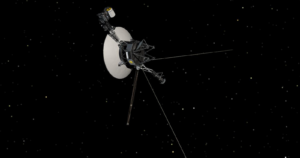
Constellations Voyager 1 crossed into interstellar space in 2012 and Voyager 2 followed in 2018, yet both encountered the edge of the heliosphere at almost the same distance from the Sun—121.6 and roughly 119 astronomical units—even though they crossed in different directions and during very different phases of the solar cycle, a similarity Johns Hopkins scientists said they could not yet explain. By Space Daily Editorial Team · Jul 10, 2026
Science Israel’s Beresheet lander crashed into the Moon in 2019 carrying several thousand tardigrades in a dehydrated, dormant state—and although later experiments suggest they probably did not survive the impact, nobody knows whether any remain intact enough to be revived if they were ever recovered and rehydrated. By Space Daily Editorial Team · Jul 10, 2026
Human Behaviour Falling in love with a machine is no longer science fiction: about one in five American adults says they have chatted with an AI built to act as a romantic partner, and among young men it is nearly one in three By Space Daily Editorial Team · Jul 10, 2026
Technology Bots have overtaken humans on one of the internet's largest networks — for the first time, agentic AI is pushing web-page requests past the halfway line By Space Daily Editorial Team · Jul 10, 2026
Technology The average American now spends over three hours a day on a phone, checking it nearly 200 times — roughly once every five waking minutes — a rhythm of attention no earlier generation ever knew By Space Daily Editorial Team · Jul 10, 2026
Technology A century before the first computer existed, a young Englishwoman wrote what is now called the first algorithm for a machine that was never even built — and foresaw that such engines might one day compose music, not merely crunch numbers By Space Daily Editorial Team · Jul 9, 2026
Human Behaviour Only about one in five workers worldwide feels truly engaged at work, a 2026 Gallup report finds, a slide to its lowest level since 2020 that it estimates costs the world economy close to a tenth of its total output in lost productivity every year By Space Daily Editorial Team · Jul 9, 2026