
Voyager 2’s last encounter with a planet did more than complete the only close reconnaissance of Neptune and Triton. It also fixed the spacecraft on a path that made one antenna outside Canberra uniquely important to the rest of its mission.
After passing over Neptune’s north pole in August 1989, Voyager 2 was deflected south. It is now escaping at an angle of about 48 degrees below the ecliptic, the broad plane in which the planets orbit. From that far-southern position in Earth’s sky, the spacecraft is hidden from the Deep Space Network stations in California and Spain. Earth itself is in the way.
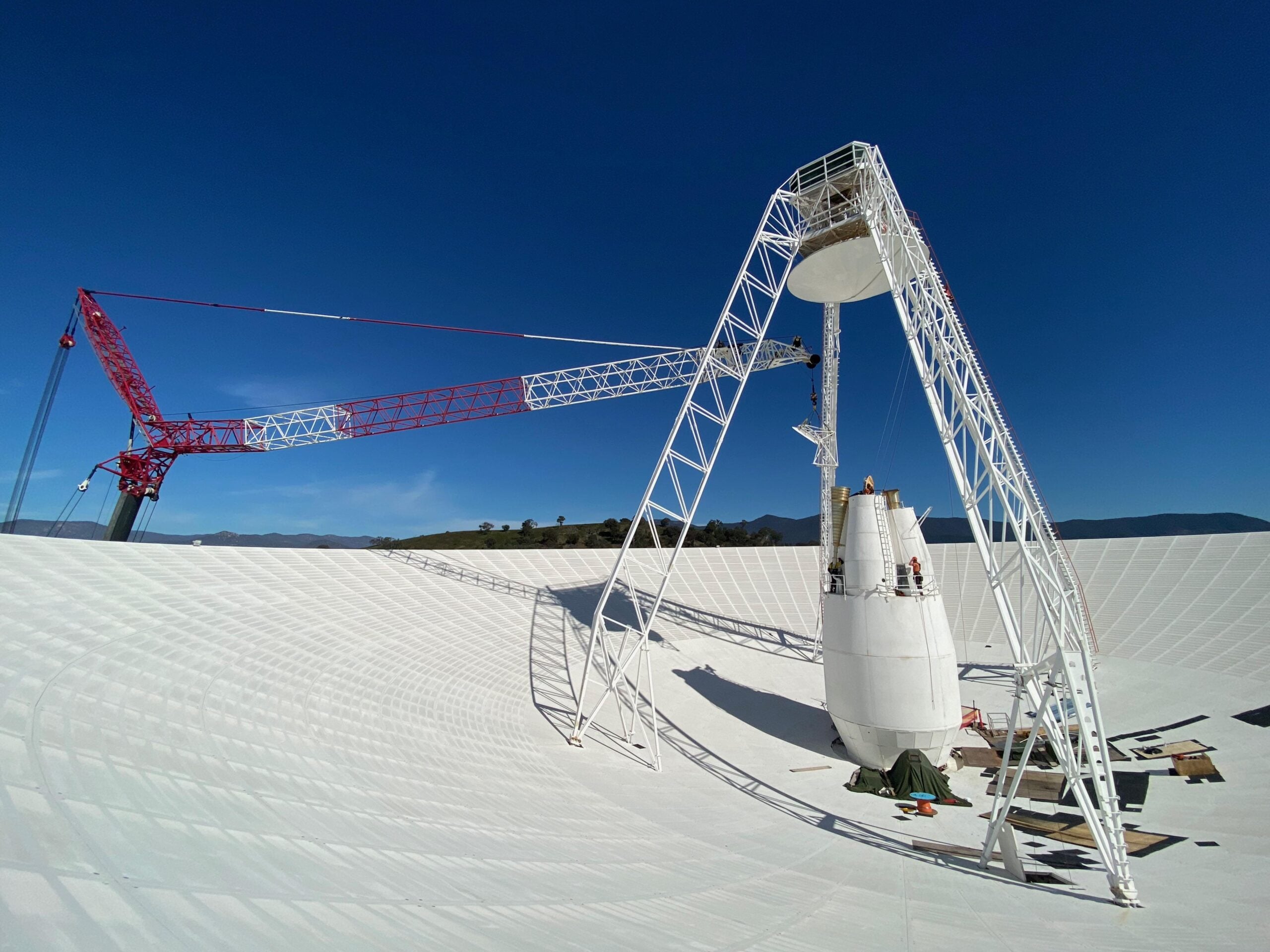
Only Deep Space Station 43, a 70-metre dish at the Canberra Deep Space Communication Complex, has both the view and the right high-power transmitter to send Voyager 2 commands. When DSS-43 was taken apart for major work in March 2020, engineers knowingly removed their only way to speak to the spacecraft.
The shutdown lasted about 11 months. Voyager 2 continued sending health reports and science data, so this was not literal radio silence. But for most of that period, Earth could listen without answering.
Neptune determined which part of Earth could still see Voyager
The dependence on Canberra begins with the way Voyager 2 left Neptune. The spacecraft flew roughly 4,800 kilometres above the planet’s cloud tops on 25 August 1989, then passed Triton about five hours later. That route gave the mission its close view of Neptune’s largest moon, but Neptune’s gravity also bent the probe sharply south.
NASA’s history of the Voyager planetary voyage puts the departure angle at about 48 degrees below the ecliptic. The spacecraft has been following that line ever since. A flyby that lasted hours therefore set the communications geometry for decades.
Voyager 1 left the planetary plane in the opposite direction after its Saturn encounter, travelling north. As we explained in our article on how a five-year Voyager mission became a nearly half-century operation, Voyager 2 retained the route to Uranus and Neptune while its twin’s close encounter with Titan ended Voyager 1’s planetary tour.
Those different trajectories are now positions in Earth’s sky. Northern stations can see Voyager 1. Voyager 2 is so far south that California and Madrid cannot establish the required line of sight. The path chosen to reach Triton made Australia the spacecraft’s only practical doorway home.
The Deep Space Network is global, but it is not interchangeable
NASA’s Deep Space Network has three complexes, near Goldstone in California, Madrid in Spain and Canberra in Australia. They are spread around Earth in longitude so that a spacecraft can remain in contact as the planet rotates.
That arrangement can create the impression that any station can replace any other. It cannot. Antennas differ in size, transmitter power, supported radio bands and what is above their local horizon.
Our earlier account of how the Deep Space Network pulls spacecraft signals out of noise looked at the network as a planetary listening system. Voyager 2 exposes a different feature of it: receiving a whisper and delivering a command are not the same engineering problem.
The Voyagers receive commands in S-band and transmit data to Earth in X-band. In 2020, NASA described DSS-43 as the only southern dish with a transmitter powerful enough, operating at the right frequency, to uplink instructions to Voyager 2. Canberra’s three smaller 34-metre antennas could be combined to receive the spacecraft’s X-band signal, but they could not substitute for the 70-metre dish as an S-band voice.
Communication was therefore asymmetric. Voyager 2 could tell Earth how it was doing. Earth could not tell Voyager 2 what to do next.
The antenna was older than the spacecraft
DSS-43 entered service in 1972, five years before either Voyager launched. It began as a 64-metre antenna and was widened to 70 metres in 1987, in part to strengthen the link for Voyager 2’s Neptune encounter.
By 2020, postponing maintenance had become its own mission risk. The antenna was supporting many spacecraft, while irreplaceable parts inside it had been operating for decades. An unexpected failure could have removed the Voyager 2 uplink without warning or preparation.
The planned work was extensive. Crews replaced two radio transmitters, including one used to communicate with Voyager 2 that had not been replaced in more than 47 years. They also renewed power equipment, heating and cooling systems, and electronics from the pedestal at ground level to the feed cones suspended above the centre of the dish.
NASA chose a controlled absence rather than wait for an uncontrolled one. The cost was a period in which a spacecraft more than 18 billion kilometres away would have to manage without new instructions.
Voyager 2 was prepared to fly alone
Before the shutdown, the mission team placed Voyager 2 into a quiet operating state designed to continue returning data without routine commanding. The spacecraft also carried onboard fault protection able to respond automatically if certain conditions moved outside safe limits.
This did not make the outage risk-free. Voyager 2 was already 42 years old. Its electrical supply was declining, its thrusters and sensors had aged, and there was no possibility of physical repair. If it encountered a problem outside the situations its software could recognise, the team would be able to see evidence of the fault in telemetry but would have no way to intervene.
The situation also revealed what a command actually means at interstellar distance. It is not a joystick movement. Engineers prepare a sequence, transmit it through the Deep Space Network, then wait many hours for the radio wave to reach the spacecraft and many more for confirmation to return. During the DSS-43 work, even that slow exchange was unavailable.
Voyager 2 did what it had been prepared to do. It kept its antenna aimed towards Earth, managed its power and continued measuring the environment beyond the heliosphere.
The eleven months were not one unbroken silence
The maintenance period began in mid-March 2020 and the upgraded station returned to full service in February 2021. There was, however, one important interruption to the interruption.
On 29 October 2020, engineers used newly installed equipment to send Voyager 2 a set of test commands. It was the first uplink since March. NASA reported that the spacecraft received and executed them, then returned confirmation.
So “11 months without commands” is a useful description of the operational constraint, not a literally uninterrupted interval. For most of the upgrade Voyager 2 could not be commanded, but the October test briefly reopened the link before the work was complete.
That reply was more than a check on the spacecraft. It confirmed that new ground equipment could still speak a radio language designed in the 1970s, across a distance light needed more than 17 hours to cross at the time.
A dish on Earth became part of the spacecraft
The dependency became visible again in July 2023, when a planned command inadvertently shifted Voyager 2’s antenna about two degrees away from Earth. The spacecraft could no longer return normal data. Controllers used DSS-43 to send what NASA called an interstellar “shout”, instructing the probe to turn its antenna back towards home. The signal worked.
Had the command failed, the team’s next hope was an automatic orientation reset already programmed aboard Voyager 2. The incident made the division of labour unusually clear: the spacecraft had autonomy, but its recovery still depended on a specific transmitter in the Australian hills.
This is the less visible architecture of a deep-space mission. Voyager 2 is not only a machine moving through interstellar space. It is also a chain that includes decades-old software, mission controllers in California, scheduling across a busy communications network and a 70-metre steel structure near Canberra.
The Neptune flyby fixed the spacecraft’s path below the planets. Earth’s curvature then removed two of the three Deep Space Network sites from the uplink. Radio design narrowed the remaining option to one dish. By 2020, maintaining that dish meant deliberately accepting months during which there would be no ordinary way to answer Voyager 2.
The spacecraft crossed those months without needing rescue. That was an achievement of preparation, but also a reminder of how thin the connection had become. A probe can travel for billions of kilometres on its inherited momentum. Keeping it an operating mission still depends on one place on Earth being able to call.
