

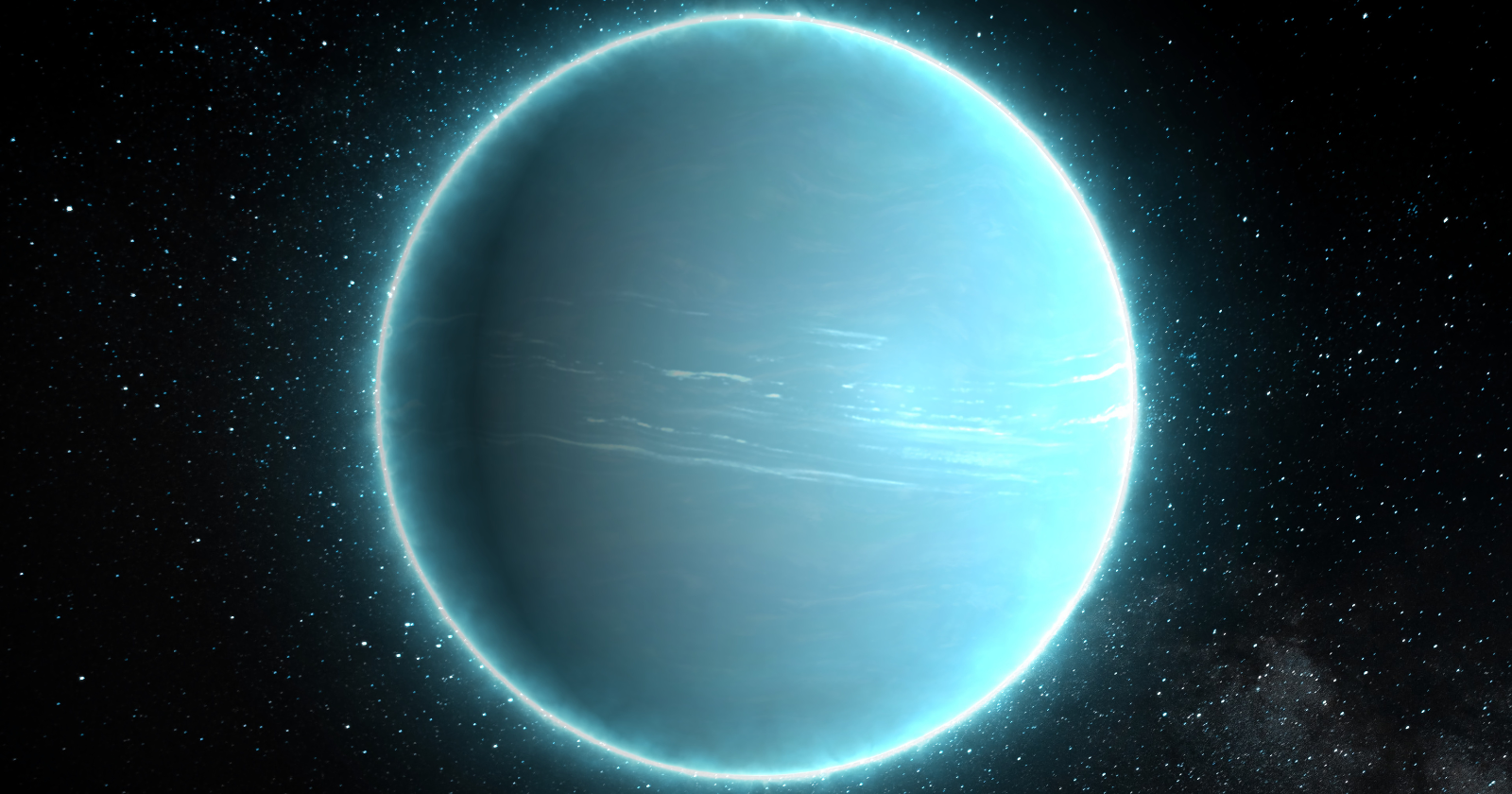
Picture Uranus the way the Voyager cameras showed it. A smooth, nearly featureless ball the color of shallow tropical water, drifting through the dark with none of Jupiter’s angry stripes or Saturn’s bright rings to catch the eye.
It looks calm. It looks, honestly, a little boring, which is part of why Uranus gets so little attention. But that placid blue-green appearance is a mask.
What it hides is quite revolting.
The blue that fools you
The color comes from methane. Uranus’s atmosphere contains a small amount of the gas, and methane soaks up the red end of sunlight while allowing blue-green wavelengths to be reflected back from the cloud tops.
NASA’s explainer on why the two ice giants differ in shade points to exactly this: red light is more absorbed by methane molecules, and a layer of haze over Uranus makes it look paler than its neighbor Neptune.
So the serene look is real, in the sense that it’s what your eyes would actually see. It just tells you almost nothing about what the atmosphere is made of, or what it would do to you.
What the clouds are actually made of
In April 2018, a team led by Oxford planetary physicist Patrick Irwin reported the first clear detection of hydrogen sulfide gas sitting above Uranus’s main cloud deck. The paper, “Detection of hydrogen sulfide above the clouds in Uranus’s atmosphere”, ran in Nature Astronomy.
Hydrogen sulfide is the same colorless, toxic gas that gives rotten eggs their smell, and people can detect it at very low concentrations, according to the Agency for Toxic Substances and Disease Registry.
The amounts measured above Uranus’s clouds are tiny. The team detected the gas at 0.4 to 0.8 parts per million at the cloud top. As co-author Leigh Fletcher of the University of Leicester put it, “Only a tiny amount remains above the clouds as a saturated vapour,” with most of it locked into the cloud ice below.
However, those concentrations are still within or above the range at which humans can ordinarily detect the gas.
Why it took so long to find out
For decades nobody could say for sure. The open question was whether Uranus’s clouds were built mainly from ammonia, the way Jupiter’s and Saturn’s are, or from hydrogen sulfide instead. The two answers point to very different stories about how and where the planet formed, so this was no trivial detail. It just sat unresolved because the signal is faint and hard to read.
What cracked it was a very large telescope plus better reference data. The observations came from an instrument on the 8-meter Gemini North telescope on Maunakea, which pulled apart reflected sunlight finely enough to spot the gas’s chemical fingerprint.
Irwin described the moment plainly: “Now, thanks to improved hydrogen sulfide absorption-line data and the wonderful Gemini spectra, we have the fingerprint which caught the culprit.” The finding also showed that Uranus is chemically different from the inner gas giants, which matters more for how planets form than the rotten-egg headline suggests.
What a visitor would actually face
The smell turns out to be the least of your problems. Irwin offered a hypothetical to Gemini: if an unlucky human ever descended through the clouds, they “would be met with very unpleasant and odiferous conditions.” That’s an illustration, not a measurement. Nobody is descending through those clouds.
And the smell would barely register before everything else killed you. As Irwin put it, “Suffocation and exposure in the negative 200 degrees Celsius atmosphere made of mostly hydrogen, helium and methane would take its toll long before the smell.” Minus 200 Celsius is roughly minus 328 Fahrenheit, and there’s nothing to breathe. The rotten-egg detail is the memorable part, but it’s a footnote to a place that is lethal in every direction at once.
From far enough away, Uranus is one of the prettier objects in the solar system, a cool blue marble that gives nothing away. Get close, and it’s frozen, unbreathable, and probably foul.