

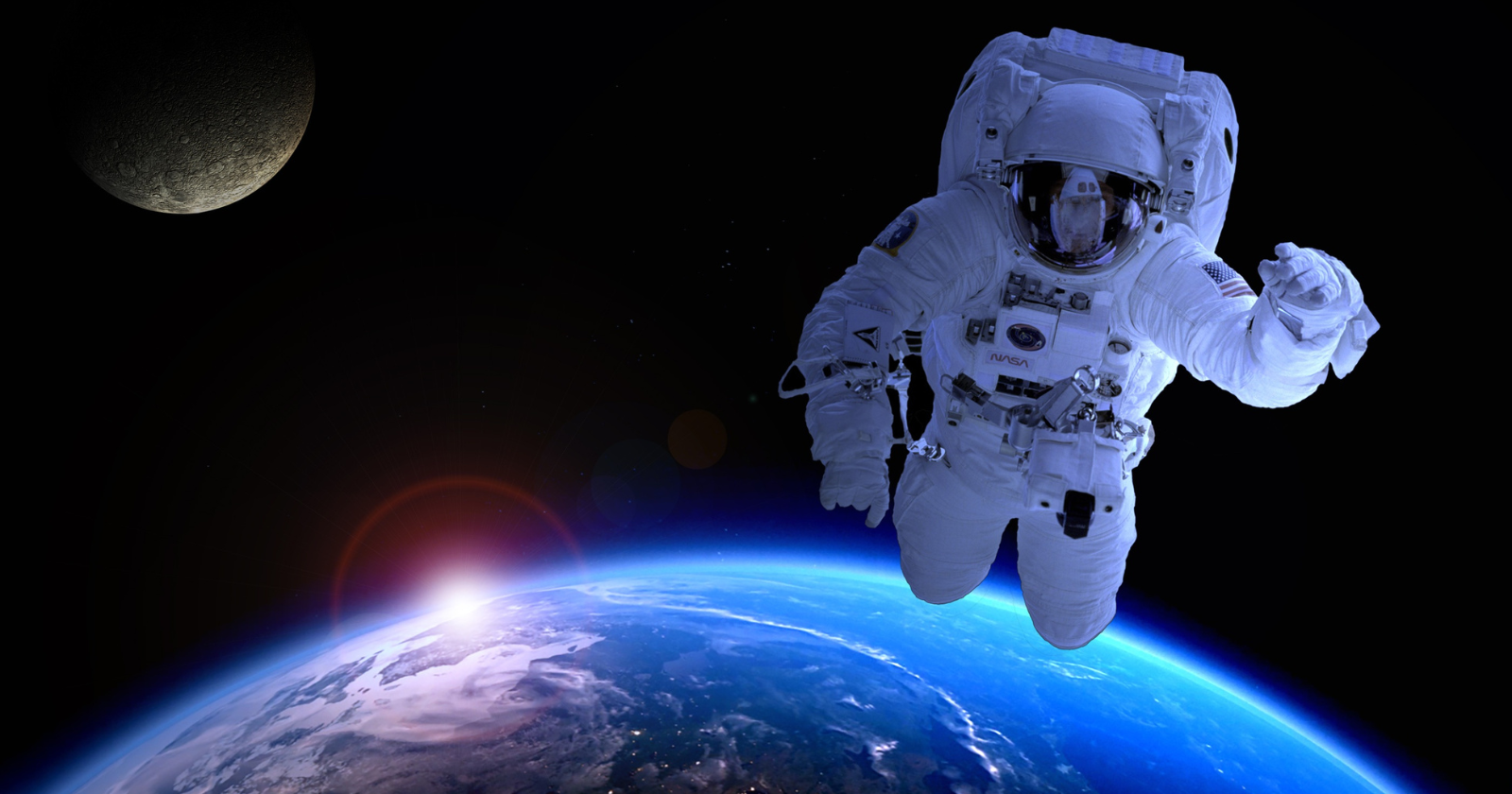
On February 7, 1984, 46-year-old Bruce McCandless II flew the Manned Maneuvering Unit out of Challenger’s payload bay, becoming the first astronaut to fly untethered from his spacecraft.
McCandless was not a rookie taking a wild swing. He had spent years as an astronaut and had served as NASA’s capsule communicator during the Apollo 11 moonwalk. So when he floated free of Challenger and made a joke about it, the line had some history behind it. By NASA’s account he said, “That may have been one small step for Neil, but it’s a heck of a big leap for me.” He was playing on Neil Armstrong’s words from the Moon fifteen years earlier.
Under the humor there was real danger. McCandless used short bursts from the MMU to open the gap. If the backpack had failed, there was no rope to reel him back in, although Challenger and a second MMU were available for rescue.
The device had a plain, almost bureaucratic name: the Manned Maneuvering Unit, or MMU. It was less a backpack than a piece of furniture. It weighed 340 pounds, closer to a refrigerator than anything you’d strap on for a walk, though in weightlessness that mass did not press down on him. It steered by squirting compressed gas. Nitrogen thrusters pushed him wherever his hands asked, controlled by hand controllers on the armrests.
The MMU took more than a decade to develop, and McCandless helped shape it alongside NASA engineer Charles “Ed” Whitsett. Whitsett called it “the rent-a-car concept,” meaning a crew member could climb in with little training and fly. His crewmate Robert Stewart, a former test pilot who also flew it that day, said, “I decided that this was the easiest thing I had ever flown.”
The drift out to 100 metres
McCandless did it in stages, which I find oddly reassuring, as if even the first untethered spacewalk was approached the way a cautious person tests thin ice.
He flew 150 feet away and returned before pushing further. At his farthest he reached 320 feet, roughly 98 metres, from Challenger. The whole solo ride lasted 1 hour, 22 minutes.
People often ask whether he was frightened out there, alone against the black with Earth turning below. His own answer was that of an engineer who trusted his machine. “I knew the laws of physics hadn’t been repealed recently,” he later said. Calm to the point of comedy, and yet it hides how much rode on those laws behaving exactly as predicted.
What it was actually for
The image tends to swallow the practical point, so it is worth saying plainly: this was not a stunt for the camera. Flying free had a job.
Later that year, in November 1984 on mission STS-51A, astronauts Dale Gardner and Joe Allen used the MMU to retrieve two communications satellites, Palapa B2 and Westar 6, that had ended up in useless orbits. The jetpack helped turn lost satellites into spacecraft they could bring home.
And then, fairly quickly, it went away. The MMU flew on only three shuttle missions, all in 1984. It was never used again: most spacewalk work could be done with tethers or the shuttle’s robotic arm, while post-Challenger safety rules would have required expensive changes before another flight.
Astronauts now use tethers, with a smaller emergency jetpack called SAFER carried as a last resort in case someone comes loose. The era of the free-flying human satellite was, in the end, about ten months long.
What I make of the image now
The photograph of McCandless, a white-suited figure against pure black with the blue curve of Earth behind him, is one of spaceflight’s most reproduced images. It is not the technology that holds the eye, but a person who agreed to be that far from safety on the strength of a calculation.
The picture sits on the edge of two feelings at once: the audacity of unclipping, and the smallness of the figure, which reminds you what that nerve is being spent against.
He chose to go out to about 100 metres, drift there in silence, and trust that the thing on his back and the physics he counted on would bring him home. It did. The image of that one man, alone and unattached, still asks a quiet question of anyone who looks at it long enough: how far out would you have gone before you decided that was far enough?