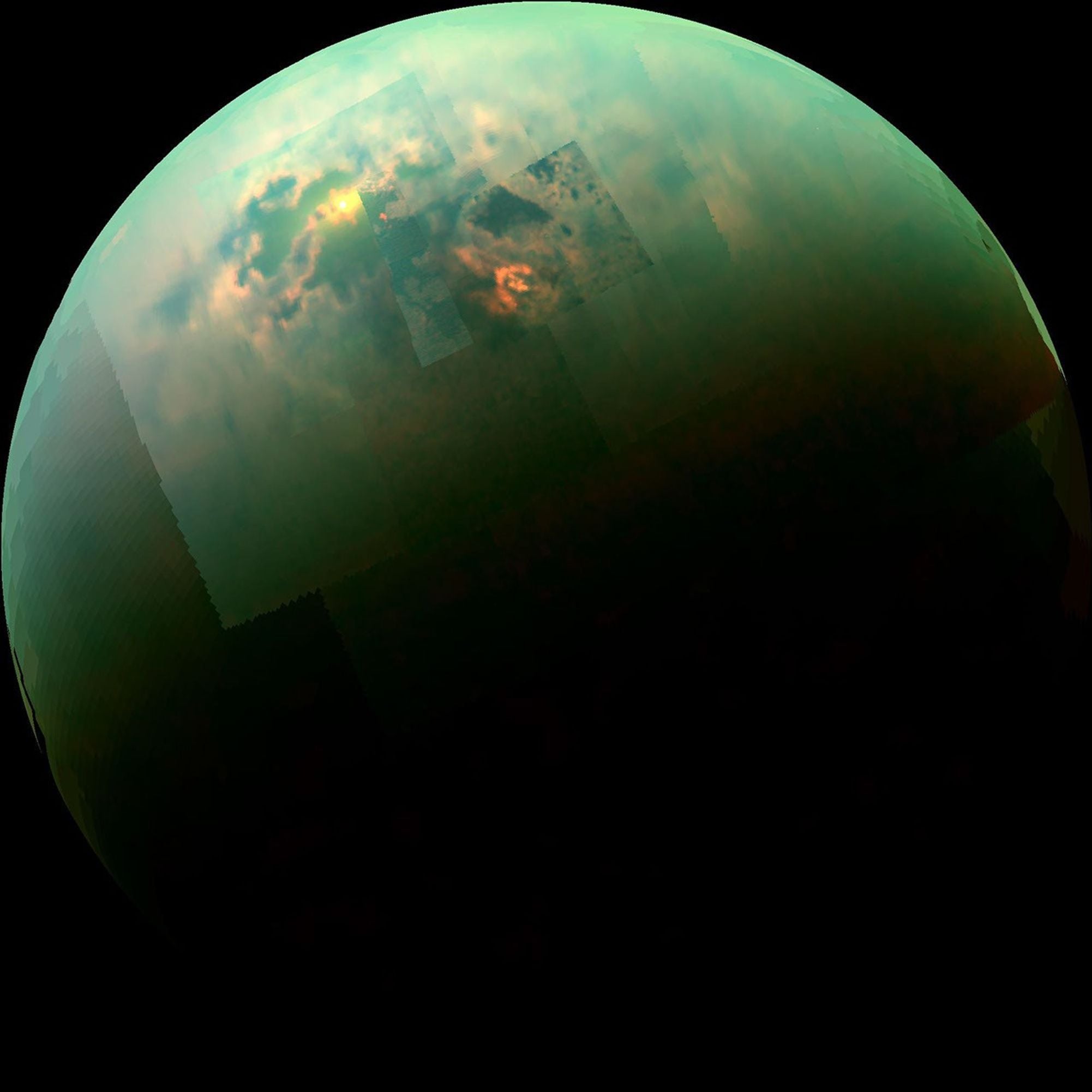
Titan is one of those places where a list of plain facts starts to sound like a pitch. Saturn’s largest moon is wider than Mercury. It has a mostly nitrogen atmosphere, clouds, rain, rivers, shorelines and seas. A person could stand on solid ground without the surrounding air behaving like a vacuum.
Then the substitutions arrive. The rivers are methane. The seas are mixtures of methane and ethane. Water is frozen into the crust and behaves as rock. The air cannot be breathed, the surface is about minus 179 degrees Celsius, and the pleasant-sounding idea of a lakeside walk ends with a heated life-support system sealed around the walker.
I do not think those qualifications diminish Titan. They stop it turning into a travel poster and reveal the more interesting world underneath. Titan is not an almost-Earth. It is a second demonstration that clouds, rainfall, erosion and standing liquids can organise a landscape when the materials and temperature are entirely different.
A moon really can be wider than a planet
NASA gives Titan a radius of about 2,575 kilometres, which makes its diameter roughly 5,150 kilometres. Mercury’s radius is about 2,440 kilometres, for a diameter close to 4,880 kilometres. Titan wins the width comparison by about 270 kilometres.
That does not make Titan a planet in disguise. The labels “planet” and “moon” describe what an object orbits, not a minimum size ranking. Titan circles Saturn. Mercury circles the Sun. Jupiter’s Ganymede is larger still, beating Titan by about two percent.
Width also hides composition. Mercury is a compact, metal-rich world and the second-densest planet after Earth. Titan is built from a mixture of rock and abundant water ice. Mercury has more than twice Titan’s mass despite being narrower. Put the two side by side and the surprise is not that astronomers misclassified one. It is that small planetary bodies can be assembled so differently.
Cold gives methane the role water plays here
At around 94 kelvins, water ice is Titan’s geological foundation. It can form hills, pebbles, channel walls and crust. Methane, a gas in an Earth kitchen, sits close enough to its liquid range to evaporate, condense and flow across the surface. Ethane and dissolved nitrogen join it in the lakes and seas.
I previously wrote a fuller account of how Titan’s active liquid cycle works while water behaves as stone. The short version is beautifully familiar: liquid leaves the surface, enters the atmosphere, forms clouds, falls as rain, runs downhill and collects again.
The underlying physics is familiar, but swapping the working fluid changes almost everything else. Liquid methane is less dense and less viscous than water. Titan’s gravity is only about one-seventh of Earth’s. The sediment can be water-ice grains, solid organics or both. A river may trace an Earth-like curve while moving unfamiliar liquid over unfamiliar ground.
“Complete cycle” needs one modest caveat. Nobody has tagged a parcel of methane and watched it travel from sea to cloud to raindrop to river and home again. The cycle is a model supported by connected observations: Cassini mapped seas and channels, Huygens saw a surface shaped by flow, and telescopes observed methane clouds. The parts fit, even though the full loop has not been filmed.
Titan has weather, not just liquid left in holes
Titan’s atmosphere is about 95 percent nitrogen and roughly five percent methane near the surface, with smaller quantities of other carbon-bearing gases. Methane supplies the humidity. Rising air cools, droplets condense, and clouds can grow deep enough to produce rain.
In 2022 and 2023, the James Webb Space Telescope and Keck Observatory followed clouds in Titan’s northern hemisphere. NASA described the sequence as evidence of convective methane clouds at different altitudes. It was not a camera view of rain hitting a lake, but it showed the vertical motion expected in rain-making weather near the hemisphere holding most of the surface liquid.
The calendar is slow. Titan follows Saturn through a 29-Earth-year orbit, so each season lasts more than seven Earth years. Cassini spent 13 years at Saturn and still observed less than half a Titan year. Clouds shifted between hemispheres, storms darkened parts of the ground, and polar conditions changed, but the spacecraft sampled only one chapter of a long climate cycle.
This is why a landscape can look dry and still belong to an active hydrological system. Earth’s riverbeds are not all full on the day a satellite passes overhead. Titan’s methane storms may be intense and separated by long quiet periods at any one location.
The lakes form a polar geography
Cassini’s radar could see through the orange haze. It found the largest bodies of liquid clustered around the north pole: Kraken Mare, Ligeia Mare and Punga Mare, surrounded by many smaller lakes. Ontario Lacus is the best-known large lake in the south.
NASA reported in 2019 that Cassini had mapped more than 1.6 million square kilometres of lakes and seas. Some small northern lakes are more than 100 metres deep and perch well above the main sea level on sharp-edged plateaus. Other basins appear dry, suggesting that the extent of liquid has changed.
The three names “lake,” “sea” and “mare” do not imply different substances. They mostly reflect scale and naming. The mixtures vary by location. Ligeia Mare appears particularly methane-rich, while ethane can accumulate because sunlight makes it from atmospheric methane and it is less volatile.
We know the surfaces are liquid from more than their dark radar appearance. Cassini detected reflections from remarkably smooth surfaces, measured radar transmission through Ligeia Mare to its floor, and caught sunlight glinting from the northern lake district. The feature image with this article is that kind of infrared mosaic, not a visible-light photograph a standing visitor would see.
“Hundreds of times more” is an estimate with a date
The famous comparison with Earth’s fuel reserves comes from February 2008. A Cassini radar team led by Ralph Lorenz concluded that Titan had hundreds of times more liquid hydrocarbons than all known oil and natural-gas reserves on Earth.
The scale is extraordinary, but the method deserves as much attention as the number. Cassini had then mapped about 20 percent of Titan by radar. Researchers estimated lake depths from surrounding topography and analogies with terrestrial lakes. They extrapolated from the better-seen north and assumed the south might hold a comparable inventory, while openly saying they did not yet know.
The Earth side of the comparison is also dated. “Known reserves” is not a fixed amount of carbon in the ground. It is an economic and technical category that changes when deposits are discovered, prices move or extraction methods improve. A reserve table from 2008 is not the same as one compiled today.
So I would use the phrase as an order-of-magnitude picture, not a modern stocktake. Later Cassini observations confirmed that Titan has vast seas and many deep lakes, but they did not turn that early calculation into an audited global volume.
Nor are Titan’s liquids crude oil. They are mainly simple hydrocarbons, especially methane and ethane, mixed with nitrogen and other compounds. Calling them an energy reserve imports an earthly purpose they do not have. There is almost no free oxygen in Titan’s atmosphere, so the methane cannot burn in the local air. At more than a billion kilometres from Earth, it is not a remotely sensible fuel field. The comparison tells us about carbon inventory and climate, not commerce.
Calm is a weather report, not a permanent property
The idea of standing beside a calm lake has unusually direct support. Cassini used a bistatic radar experiment, transmitting radio waves toward Titan and letting antennas on Earth receive the reflection. During observations between 2014 and 2016, the open surfaces of Kraken Mare, Ligeia Mare and Punga Mare were astonishingly smooth.
I explored those measurements in an earlier article about Titan’s mirror-smooth seas and rougher estuaries. The inferred root-mean-square surface roughness was no more than 3.3 millimetres in the open sea regions measured. Some estuaries were rougher, possibly where methane-rich river liquid entered a sea containing more ethane.
That result does not condemn Titan to eternal stillness. Cassini visited at particular times and geometries. Wind should be capable of raising waves, rainfall can strike the surface, tides act under Saturn’s gravity, and seasonal changes may alter all three. There have also been transient radar-bright features nicknamed “magic islands,” with waves, bubbles and floating solids among the proposed explanations.
“Calm” is therefore fair if it describes the lakes Cassini encountered, not every hour in Titan’s history. I like that limitation. It turns an abstract claim into something recognisable: a distant spacecraft happened to find fair weather on an alien sea.
You could stand there, but not in ordinary clothes
Titan’s surface pressure is about 60 percent greater than sea-level pressure on Earth. That is roughly the pressure a swimmer feels 15 metres underwater. Unlike the Moon or Mars, Titan would not make exposed body fluids boil because the ambient pressure was too low.
This narrow point led me to ask earlier what “no pressure suit” really means on Titan. It means the clothing would not have to inflate against vacuum. It does not mean a scarf and good boots would be enough.
The outside gas is nitrogen and methane with essentially no oxygen for a human to breathe. A visitor would need a closed breathing system, carbon-dioxide removal and strict separation between oxygen-rich equipment and methane outside. The suit would need formidable insulation and active heating because minus 179 degrees Celsius is not an extension of terrestrial winter.
The dense atmosphere would continually carry heat away by convection. Seals, lubricants, batteries and joints would all have to work at cryogenic temperature. A tear might not cause explosive decompression, but it could admit lethal cold and unbreathable gas. “Heated, oxygenated and sealed” is the useful description.
Gravity would make the scene stranger. A person would weigh about one-seventh as much as on Earth, while moving through air much denser than ours. Steps could become long, buoyant bounds. Yet the orange haze would absorb and scatter much of the light. Sunlight at Saturn’s distance is roughly 100 times fainter than at Earth, and the unaided eye would not see the false colours used to reveal surface detail in Cassini mosaics.
Huygens found a dry shoreline written by rain
The only machine to land on Titan remains the European Space Agency’s Huygens probe. On 14 January 2005 it descended for two hours and 28 minutes, photographing branching channels that ran from bright uplands toward darker low terrain.
Huygens touched down among rounded pebbles on a frozen surface. The pebbles were consistent with dirty water ice. At Titan’s temperature, they were rocks in every practical sense. The landing site resembled a dry riverbed or floodplain, and the warm probe released methane from damp material beneath it.
The scene matters because it joins atmosphere to geology. Rain had not merely filled static basins. Flowing liquid had rounded clasts, cut channels, moved dark organic sediment and reshaped the ground.
It also leaves puzzles. I wrote about a 2025 study that found only about 1.3 percent of Titan’s large coastal rivers appear to build deltas, compared with almost every river of comparable size on Earth. Perhaps sediment behaves differently, shorelines erase deposits, or Titan’s deltas take unfamiliar forms. The river networks are obvious; what they do at the sea remains unexpectedly hard to explain.
Rich organic chemistry is not evidence of life
High above Titan, ultraviolet light and energetic particles break methane and nitrogen molecules apart. Their fragments recombine into ethane, hydrogen cyanide and a much larger family of carbon-bearing compounds. Some form the haze. Heavier material settles onto the surface and helps build the dark equatorial dunes.
This is why Titan attracts origin-of-life research. It brings abundant organics, active weather and long-lived liquid environments together. But the lakes contain almost no liquid water, and cryogenic hydrocarbon chemistry is not simply cold biochemistry.
In a recent piece, I examined a proposal for organic bilayer compartments forming in splashes from Titan’s lakes. The mechanism is physically plausible enough to test, but it is not an observed membrane and certainly not a cell. There is no evidence of life on Titan.
That boundary is worth protecting. A world can be chemically inventive without being inhabited. Titan lets us ask how far carbon chemistry travels when water, oxygen and warmth are removed from the surface experiment.
The methane itself should not have lasted forever
Titan’s weather contains a slow leak. Sunlight destroys methane in the upper atmosphere, creating heavier products and allowing hydrogen to escape. If nothing replaced the methane, the clouds and seas would not survive on geological timescales.
The 2008 inventory estimate sharpened this problem. Even if all the observed surface liquid were methane, the team calculated that it would sustain atmospheric losses for only a few million years. Titan is more than four billion years old.
Possible sources include methane released from the interior, perhaps episodically. The evidence for when, where and how that release occurs remains incomplete. An impact can free methane from the crust, but a 2025 model I covered found that even favourable impact histories extended the atmospheric methane lifetime by no more than a few percent.
The open budget means Titan’s present climate may not be permanent. The moon could move through wetter and drier eras as methane is stored, released and destroyed. The lakes we see may be one state in a much longer history rather than fixtures that have occupied the same shorelines since the Solar System formed.
Dragonfly will arrive far from the great seas
The next explorer is not a boat. NASA currently lists July 2028 as the earliest launch date for Dragonfly, with arrival in late 2034. The car-sized, nuclear-powered craft will use Titan’s dense air and low gravity to fly between dunes and the region around Selk Crater.
Dragonfly is not scheduled to land at Kraken Mare or sample a northern lake. Its route is chosen to investigate organic materials, geology and environments where impact heat may once have brought liquid water into contact with surface chemistry. It will also measure the atmosphere and weather around its landing region.
That leaves the seas incompletely explored. Cassini gave us radar, infrared spectra, radio reflections and brief seasonal coverage. A future lake lander, shoreline station or aircraft sent north could measure waves, currents, chemistry, depth and rainfall directly. None is currently approved.
The careful version is already enough
Titan is about 270 kilometres wider than Mercury. It supports a methane-centred weather cycle with clouds, rain, rivers, lakes and seas. Cassini-era modelling placed its liquid hydrocarbon inventory hundreds of times above the oil and gas reserves known on Earth in 2008, though the estimate rested on partial maps and uncertain depths.
Its seas were exceptionally calm during several Cassini measurements, not proven flat for all time. Its atmosphere supplies tolerable pressure, not oxygen or warmth. A person could stand beside a hydrocarbon lake only inside something closer to a personal heated habitat than ordinary clothing.
Those corrections do not drain the wonder from the scene. They are the scene.
I picture dark liquid under a hazy sky, water-ice ground at the shore, distant clouds carrying methane, and a weak Sun occasionally finding the right angle to flash from the surface. Every part of that picture comes from measurements, but the measurements are still sparse enough to leave weather, shorelines and seasons we have never seen.
Titan is not extraordinary because it imitates Earth perfectly. It is extraordinary because it reaches some of the same outcomes by another route. It has built a recognisable world from the wrong liquid, the wrong rock and a temperature at which a human visitor would survive only by carrying a small warm Earth around their body.