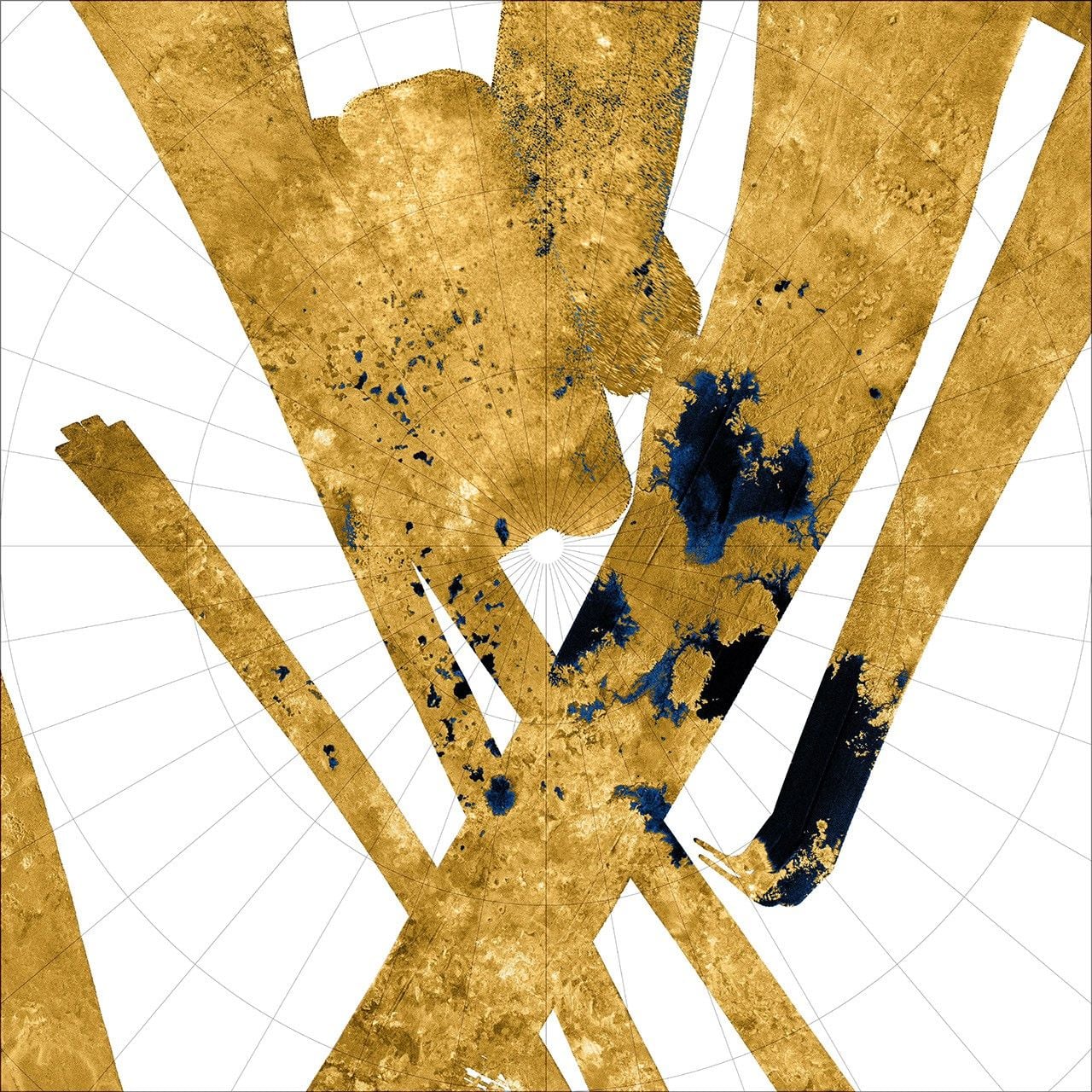
Across four flybys in 2014 and 2016, Cassini aimed radio signals at Titan’s three largest seas so precisely that the reflections travelled onwards to a 70-metre receiving dish on Earth. The echoes were narrow and intensely mirror-like. In the open bodies of Kraken Mare, Ligeia Mare and Punga Mare, the inferred root-mean-square surface roughness was no greater than 3.3 millimetres.
Near estuaries and the straits joining the seas, the surface was somewhat rougher. The radio reflections also changed in ways consistent with methane-rich liquid arriving at seas containing more ethane, a cryogenic counterpart to freshwater meeting salty ocean water on Earth.
Both findings need careful wording. Cassini did not film three-millimetre wave crests or watch a methane river enter the sea. The 3.3-millimetre result is a statistical measure of height variation at the radio wavelength scale, while the river interpretation comes from radar reflectivity and remains one possible explanation for it.
This is one study, not settled consensus about every condition in Titan’s seas. It is a 2024 reanalysis of four carefully selected observations, each a snapshot of a particular track at a particular time. What I find most interesting is how much planetary oceanography the team extracted from signals that left a spacecraft at Saturn, reflected from a moon and arrived at Earth.
Cassini used Titan’s seas as enormous radio mirrors
The work was led by Valerio Poggiali and published in Nature Communications as “Surface properties of the seas of Titan as revealed by Cassini mission bistatic radar experiments”. “Bistatic” means the transmitter and receiver were in different places. Cassini transmitted; Titan reflected; Earth received.
That geometry differs from the more familiar Cassini radar images in which the spacecraft sent a pulse towards Titan and listened for the return itself. For these experiments, the spacecraft’s high-gain antenna was aimed at a predicted specular point on the surface, the place where an incoming ray should reflect at the corresponding outgoing angle. NASA’s Deep Space Network then had to be waiting in the right place on Earth.
The team analysed the outgoing, or egress, portions of flybys T101 on 17 May 2014, T102 on 18 June 2014, T106 on 24 October 2014 and T124 on 14 November 2016. Those were the observations whose reflection points crossed the main body of at least one of Titan’s three great northern seas. The researchers used X-band data received at the Canberra Deep Space Communication Complex in Australia because its signal-to-noise ratio was better than the alternatives.
Cassini transmitted right-circularly polarised radio waves. Reflection from the surface produced components in two circular polarisations, both recorded on Earth. Their relative strength depends on the angle of reflection, the electromagnetic properties of the surface and its roughness. This allowed the researchers to estimate composition and texture separately, something a single-polarisation echo cannot do as cleanly.
The choreography had almost no room for improvisation. The spacecraft, the rotating moon, the receiving station and the predicted reflection point all had to line up. The useful returned power at Earth was on the order of zeptowatts, or trillionths of a billionth of a watt.
The 3.3-millimetre number is roughness, not a maximum wave crest
The echoes from the open seas were extremely narrow in frequency. Rough surfaces spread a reflected radio signal into a broader range because different facets are moving and tilted in slightly different ways. A nearly flat surface behaves more like one coherent mirror.
The paper reports a parameter called s, the root-mean-square variation in surface height. Imagine taking many small height measurements relative to a local mean surface. RMS roughness describes their typical statistical departure from that mean. It is not the vertical distance from a wave trough to a crest, and it does not impose a hard ceiling on every isolated ripple.
That distinction matters because the phrase “waves no larger than 3.3 millimetres”, used in the Cornell summary of the research, is understandable shorthand but more definite than the measurement itself. The paper’s careful result is that the main sea surfaces were mostly level, with s at or below 3.3 millimetres in the observed regions.
An earlier Cassini analysis published in Earth and Planetary Science Letters found RMS heights of roughly 1.5 to 2.5 millimetres over Kraken and Ligeia, which its authors related to characteristic wave heights of about 6 to 10 millimetres. That 2017 surface-roughness study used a different method and different assumptions. The two papers broadly agree on the quieter conclusion: calm conditions dominated the large portions of sea sampled by Cassini.
They do not establish that Titan’s seas are permanently still. The flybys did not continuously monitor one patch through a full day, season or storm. Titan’s seasons each last more than seven Earth years. Wind fields, tides and local currents can change, while small active areas may be lost when a measurement averages across a much larger footprint.
The coasts and straits were measurably rougher
The open-sea numbers were not uniform across the whole northern liquid system. Trevize Fretum and Genova Sinus showed RMS roughness from 3.6 to 5.2 millimetres. These areas are thought to connect Ligeia with Kraken and Punga with Kraken, so tidal flow through constricted passages is a plausible source of activity.
At the mouth of Moray Sinus, one polarisation channel was lost, limiting what could be recovered about composition. If the surrounding composition is assumed, a local drop in returned power could be represented by roughness of about 9.3 millimetres across a region smaller than 30 kilometres. The paper treats that value as a possible explanation rather than a direct measurement with the same confidence as the open-sea results.
Southern and central Kraken also appeared rougher than its northern part. Again, “rougher” is relative. These remain smooth surfaces by terrestrial coastal standards.
On Earth, waves, tides, river discharge and currents all leave different patterns in surface texture. Titan should have analogous processes, but the working liquid is a cold mixture of methane, ethane and dissolved nitrogen under one-seventh of Earth’s gravity. The same physical categories apply without producing the same scale or timing.
This coastal activity connects naturally to a question I explored in my earlier article about Titan’s missing river deltas. Rivers reach these seas, yet only two probable deltas have been identified among the large mapped coastal rivers. Tides, mobile shorelines and currents could be redistributing sediment before a familiar fan-shaped deposit survives. Millimetre-scale roughness does not solve that problem, but it provides evidence that the meeting places are more active than the open basins.
The freshwater analogy comes from dielectric differences
Radar can probe more than shape. A material’s relative dielectric constant describes, in part, how it responds to an electric field and reflects radio energy. Liquid water has a high value, close to 80 under ordinary terrestrial conditions. Titan’s liquid hydrocarbons are expected to sit roughly between 1.5 and 2.
The 2024 team found statistically significant differences across the seas. The surface of Ligeia Mare produced an effective relative dielectric constant of 1.38 plus or minus 0.03. Central Kraken reached 1.71 plus or minus 0.11, and the highest values appeared in central and southern Kraken. If these differences are mainly compositional, higher values point towards a greater share of ethane.
Estuaries including Trevize Fretum, Genova Sinus and Moray Sinus returned lower effective values than central and southern Kraken. Titan’s rainfall is expected to be dominated by methane, which is more volatile than ethane. Rivers supplied by that rain could therefore carry methane-rich liquid into a sea where photochemically produced ethane has accumulated.
That is the basis of the freshwater comparison. Fresh river water has a different composition and density from saltwater, leaving gradients and mixing zones at an estuary. On Titan there is no saltwater at the surface, and “fresh” does not mean drinkable or water-based. It means relatively methane-rich liquid entering a more ethane-rich reservoir.
A 2014 hydrological model of Ligeia and Kraken anticipated a related pattern. Ralph Lorenz showed how precipitation, evaporation and restricted exchange through straits could leave Ligeia more methane-rich while ethane and other less volatile solutes became more concentrated in Kraken.
The public summary of the 2024 paper described the rivers as pure methane. The paper itself is more guarded. Lower dielectric values at the estuaries may reflect lower ethane-to-methane ratios, but a porous or low-density surface layer could also affect the result. Across the seas more broadly, some retrieved values were lower than expected for any simple methane-ethane-nitrogen mixture. The authors discuss loose surface material, fine roughness, bubbles and limitations in the reflection model as possible contributors.
Cassini therefore found a pattern consistent with methane-rich inflow. It did not chemically sample a river.
The seas are deep parts of a much larger methane cycle
In my earlier overview of Titan’s methane weather, I described the broad exchange: methane evaporates, forms clouds, falls as rain, runs through channels and collects in polar lakes and seas. Water at minus 179 degrees Celsius is the hard crust beneath that system rather than its flowing liquid.
The three seas are not shallow puddles. Kraken Mare extends roughly 1,200 kilometres across its sprawling outline, Ligeia about 500 kilometres and Punga about 390 kilometres. Cassini radar altimetry did something different from the bistatic experiments when it pointed down into Ligeia. The signal passed through the surface, reflected from the bottom and revealed a maximum measured depth of about 160 metres along the track.
Marco Mastrogiuseppe and colleagues reported that result in their 2014 bathymetry paper. The radio signal travelled through the liquid with very little attenuation, placing strong limits on suspended particles and radio-absorbing contaminants. Later work supported a methane-dominated composition containing ethane and dissolved nitrogen.
Surface composition, whole-column composition and seabed depth are distinct measurements. The bistatic study was most sensitive to the top layer where the reflection formed. Altimetry sounding integrated the path through the liquid. Differences between them could reveal genuine vertical layering, or they could expose assumptions in how each radar signal was modelled.
The methane cycle also has a supply problem. Sunlight and energetic particles continually destroy atmospheric methane, creating ethane and the heavier organic material that makes Titan hazy. As I discussed in my article on a 2025 impact-replenishment study, even favourable impact histories could not keep the present methane atmosphere alive for much longer. Rivers and rain show that methane is moving now; they do not tell us where the long-term replacement comes from.
Cassini left oceanography without an ocean-going mission
Cassini ended in Saturn’s atmosphere in September 2017, but the four bistatic experiments show why its archive is still productive. The spacecraft did not need a dedicated sea-state instrument to reveal surface roughness. Researchers combined the two received polarisations, precise geometry, calibrated power and models of coherent reflection to obtain a measurement the mission designers could not have watched directly.
The limits are equally clear. Four flybys cannot provide a weather record. They cannot distinguish a steady tidal current from a transient wind field without repeated observations, and they cannot settle whether the dielectric gradients come from composition, a surface film, bubbles or microscopic texture.
NASA’s Dragonfly mission will examine Titan’s equatorial dunes and the Selk impact structure. It is not designed to visit the northern seas. Directly testing the freshwater analogy would require a future polar orbiter, aircraft, floating probe or boat able to measure methane, ethane, nitrogen, temperature, currents and suspended material while watching the same estuary change.
Until then, the 3.3-millimetre figure is best read as a precise description of four quiet encounters, not a permanent forecast. The open seas were mirror-smooth when Cassini’s radio tracks crossed them. The rougher boundaries are where the remaining questions concentrate.