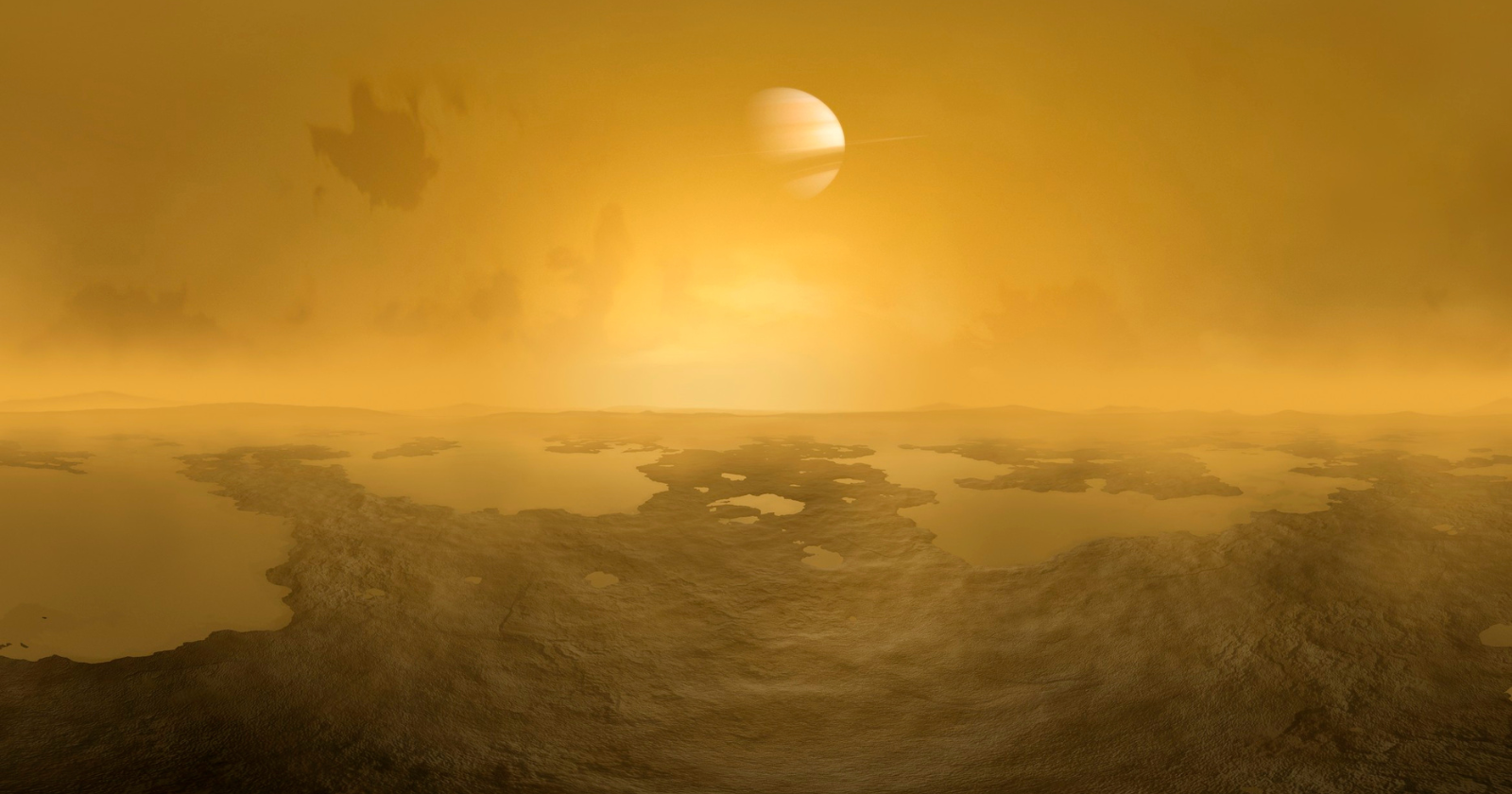
Of all the places people talk about settling beyond Earth, Titan is the one that makes me stop and reconsider what living somewhere else would even feel like. Saturn’s largest moon is the only other world in the solar system with a thick atmosphere and standing liquid on its surface. It is also, by one specific measure, the friendliest ground off Earth: a person could in principle stand outside on Titan without a pressure suit.
That last point sounds wrong the first time you hear it, so it is worth being precise about what it does and does not mean.
I am a writer with a long interest in this beat, not a planetary scientist, so treat what follows as a careful reading of the material rather than expert judgement. The short version is that Titan is a serious candidate for the most interesting question in the outer solar system, and also a brutal place that would kill an unprotected human in minutes.
What Titan actually is
Titan is bigger than the planet Mercury, about 5,150 kilometres across, and the second-largest moon in the solar system. According to NASA’s summary of the moon, its atmosphere is roughly 95 per cent nitrogen with about 5 per cent methane, and the surface pressure is around 1.5 bar, close to 50 per cent higher than the pressure you are sitting in now.
That is the detail that matters for the pressure-suit claim. Human bodies need the right pressure and the right gas to breathe. Titan supplies the pressure. It does not supply the oxygen, and it is savagely cold, but the ambient pressure alone is survivable, which is not true anywhere else we could stand.
The surface sits at about minus 179 degrees Celsius. At that temperature methane and ethane are liquid, and Titan has rivers, lakes and seas of them, the only place besides Earth known to hold stable liquid on its surface. I wrote recently about how Titan’s methane rivers behave differently from Earth’s, rarely forming the deltas our rivers do.
We have been there once. The Huygens probe, carried by the Cassini orbiter, descended through the haze and landed on Titan in January 2005, still the only landing humans have ever managed in the outer solar system.
Why it keeps coming up as a place to live
The case for Titan, made most fully by the science writers Charles Wohlforth and Amanda Hendrix in their 2016 book Beyond Earth, rests on a few genuine advantages over the usual candidates.
The thick atmosphere and its high-altitude haze act as a shield, blocking much of the radiation that makes Mars and the Moon so hostile over the long term. There is no need to bury a settlement under metres of regolith. The nitrogen and methane are raw material for fuel, plastics and breathable air if you can split the ice for oxygen. And the gravity is about one-seventh of Earth’s.
That low gravity, combined with the dense air, produces the detail everyone remembers: a person wearing wings could probably fly under their own muscle power. That is a real consequence of the physics, not a flourish, though nobody has tested it and the engineering of doing anything useful in that cold is another matter entirely.
The catch, which is not small
None of this makes Titan comfortable. It makes it interesting, which is different.
The cold is the first problem and it does not go away. Minus 179 degrees is cold enough to make many ordinary materials brittle, and keeping humans and machines warm would swallow enormous amounts of energy. Sunlight at Saturn’s distance is roughly one per cent of what reaches Earth, and Titan’s haze cuts it further, so solar power is close to useless. Anything living there would run on nuclear energy, as every spacecraft sent beyond Jupiter already does.
Then there is the water problem. Titan’s liquid is methane, not water. The water is there, but it is frozen into bedrock as hard as granite, with a possible ocean far below the crust. And there is no oxygen to breathe, so the pressure being survivable only gets you so far. You would still need bottled oxygen and a heated suit; you would simply not need it to be pressurised.
The distance compounds all of it. A one-way radio signal takes well over an hour, and a crewed trip with current propulsion would take years. Isolation on that scale is its own hazard, quite apart from the chemistry.
What Dragonfly will and will not settle
We are about to look far more closely. NASA’s Dragonfly mission, led by the Johns Hopkins Applied Physics Laboratory, is a nuclear-powered rotorcraft, an eight-bladed drone that will fly between sites on Titan. It is confirmed for launch in 2028, with arrival at Titan around 2034.
It is worth being clear about what habitability means here, because the word does a lot of quiet work. Dragonfly is built to study Titan’s chemistry and to ask whether the moon could host, or could once have hosted, the building blocks of life. That is a question about prebiotic chemistry and possibly microbes. It is not a question about whether people could move in.
Those two senses of the word get blurred all the time, and keeping them apart is most of the honesty in a piece like this.
So, could humans live there
My reading of the evidence is that the honest answer is not soon, and not easily, and not with anything we currently know how to build. The cold and the energy budget alone are beyond us for now, and the case for Titan as a home is a thoughtful argument about the distant future, not a plan.
What I find worth holding onto is narrower and more solid. Among all the dead, airless rocks we might reach, Titan is the one place where the air would hold you up, the pressure would not burst you, and the sky would have weather in it. That is not the same as habitable. It is just the closest thing to familiar that the outer solar system has to offer, and Dragonfly is about to tell us a great deal more.