Titan has an unusual way of making an alien landscape feel familiar. Clouds gather. Rain falls. Rivers cut channels. Lakes and seas fill, evaporate and feed the atmosphere again. The verbs belong to Earth. The materials do not.
At Titan’s surface, near minus 180 degrees Celsius, water is part of the ground. Methane and ethane are the fluids. Above them, sunlight and energetic particles work on a thick nitrogen atmosphere, breaking molecules apart and rebuilding them into a chemical inventory complicated enough that many products remain unidentified.
That combination has made Titan the strongest natural test of a question that is easy to state and difficult to think about honestly: can some of the organisation associated with life begin in a liquid other than water?
A 2025 paper in the International Journal of Astrobiology offered a physically coherent way to build one essential piece. Physical chemist Christian Mayer and NASA Goddard planetary scientist Conor Nixon proposed that methane rain striking an organically coated lake could generate hollow spheres enclosed by bilayer membranes.
The important word is proposed. No membrane has been found on Titan. The paper did not report a laboratory creation of one. It did not find a primitive cell, and it does not claim that a cell is waiting in a lake to be wrapped. It describes how a compartment that resembles the boundary of a cell might form without liquid water.
That distinction is not a small disclaimer attached to the story. It is the story.
Titan has the stage, but not yet the result
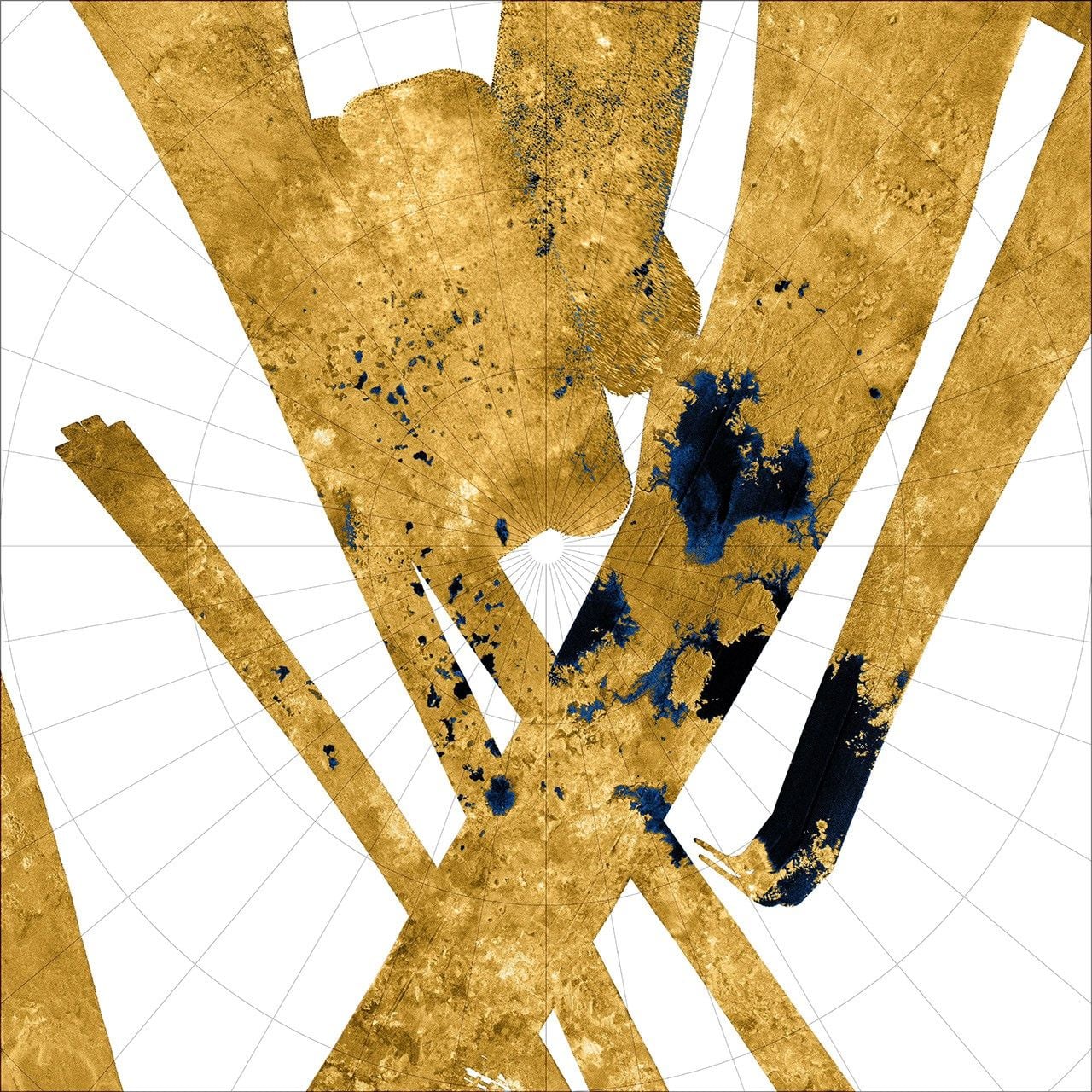
Several pieces of this world are no longer speculative. Radar from Cassini mapped stable lakes and seas, concentrated around Titan’s poles. Huygens photographed rounded ice pebbles and drainage channels after descending through the atmosphere. Clouds, rain-darkened terrain and river networks show an active methane weather cycle.
I have written before about the strange precision with which Titan repeats Earth’s water cycle using different substances. Methane evaporates, condenses into clouds, falls as rain and returns through channels to lakes. The analogy is useful until it becomes a shortcut. A hydrocarbon sea at 90 to 93 kelvin is not a cold version of an ocean on Earth.
Titan’s atmosphere supplies the other half of the stage. Ultraviolet light and charged particles split methane and nitrogen. The fragments recombine into hydrocarbons, nitriles and larger organic material, some of which forms the orange haze and some of which settles or rains onto the surface. The 2025 paper counted 24 identified atmospheric molecules while noting that Cassini saw signatures of more complex material that could not all be named.
Even the methane cycle contains an unresolved problem. Sunlight steadily destroys atmospheric methane, yet the moon still has rain and seas. My earlier look at whether impacts could replenish Titan’s methane found that even favourable impact histories barely extended its atmospheric lifetime. Titan gives researchers a working chemical system without giving up all of its bookkeeping.
A membrane is a border, not a miniature animal
Why care about a microscopic bubble?
Chemistry before life has a dilution problem. Useful molecules drift apart. Products mix back into the environment. Gradients disappear. A compartment changes that by creating an inside whose contents can remain different from the outside. It can concentrate ingredients, hold reaction products together and allow one small chemical history to diverge from another.
On Earth, many membrane-forming molecules are amphiphiles. They contain a part that interacts readily with water and another part that avoids it. In water, the molecules can arrange into two layers, hiding the water-avoiding portions inside while exposing water-friendly ends. Close that sheet into a sphere and it becomes a vesicle.
Titan turns the arrangement inside out. Methane and ethane are non-polar solvents. Candidate molecules such as organic nitriles have polar ends that could associate with one another, while their less polar sections face the surrounding hydrocarbon liquid. The geometry might resemble a membrane on Earth even though the chemistry and orientation are different.
A vesicle is still only a container. It has no demonstrated metabolism, genetic information, selective transport, energy system, controlled growth or self-reproduction. It cannot be assumed to evolve merely because one mixture lasts longer than another. A membrane may be a condition for a primitive cell, but it is not a primitive cell by itself.
The clever part of the 2025 proposal is the choreography
The mechanism begins with organic molecules reaching a lake and collecting at the boundary between liquid and atmosphere. Suitable amphiphiles would form a monolayer, a film only one molecule thick. The authors argue that the film could lower surface tension and repair itself after disturbance.
Then rain supplies motion.
A large methane raindrop, or perhaps a hail particle, hits the coated surface and throws smaller droplets of lake liquid upward. Each secondary droplet tears away with a patch of the film around it. It now carries one molecular layer.
When that coated spray droplet falls back, it meets the monolayer still covering the lake. As the droplet passes through the interface and sinks, the two coatings come together and close. The methane inside the droplet becomes enclosed by a bilayer. What began as weather ends as a vesicle.
This is more than an attractive animation. It attempts to solve a specific energetic problem. A 2020 quantum-chemistry study concluded that acrylonitrile, the best-known candidate for a Titan membrane, should strongly prefer a crystal over a freely assembled membrane in liquid methane. Molecules left in a uniform solution may never volunteer to become a hollow sphere.
The rain mechanism does not wait for that spontaneous assembly. It uses a surface to organise the first film, an impact to wrap the film around a droplet and a second crossing of the surface to add another layer. In plain terms, the environment performs the folding.
Every arrow in the diagram carries an uncertainty
Calling the sequence plausible means that it can be reconciled with current knowledge and converted into a test. It does not mean scientists know that it happens, or even that it is likely.
The required monolayer has not been measured on Kraken Mare, Ligeia Mare or any smaller lake. Researchers do not yet know whether suitable amphiphiles arrive in sufficient concentrations, remain at the interface, survive ultraviolet processing and form the needed structure in a realistic methane, ethane and dissolved-nitrogen mixture.
The droplet physics adds more unknowns. A rain impact must generate secondary spray. The coating must remain intact around a droplet. That droplet must return to the lake in the right way. The two films must close rather than tear, merge flat or crystallise. The completed sphere then needs to persist long enough to matter chemically.
There is a more recent warning. In March 2026, laboratory work reported that acrylonitrile formed a stable molecular cocrystal with ethane and showed little evidence of the behaviour needed for the classic acrylonitrile membrane in Titan-like liquids. The experiment weakened the leading material candidate.
It did not reproduce the new paper’s whole scenario. The researchers did not build an organically coated lake, make rain strike it and follow droplets through a second film. Mayer and Nixon also considered mixed membranes and other nitriles or amines, not acrylonitrile alone. The fair conclusion is narrower: one famous molecule looks less promising, while the proposed mechanical route itself remains untested.
Stable chemistry is not automatically evolution
The paper goes beyond initial formation. A fresh vesicle might be only kinetically stable, meaning cold conditions allow it to persist temporarily even though another arrangement has lower energy. While drifting through a lake, it could absorb molecules that fit the membrane better. More stable mixtures would last; unstable ones would disappear.
Repeated rain could make many populations. Currents and shorelines might mix them. In the authors’ scenario, the chemical recipes that survive could become more common, producing a type of compositional selection and perhaps, over immense spans of time, more complex protocell-like structures.
This is the most speculative part. Persistence is not the same as reproduction. Sorting stable structures is not yet Darwinian evolution. A crystal can outlast another crystal without acquiring heredity or adapting. Moving from a selected membrane composition to a system that copies information and builds descendants remains a large, unexplained transition.
That does not make the earlier steps trivial. An environment that repeatedly creates compartments and sorts them by stability would be doing more than accumulating random organic sludge. It would demonstrate an increase in chemical organisation. It would not demonstrate life.
A good hypothesis tells us how it can fail
The most productive next mission may begin on Earth. A cryogenic chamber could hold a measured methane, ethane and nitrogen lake beneath a Titan-like atmosphere. Researchers could add candidate amphiphiles, verify whether a surface film forms, generate repeated methane droplets and collect the resulting liquid.
Light scattering could reveal particles in the size range predicted for vesicles. Raman spectroscopy could identify their molecules. Follow-up work could test whether the structures are hollow, whether they truly have two layers and how quickly they fall apart.
A null result would not be an embarrassment. It could show where the chain breaks: no stable film, no coated spray, no closure, or a lifetime too short for useful chemistry. Each answer would tell us whether water is merely Earth’s solvent or whether it solves assembly problems that liquid hydrocarbons cannot.
Direct confirmation on Titan will take longer. NASA’s Dragonfly rotorcraft will explore equatorial dunes and the Selk impact region, not the northern seas. As I noted in my recent account of Dragonfly’s journey and science plan, the mission is built to sample surface organics and investigate habitability across multiple landing sites. NASA says it will not carry the lake light-scattering instrument that this vesicle search would need.
A later boat, shoreline lander or submarine would have to sample the liquid directly. The target would be delicate structures that may be rare and almost as dense as the fluid around them. That is hard engineering. At least the hypothesis tells the engineers what to look for.
Titan matters most when the Earth analogy breaks
Titan repeatedly punishes the assumption that familiar scenery means familiar physics. Rivers do not reliably build deltas there. In another earlier article, I examined why only a small fraction of mapped Titan rivers end in visible deltas. Water-ice sediment, hydrocarbon liquid, shifting shorelines and poorly constrained wave action refuse to behave like a standard Earth coast.
The membrane question deserves the same restraint. A lake, organic molecules and rain do not guarantee prebiotic chemistry. A hollow sphere does not guarantee a cell. A plausible path does not guarantee that nature takes it.
If vesicles are found, they would show that matter can build a durable inside and outside in a solvent and temperature regime radically unlike our own. That would widen the known conditions for prebiotic organisation without proving a second origin of life. If the structures cannot form, the failure would identify a real chemical boundary and make our definition of habitability less vague.
For now, Titan gives us neither a second genesis nor a dead end. It gives us a clean question with observable ingredients, missing steps and an experiment capable of returning no. That is a humbler claim than life in a methane sea, and a more useful one.