In July 2028, if the current schedule holds, a SpaceX Falcon Heavy will rise from the same Florida launch complex used by Apollo and begin sending a car-sized aircraft toward Saturn. The rocket will be familiar. The payload and destination will not.
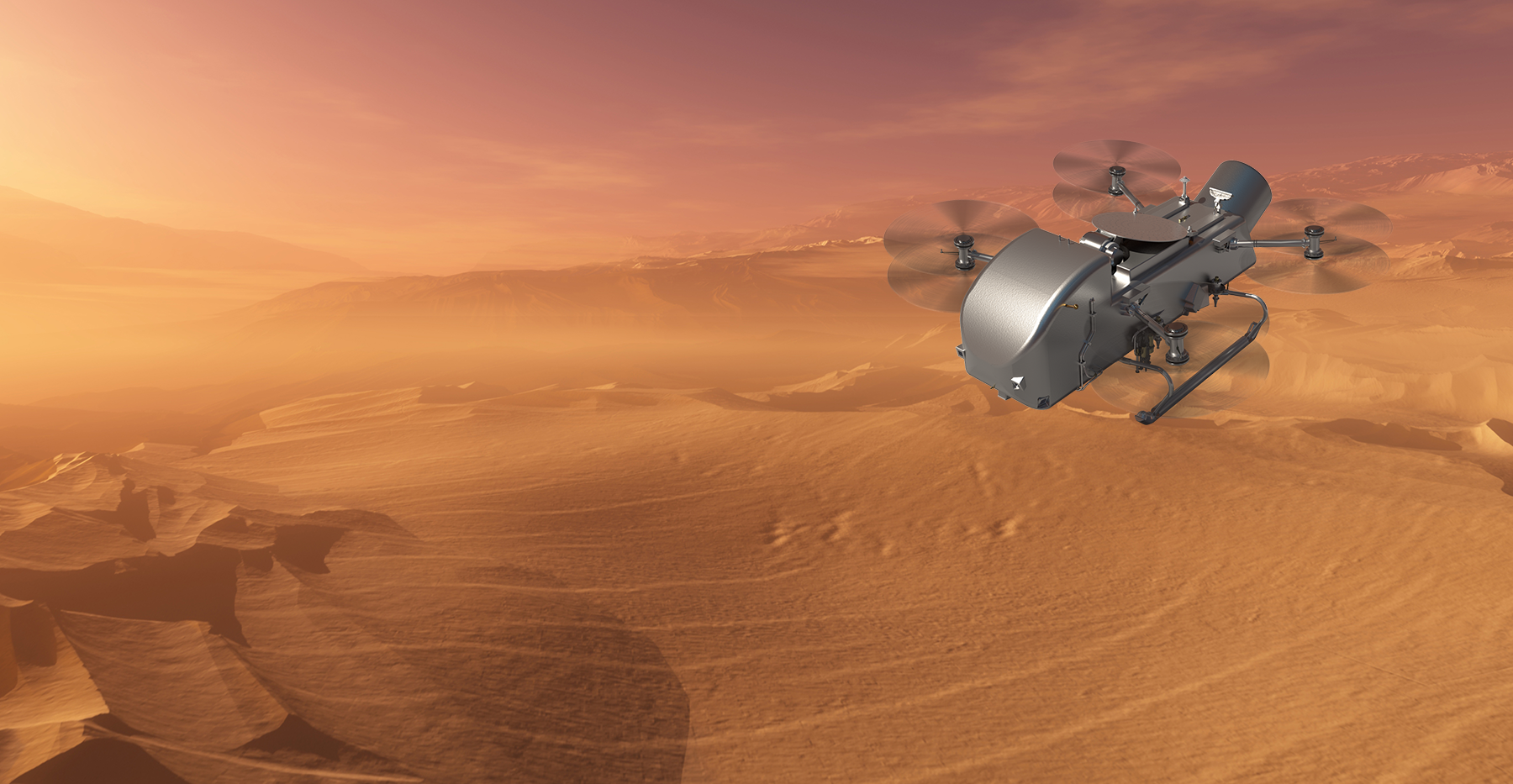
NASA’s Dragonfly is a nuclear-powered rotorcraft built to fly through the dense atmosphere of Titan, land, drill into the ground, analyse samples, recharge, and then fly again. It will carry its whole laboratory between sites rather than asking scientists to infer an entire world from the patch of ground beneath one stationary lander.
The journey is expected to take six and a half years. When Dragonfly arrives in late 2034, it will meet a moon with clouds, weather and seasons; river channels etched into the surface; and lakes and seas fed by rain. The familiar nouns are almost misleading. Titan is cold enough that water is part of the bedrock. Methane and ethane are the liquids moving through its landscape.
It is tempting to tell this as a story whose ending is already written: a powerful rocket, a flying laboratory, an alien shore. I do not think the mission needs that treatment. Dragonfly is ambitious precisely because the ending is uncertain. The machine must still be finished, launched, kept alive for years, delivered through a thick atmosphere and trusted to fly itself on a world nobody can fully reproduce on Earth.
July 2028 is a target window, not a guaranteed day
NASA selected SpaceX in November 2024 to launch Dragonfly on Falcon Heavy from Launch Complex 39A at Kennedy Space Center. The firm-fixed-price launch-services contract is worth about $256.6 million and includes mission-related costs as well as the rocket. The stated launch period runs from 5 to 25 July 2028.
NASA’s current Dragonfly mission page uses the careful formulation “no earlier than July 2028” and gives arrival as late 2034. Those words matter. A launch window is the working plan around which the spacecraft, rocket, range and trajectory are coordinated. It is not a promise immune to hardware findings, weather or programme decisions.
Dragonfly has already moved from earlier launch dates. NASA’s Office of Inspector General traced schedule replans driven by funding constraints, pandemic effects, supply-chain pressure and development challenges. The agency established a 2024 life-cycle cost baseline of about $3.35 billion, according to the inspector general’s project review. Acknowledging that history is not pessimism. It is a more respectful way to describe a difficult mission than pretending dates in deep-space exploration never change.
The cruise will last six and a half years
Falcon Heavy supplies the first enormous impulse, but it cannot erase the scale of the outer solar system. Dragonfly will leave Earth in 2028 and follow an interplanetary trajectory that includes an Earth gravity assist. NASA’s fiscal 2027 planning documents describe a six-and-a-half-year cruise before entry, descent and landing at Titan.
Principal investigator Elizabeth “Zibi” Turtle gave the calendar in unusually plain terms in an official NASA conversation: launch in July 2028, arrival in December 2034, followed by a nominal surface mission of about 3.3 years. That makes the voyage more than twice as long as the planned primary exploration phase.
During cruise, Dragonfly will be enclosed within an entry capsule attached to a cruise stage that provides power, communications, guidance and trajectory control. This is not six quiet years for the operations team. Engineers will monitor the spacecraft, maintain its health, check instruments and prepare for a landing sequence that cannot be rehearsed at the destination.
The delay also sets a human scale around the mission. Children who watch the launch will be older teenagers when the first Titan data arrive. Some engineers who began with Dragonfly as a proposal may retire before its primary mission ends. Deep-space exploration is built out of handoffs between people as well as stages between planets.
Dragonfly will meet Titan atmosphere-first
Unlike a Saturn orbiter, Dragonfly is not expected to brake into orbit and study Titan from above before landing. Its arrival is a direct atmospheric entry. The protective aeroshell must absorb the heat and force of entry, after which a drogue parachute and then a much larger main parachute slow the capsule in Titan’s deep air.
The numbers can sound confusing because different parts of the descent are timed from different starting points. Turtle described roughly two hours from the top of entry interface to the surface. NASA’s inspector general described about 90 minutes descending through the atmosphere by parachute. Both can be true: the longer figure covers the broader entry-to-touchdown sequence, while the shorter one refers to the parachute-dominated portion.
Near the surface, Dragonfly will not remain dangling beneath a parachute. The backshell will orient the suspended craft, the rotors will help remove unwanted spin, and the lander will separate at roughly 900 metres altitude. From there it becomes an aircraft. NASA’s detailed entry, descent and landing concept describes a powered flight to the chosen surface site.
Earth cannot fly it by joystick. The one-way radio delay across the Saturn system is far longer than the landing manoeuvre, so Dragonfly must sense terrain, select a safe point and control its descent autonomously. Human operators can write rules and test software for years. At Titan, the vehicle has to apply them alone.
A heavy rotorcraft can fly there because Titan rewrites the equation
Dragonfly is not a little helicopter. NASA lists a mass of about 875 kilograms, a length and width of roughly 3.85 metres, and eight sets of 1.35-metre coaxial rotor blades. Yet Titan gives flight engineers a rare combination: atmospheric density near the surface is more than four times Earth’s, while gravity is only about one seventh as strong.
Dense air gives each blade more material to push. Weak gravity reduces the force needed to remain aloft. As our earlier SpaceDaily examination of Dragonfly’s flight physics explained, a simple ideal-hover comparison produces a roughly 40-to-one power advantage over Earth for the same vehicle. That is a physical scaling result, not Dragonfly’s measured full energy budget. Real flight also pays for drag, control, electrical losses, avionics, heaters and safety margin.
The eight rotor assemblies are arranged as four coaxial pairs, effectively giving Dragonfly two coordinated quadcopter systems. That architecture adds redundancy and gives the craft the control authority to climb, turn, translate and land. Titan’s near-surface winds are expected to be manageable, but dunes, dust and methane rain make this a real atmosphere rather than a perfect wind-tunnel gas.
Solar panels are a poor fit so far from the Sun and beneath Titan’s haze. Dragonfly will use a Multi-Mission Radioisotope Thermoelectric Generator, or MMRTG, to turn heat from plutonium-238 decay into electricity. It is not a fission reactor. The generator provides steady power and crucial warmth, recharging a 134 ampere-hour battery between flights. The mission’s spacecraft and instrument overview says Dragonfly should be able to visit 20 to 30 sites and cover about 115 kilometres during the primary mission.
Titan has Earth’s landscape grammar with different chemistry
Titan is the only moon with a substantial atmosphere and the only world besides Earth known to support stable liquid on its surface. Nitrogen dominates its air, as it does ours, but methane drives weather. It evaporates, condenses into clouds, falls as rain, runs through channels and collects in lakes and seas mixed with ethane and other hydrocarbons.
NASA’s Cassini account of Titan describes a surface with rivers, polar seas and equatorial dunes. Each season lasts about 7.5 Earth years because Saturn takes roughly 29.5 years to orbit the Sun. Webb observations and climate modelling have continued to follow that slow circulation; a 2025 NASA visualization of Titan’s seasonal cycle shows methane humidity, cloud cover and winds migrating as sunlight shifts between hemispheres.
Our previous look at Titan’s active liquid cycle went deeper into the analogy. The most important caution is that an Earth-like process does not imply an Earth-like environment. Titan averages around minus 179 degrees Celsius. Water ice is hard ground. Methane and ethane are rain and sea. Sunlight at the surface is dim and filtered through an organic haze.
Dragonfly will not land beside one of the great northern seas. Its planned initial region is the equatorial Shangri-La sand sea, far from Kraken Mare and Ligeia Mare. The title’s rivers and seas describe the world Dragonfly is going to understand, not the immediate scenery around its first touchdown.
The mission is about chemistry before biology
NASA is refreshingly direct about the scientific boundary: Dragonfly is not primarily a mission to detect life. It is designed to investigate Titan’s habitability, measure complex organic chemistry and ask how far prebiotic processes have progressed.
Titan’s upper atmosphere is a chemical factory. Sunlight and energetic particles break apart nitrogen and methane, allowing carbon-, hydrogen- and nitrogen-bearing molecules to recombine into increasingly complex material. Haze particles settle onto the surface. In some places, impacts may have melted the water-ice crust, briefly bringing liquid water, energy and atmospheric organics together.
Recent laboratory work underlines why samples matter. As SpaceDaily reported in our coverage of Titan-like cryogenic crystals, hydrogen cyanide can form stable structures with methane or ethane under carefully controlled cold conditions, challenging an everyday rule about polar and nonpolar molecules refusing to mix. That does not show such crystals are abundant on Titan, and it certainly does not make them alive. It shows that intuition trained at room temperature is an unreliable guide there.
Another recent line of work explored whether methane rain splashing into hydrocarbon lakes might create hollow organic bilayers. Our earlier report on that proposed vesicle pathway emphasized its limits: no vesicle has been detected on Titan, and the study proposed a physically testable mechanism rather than observing the event. Dragonfly will not settle every attractive Titan hypothesis. It can give those hypotheses better chemical ground to stand on.
A flying laboratory will drill, listen and look
Dragonfly’s ability to move matters because Titan is not chemically uniform. A stationary lander could analyse one location beautifully and leave scientists wondering whether its sample was typical. A rotorcraft can compare dunes, interdunes, ejecta and crater terrain with the same calibrated instruments.
The Drill for Acquisition of Complex Organics, known as DraCO, will collect material and transfer it into the Dragonfly Mass Spectrometer, or DraMS. The mass spectrometer will use laser desorption and gas chromatography routes to identify molecules across a wide range of masses. The Dragonfly Gamma-Ray and Neutron Spectrometer, DraGNS, will measure bulk elemental composition beneath the craft.
The Dragonfly Geophysics and Meteorology package, DraGMet, will measure atmospheric conditions and includes a seismometer. DragonCam will provide panoramic, microscopic and navigation imagery. Together, those systems can connect chemistry to context: what a sample contains, what landscape it came from, what weather acts on it and what lies beneath the surface.
I would be cautious about translating that list into a promise of one decisive result. Instruments have detection limits. Samples can surprise teams in mundane ways. A negative result may mean a compound is absent, below detection or simply absent at that site. The strength of Dragonfly is not omniscience. It is repeated, comparative measurement across several environments.
The route begins in dunes and points toward Selk crater
Shangri-La offers broad dune fields that radar data suggest are relatively safe for landing while still rich in organic material. After checkout, Dragonfly is expected to make progressively longer sorties, often flying once every one or two Titan days. One Titan solar day, sometimes called a Tsol, lasts nearly 16 Earth days, leaving long intervals for analysis, communication and battery charging.
NASA’s present mission plan calls for several miles of travel on individual flights and about 20 to 30 science sites over 3.3 years. The cumulative range of about 115 kilometres would exceed the surface distance covered by any Mars rover to date, though the comparison is imperfect because Dragonfly can cross obstacles rather than drive around them.
The major geological destination is Selk impact crater. The impact may have generated liquid water that persisted long enough to interact with organic material. Estimates of the duration and extent depend on models, so it would be premature to picture Selk as an ancient warm lake with a known history. It is valuable because it offers a plausible natural experiment: Titan’s organic inventory exposed to transient liquid water.
Dragonfly can sample along the route rather than racing straight for the crater. That matters. Dune grains reveal atmospheric and surface processing; interdune areas may expose different material; crater ejecta can bring buried substances within reach. The journey is part of the science, not dead time between two important points.
In 2026, the aircraft is becoming hardware
Dragonfly spent years as simulations, test vehicles, instrument breadboards and artist’s concepts. By mid-2026 it had crossed a psychologically important line. The flight structure was beginning to look like the aircraft that may actually land on Titan.
NASA’s 9 July 2026 project update reported that the nearly 13-foot fuselage completed structural testing and was delivered for the next integration phase ahead of schedule on 29 June. Mechanical, thermal and electrical integration began on 1 July. Teams were installing the wiring, connectors and internal systems that turn a light honeycomb frame into a spacecraft.
The high-gain antenna had already been mounted. It sits on a powered arm so it can rise for communication and fold into a locked position before flight. Engineers suspended the structure on bungee cords to measure how rotor vibrations would travel through the fuselage, then tested it resting on its skids. They also pressurized the body to find leaks, because Titan’s dense atmosphere creates thermal and sealing problems most vacuum-bound spacecraft never face.
Elsewhere, teams have dropped a full-scale parachute system, exposed the heat shield to thermal and structural loads, spun rotors in dense-gas wind tunnels and tested the sample-transfer chain. The work is not glamorous in the way an arrival animation is glamorous. It is more convincing. Missions become real through connectors, sealing rates, resonance plots and tests that discover weaknesses while there is still time to fix them.
There is a great deal left to survive
Between a successful structural test and science on Titan sit several separate missions’ worth of risk. Dragonfly has to complete assembly and environmental qualification. Its radioisotope power system has to be fuelled and integrated. Falcon Heavy and spacecraft must meet at the launch site on schedule. The launch window, cruise, navigation corrections, atmospheric entry, parachutes, separation and first powered landing all have to work.
Then the surface mission begins in a place where the average temperature can embrittle materials, organic dust may move through the air and methane rain is possible. The rotorcraft must keep itself warm, recharge, communicate across more than a billion kilometres and repeatedly expose moving parts to an environment with no repair crew.
I do not list those hazards to drain the wonder from Dragonfly. They are the source of the wonder. A mission is not brave because a narrator calls it bold. It is brave because engineers identify failure modes one by one and still find a defensible route through them.
If the schedule holds, the Falcon Heavy launch in July 2028 will be Dragonfly’s loudest moment for years. After that comes a long, mostly invisible crossing. In December 2034, the same machine may descend through orange haze, unfold from its delivery system and become an aircraft in another world’s sky.
What Dragonfly can honestly give us
Dragonfly may find an unexpected organic inventory. It may show that impact sites support richer water-driven chemistry than dunes. It may discover that some laboratory-favoured molecules are rare or absent. It may return weather and seismic records that change how we understand Titan before the mass spectra receive their final interpretation.
None of those outcomes would answer the origin of life in a sentence. Titan is not a frozen copy of early Earth, and prebiotic chemistry is not biology waiting to be photographed. The moon offers a second natural laboratory where carbon chemistry, liquids, energy and time have combined under conditions profoundly unlike ours.
That is enough. I find Dragonfly most compelling when its claims are kept at human scale. We built instruments on the basis of incomplete maps from Cassini and one brief descent by Huygens. We are placing them inside a machine that must teach itself where to land. We are accepting six and a half years of waiting for the chance to compare sand from one alien place with sand from another.
Titan has weather, seasons, rivers and seas, but the resemblance to Earth is only the beginning of the question. Dragonfly is going there to find out where the resemblance ends.