

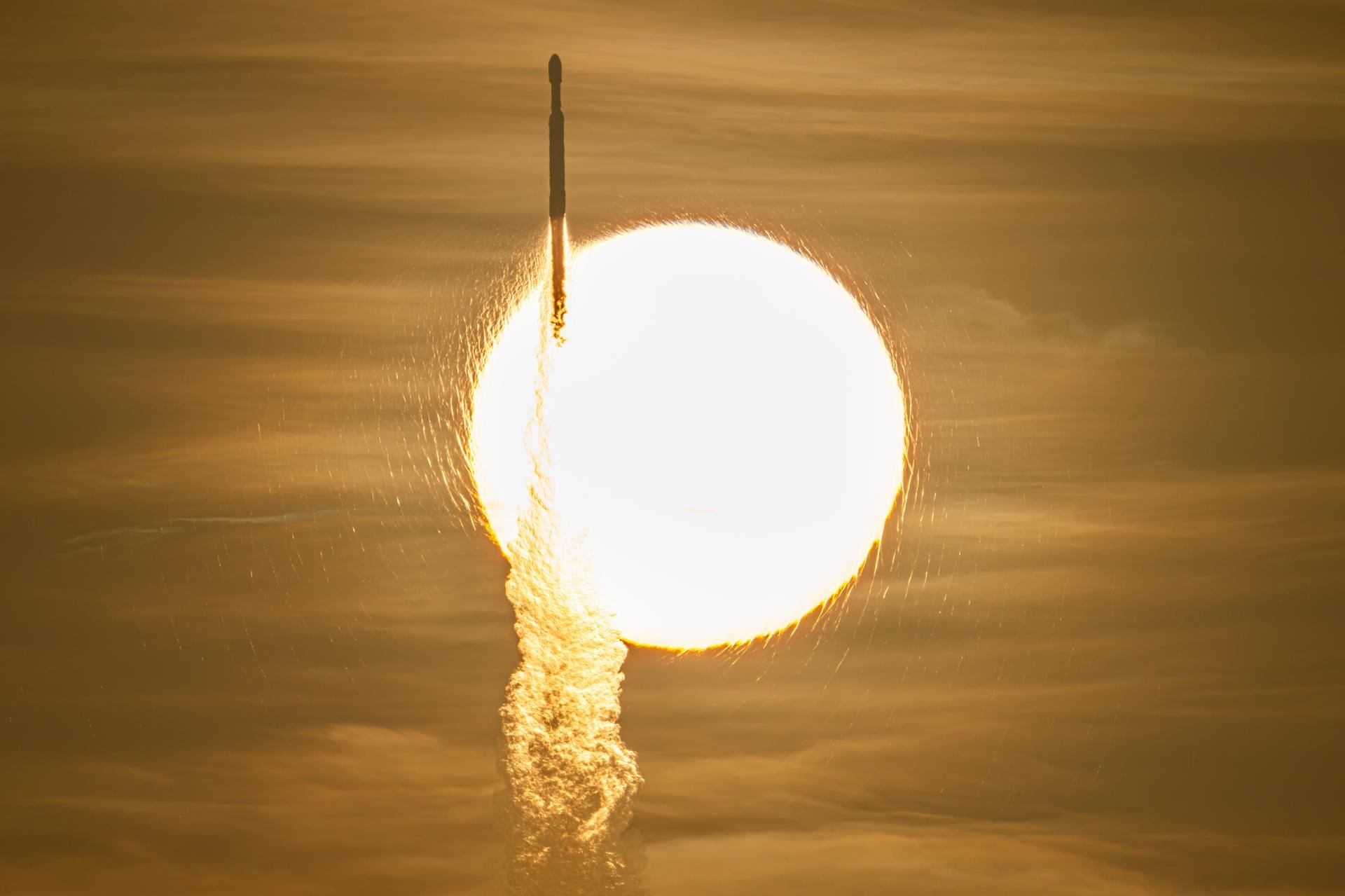
At 7:26 a.m. EDT on Sunday, August 30, a SpaceX Falcon Heavy rose from Launch Complex 39A at NASA’s Kennedy Space Center carrying the Nancy Grace Roman Space Telescope. Seven minutes later, controllers at Goddard Space Flight Center were receiving telemetry. At 7:57 a.m., 31 minutes after liftoff, the observatory separated from the rocket’s second stage and began flying on its own.
That sequence turned Roman from a repeatedly threatened development programme into a spacecraft on a three-month, million-mile journey. NASA later confirmed that its solar panels and lower instrument sun shade had deployed successfully. The telescope is now heading for a halo orbit around the second Sun-Earth Lagrange point, L2, about 1.5 million kilometres from Earth.
The successful departure was confirmed in NASA’s postlaunch release. It is the end of Roman’s launch campaign, but only the beginning of months of deployments, cooling, calibration and testing before science operations.
From liftoff to a spacecraft flying alone
The Falcon Heavy performed its planned burns and placed Roman on an escape trajectory rather than into an ordinary Earth orbit. Its two side boosters separated and returned to landing zones at Cape Canaveral. The centre core and upper stage continued carrying the telescope, with the upper stage completing the final burn before spacecraft separation.
Roman established communications through a Tracking and Data Relay Satellite during ascent. After separation, responsibility began passing from NASA’s Near Space Network to the Deep Space Network, starting with the Canberra complex in Australia. Madrid and Goldstone were scheduled to follow, giving controllers continuous contact during the early journey.
An hour and 23 minutes after launch, the mission team confirmed deployment of the solar panels and lower instrument sun shade. Over the next several days, the spacecraft must deploy its high-gain antenna and visor-like aperture cover, power on the Coronagraph Instrument and perform the first of two planned mid-course corrections.
NASA’s postlaunch news conference on the Roman Space Telescope mission. Watch on YouTube.
About nine months ahead of the formal deadline
Roman’s official commitment was to be ready for launch no later than May 2027. Launching on August 30, 2026 puts the mission roughly nine months ahead of that outer deadline. NASA has also called the date eight months early, reflecting whether the comparison uses the beginning or end of the May commitment window.
The more important point is that a major astrophysics observatory did not merely protect its deadline. The hardware finished early enough for NASA’s Launch Services Program and SpaceX to accelerate the flight. A July 2026 Government Accountability Office assessment said the project was working toward August readiness, two months earlier than its earlier October 2026 launch date.
NASA completed Roman’s construction in late 2025 and subjected the integrated observatory to vibration, acoustic and thermal-vacuum testing. Those tests simulated rocket forces and the temperature extremes of space. Early completion created a rare reversal of the usual flagship-mission story: the agency had to adjust tracking and launch support to accommodate a telescope that was ready sooner.
Three cancellation proposals and a fourth major threat
The launch also closes a political survival story. Before it was renamed Roman, the project was known as the Wide Field Infrared Survey Telescope, or WFIRST. Presidential budget requests for fiscal years 2019, 2020 and 2021 each proposed zero funding and termination. Congress rejected the proposals and restored money for development every time.
A fourth major threat arrived late in construction. The fiscal 2026 budget process proposed a sharp reduction in Roman funding while the completed observatory was nearing launch. This was not another explicit zero-dollar cancellation request, but astronomers warned that the cut could strand or delay a spacecraft that had already absorbed most of its development cost.
SpaceDaily’s detailed account of the four budget confrontations distinguishes the three formal termination proposals from that later funding threat. A separate history of Roman’s long route to launch traces the project from late-1990s concepts through an abandoned 2020 launch expectation, its 2020 renaming and the final Falcon Heavy campaign.
Survival was not automatic. Roman was the top-ranked large space priority in the US astronomy community’s 2010 decadal survey, but it competed for money while the James Webb Space Telescope was consuming resources and schedule margin. The mission’s repeated return in congressional budgets is the reason the telescope could be waiting inside a payload fairing when the early launch opportunity appeared.
A million miles is a destination, not an altitude
Roman is bound for L2, a region where the gravitational geometry of the Sun and Earth allows a spacecraft to orbit the Sun while remaining roughly aligned with Earth. It will not sit motionless at a point. Roman will trace a large halo orbit around L2, using periodic station-keeping manoeuvres.
The location keeps the Sun, Earth and Moon on the same general side of the spacecraft. That geometry helps the sun shield maintain a stable thermal environment and gives the telescope a broad view away from bright nearby objects. Webb operates in the same general L2 region, although the two observatories will follow their own trajectories.
NASA expects the journey and commissioning period to take about three months. The primary mirror and instruments must cool, align and demonstrate stable performance. The Wide Field Instrument will activate several weeks into the flight, followed by calibration campaigns. NASA anticipates releasing the first Roman images in early 2027.
The spy-mirror telescope becomes a survey machine
Roman carries a 2.4-metre primary mirror, the same diameter as Hubble’s. The mirror began as one of two telescope assemblies transferred to NASA by the US National Reconnaissance Office in 2012. SpaceDaily previously examined how the surplus reconnaissance hardware became the heart of a civilian observatory.
The resemblance to Hubble ends at the focal plane. Roman’s 300-megapixel Wide Field Instrument uses 18 detectors and captures a field at least 100 times larger than Hubble’s infrared view while preserving comparable sharpness. NASA says the observatory will be able to survey the universe up to a thousand times faster.
That wide view is intended to turn precision astrophysics into population science. Roman will map the distribution of galaxies across cosmic time, measure how matter bends background light, search for supernovae and conduct a microlensing census of planets toward the centre of the Milky Way. Its daily compressed science return is expected to reach about 1.4 terabytes. A SpaceDaily report on Roman’s data stream explains how that could accumulate to about 20 petabytes while mapping more than two billion galaxies.
The second instrument is a technology demonstration
Roman’s Coronagraph Instrument has a different job. It will suppress a star’s glare so the telescope can image nearby Jupiter-like planets and dusty planet-forming discs. It is not expected to produce the mission’s main statistical surveys and is not designed to find an Earth twin.
Its importance lies in demonstrating high-contrast imaging systems in space. The masks, deformable mirrors and wavefront controls will test technologies relevant to a future observatory capable of separating the faint light of an Earth-like planet from its star. Success would help bridge the gap between today’s giant-planet images and NASA’s longer-term Habitable Worlds Observatory concept.
The decisive risk has moved from Congress to commissioning
Launch removes one class of risk and exposes another. Roman has survived budget documents, construction, environmental testing and the violence of a Falcon Heavy ascent. It must now deploy components that cannot be serviced at L2, maintain communications across a million miles and prove that its optical and thermal stability match predictions.
Nothing in today’s success guarantees the quality of the first survey. The spacecraft still has mid-course corrections, instrument activation, cooldown and calibration ahead. Yet the milestones already completed are concrete: Roman launched at 7:26 a.m. EDT, established telemetry, separated cleanly, deployed its power system and began the journey toward L2.
The observatory that nearly did not exist is no longer waiting for a budget line or a launch window. It is a working spacecraft, travelling outward nine months before the far edge of the deadline that once defined its future.