
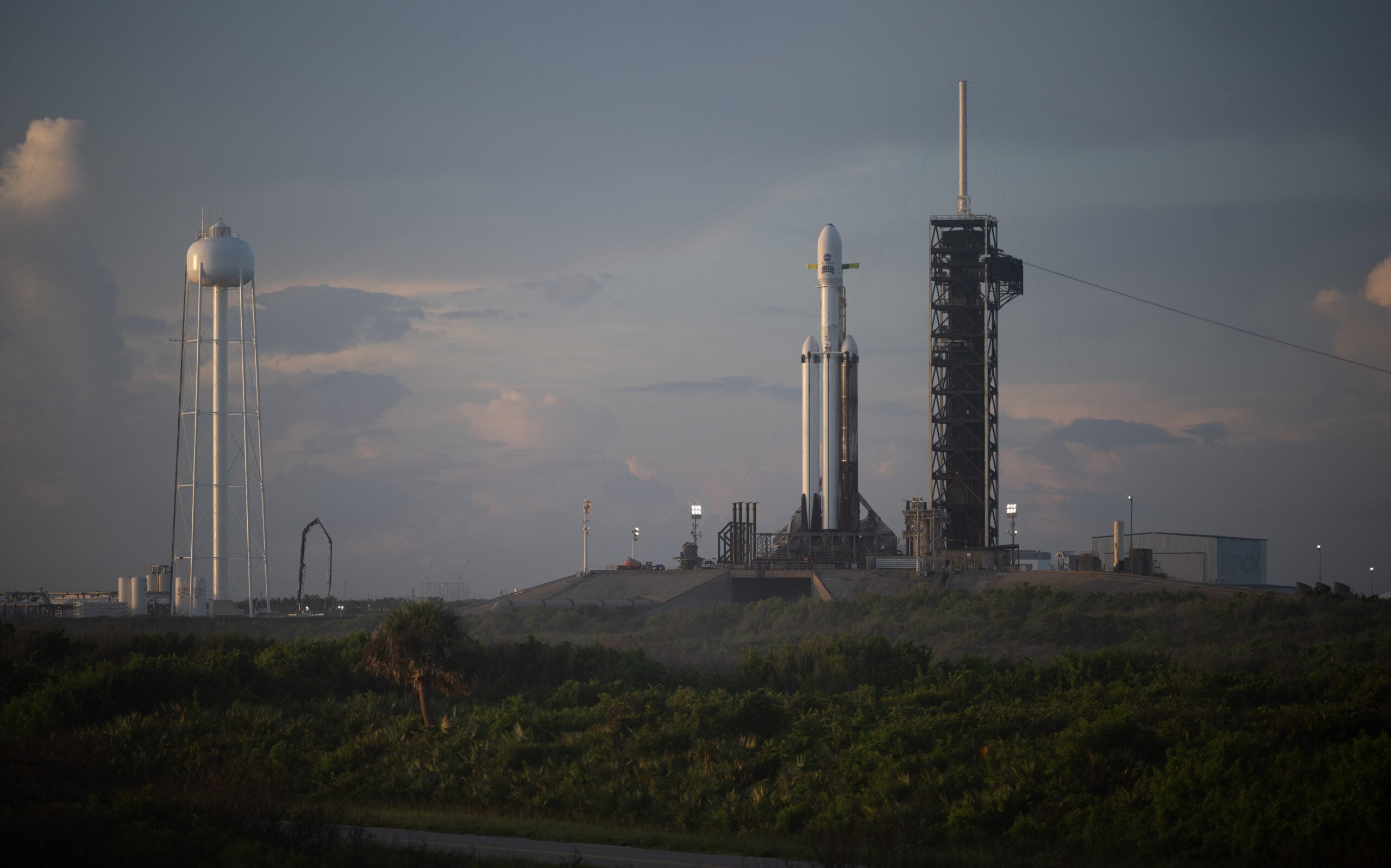
On Sunday morning a SpaceX Falcon Heavy left Pad 39A at Kennedy Space Center with a 300-megapixel infrared camera in its nose. The rocket reached orbit. The camera is now on its way to a quiet station 1.5 million kilometres from Earth, where NASA says it will sit and survey the sky for a five-year prime mission.
That is the whole job, stated as a machine. Once the observatory is fully operational, the Space Telescope Science Institute expects it to send home about 1.4 terabytes of compressed data every day. That exceeds 500 terabytes a year, or roughly 2.6 petabytes across five years when multiplied directly. STScI separately expects Roman’s processed and archived data products to reach about 20 petabytes. The figures describe different stages of the data pipeline, not one continuous pile from the downlink. Hubble, in thirty-five years of work, has returned more than 400 terabytes, so Roman’s expected annual downlink alone would exceed Hubble’s lifetime return.
The comparison is not a slight on Hubble. It is what a survey camera does when you stop asking it to stare at one small patch and start asking it to sweep.
A camera that swallows sky
NASA’s Wide Field Instrument is that 300-megapixel infrared camera. STScI puts its infrared field of view at 200 times Hubble’s. In a single pointing it takes in a patch of sky Hubble would have to tile, visit after visit, to cover. The point of that width is not a prettier postcard. It is a census. Julie McEnery, Roman’s senior project scientist at NASA, said before launch that the main survey will take more than a year and contain over two billion galaxies, with broadly the same sharpness as Hubble across a field wide enough that the dark parts of the universe have fewer places to hide.
Astronomers want that map because most of the universe is still unaccounted for in ordinary matter. Dark energy and dark matter, taken together, are treated as about 95 percent of the cosmos and neither has a settled physical identity. Roman’s job is to watch how galaxies sit and move across huge volumes, and how distant stellar explosions mark the expansion, until the geometry of that expansion is measured well enough to show whether the standard model is merely incomplete or actually wrong. McEnery put the hope plainly: the surveys may confirm hints that the standard model is incorrect, and then force the field to say what should replace it.
The same wide field is also a planet trap. As the camera returns again and again to crowded star fields, it is expected to find thousands of worlds around other stars, including kinds that earlier observatories were not built to count. A second instrument, a coronagraph flying as a technology demonstration, is there to try something harder still: block a star’s light on purpose so a planet beside it can be seen directly. That work is not the survey. It is a test.
A hundred days before the counting starts
The camera does not begin the census on launch day. SpaceNews, citing NASA, said the trip to the Earth-Sun L2 point takes about 100 days, and that commissioning happens on the way. The first science observations are expected after arrival, not from the pad. Until then the machine has to deploy, talk to the ground, cool, align, and prove that a 300-megapixel focal plane still behaves like a camera once it has left Florida.
If the five-year prime mission holds, the surveys NASA has already assigned are supposed to be finished inside that window. Officials have said the spacecraft may carry fuel for about five years more. That extra time is not a second mission yet. It is margin, and a decision for later, after the first maps exist.
About 75 percent of the observing time is already promised to community-defined surveys. The data, STScI has said, will not sit behind a proprietary year the way Hubble programmes often do. There is no exclusive window. The pictures become public as they are processed. The practical problem is not secrecy. It is bulk. Twenty petabytes is not something most laptops can hold. STScI’s own image for the pile is a monument of sand, one grain per byte, on the scale of the Statue of Liberty. Researchers are being told to go to the data, in the cloud archive, rather than dragging the sky home.
What left the pad
None of that has happened yet. What happened on Sunday is simpler. A Falcon Heavy lifted through scattered cloud from Pad 39A, and a 300-megapixel camera began a million-mile wait. The count it is meant to return—more than two billion galaxies, about 1.4 terabytes of compressed data downlinked each day, and an archive that may reach 20 petabytes once processing is included—is still in the future tense. The instrument is real. The station is empty. The first files have not arrived.
If the machine works, the archive will grow faster than Hubble’s ever did, and it will grow in public. If it does not, the pad will have sent a very large camera to a very quiet point for nothing. Either way, the story that left Florida on Sunday is not a press kit about dark energy. It is a camera, a distance, and a pile of sky that has not been gathered yet.
Correction, 31 August 2026: An earlier version treated Roman’s expected 1.4-terabyte daily downlink and 20-petabyte processed archive as the same measure. The five-year downlink totals about 2.6 petabytes; processing and derived products expand the archive toward 20 petabytes.