

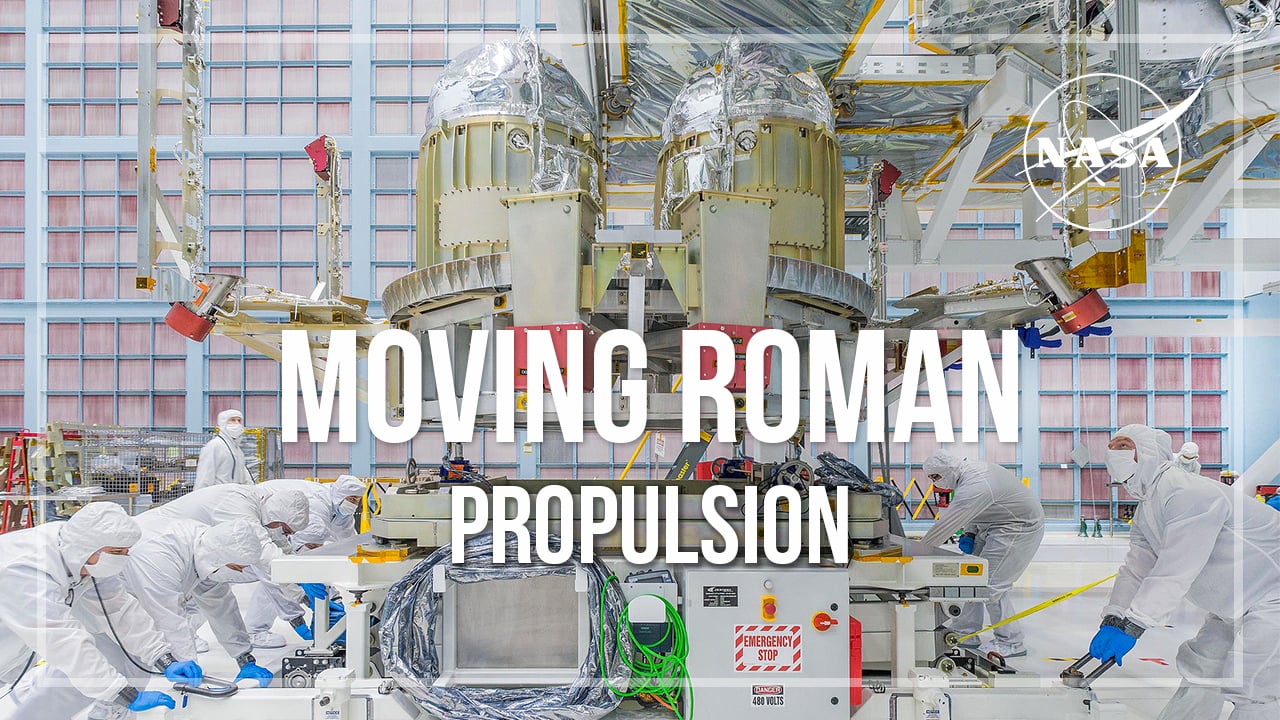
NASA’s Nancy Grace Roman Space Telescope began its journey to the Sun-Earth L2 region with a propellant budget built around uncertainty. The first major test of that reserve has produced a result far better than the conservative plan.
Roman’s team had allocated 441 pounds, or 200 kilograms, of fuel for the first mid-course correction. The manoeuvre on August 31 used about 40 pounds, or 18 kilograms, and was executed with more than 99 percent accuracy, according to NASA’s September 14 mission update.
The saving is worth more than one cheap burn. NASA now estimates that several advantages together could leave Roman with enough propellant for at least 22 years of potential science operations, compared with the 10 years covered by its original fuel plan.
That is a fuel horizon, not a guaranteed retirement date. Roman still has to reach its operating orbit, complete commissioning and remain mechanically and electronically healthy. Even so, a lighter-than-planned spacecraft and an accurate first manoeuvre have turned engineering margin into the possibility of more than a decade of additional astronomy.
The 200 kilograms protected against an uncertain launch
A spacecraft launched towards L2 does not arrive on a predetermined rail. Tiny differences in the rocket’s final speed and direction become large positional differences during a journey of roughly 1.5 million kilometres. Mission designers therefore reserve propellant for course corrections under conservative assumptions.
The allocation is not a forecast of what the burn will most likely use. It is protection against the demanding end of the launch-dispersion envelope, combined with margins for uncertainty in the spacecraft’s final mass and propulsion performance.
Roman launched aboard a SpaceX Falcon Heavy on August 30. Its first mid-course correction followed on August 31, adjusting the transfer towards the broad looping orbit it is expected to enter around L2 in early December. The manoeuvre achieved its target with better than 99 percent accuracy while consuming only nine percent of the allocated fuel.
In simple subtraction, Roman retained 182 kilograms that had been protected for the event. The operational gain is more complicated because mission lifetime depends on the collection of future manoeuvres, tank reserves and performance assumptions, not on dividing the remaining propellant by one burn.
NASA’s accounting adds three gains of roughly four years
The original plan covered a five-year primary mission followed by a possible five-year extended mission. That made 10 years the baseline propellant requirement, even though approval of an extension would still depend on spacecraft health, scientific value and future budgets.
NASA attributes roughly four additional years of potential operations to the efficient first correction. A second four-year gain came before liftoff.
Engineers had developed the fuel budget around a conservative maximum observatory mass of 21,605 pounds, or 9,800 kilograms. Roman’s actual launch mass was 17,760 pounds, or 8,056 kilograms. The completed spacecraft was therefore 1,744 kilograms lighter than the planning ceiling.
Lower mass meant that a given change in velocity required less propellant. It also left enough allowable launch capacity for technicians to fill the tanks to their full volume rather than loading only what the 10-year requirement demanded. NASA estimates that this launch surplus could enable about four more years.
The remaining four years are still projected rather than banked. Because the first correction placed Roman so accurately, the second mid-course burn is expected to be very small. NASA also expects the later L2 orbital insertion to consume less than originally allocated. If those manoeuvres perform as forecast, the total reaches at least 22 years.
The next two manoeuvres still matter
The second correction was moved later in September because the spacecraft was already so close to its desired path. It will provide the final energy adjustment needed before Roman conducts its insertion approximately 100 days after launch.
The three gains rest on different footing. The 18 kilograms is a measured result, and the extra fuel is already in the tanks. Savings from the second correction and insertion remain an expectation based on the trajectory now being observed.
The telescope is also still in commissioning. NASA has begun activating its 300-megapixel Wide Field Instrument and the Coronagraph Instrument, but powering hardware is not the same as completing calibration or beginning routine science. The agency’s commissioning outline describes a staged process of deployments, checkouts, cooling, alignment and performance testing.
SpaceDaily’s report on the August 30 launch traced Roman’s rapid transition from a repeatedly threatened development programme to a spacecraft on its way to L2. The new fuel estimate is encouraging, but commissioning is still under way.
L2 reduces some demands but does not eliminate propulsion
The second Sun-Earth Lagrange point is often described as a place where gravitational forces balance. That shorthand can suggest a spacecraft simply stops there. Roman will instead follow a large halo-like path around the L2 region while orbiting the Sun in step with Earth.
The orbit offers a stable thermal and observing geometry. Earth, the Moon and the Sun stay on approximately the same side of the observatory, allowing its sunshade to protect the telescope while antennas maintain communication with the ground.
It is not perfectly stable. Perturbations from gravity, solar radiation pressure and small navigation errors gradually move a spacecraft away from its desired path. NASA expects Roman to perform station-keeping burns roughly every 28 days.
The observatory also uses reaction wheels to turn and point without firing thrusters. Those wheels accumulate angular momentum from persistent external torques and sometimes need to be unloaded, another task that can involve the propulsion system. NASA Goddard’s Roman propulsion overview describes hydrazine fuel as the mission’s primary finite resource.
Electricity is replenished by the solar array, but propellant is not. Once the available hydrazine falls below the reserve needed to control the orbit and attitude safely, science operations cannot continue in their normal form. Saving fuel early is therefore unusually close to saving operational lifetime.
Twenty-two years of fuel does not promise 22 years of science
NASA carefully calls the new figure at least 22 years of potential science operations. Propellant may be the principal consumable, but it is not the only way a mission can end.
Detectors, electronics, communications hardware, reaction wheels and thermal systems can degrade. Micrometeoroid impacts and radiation can damage components. Ground systems and expertise must be maintained, and extended missions compete for funding through periodic scientific review.
Roman was designed with redundancy and margin, but no engineering team can certify in 2026 that every critical component will still function in 2048. What the projection says is that fuel should not be the limiting factor before then, if current assumptions hold.
Nor does it formally extend the approved science programme today. NASA’s five-year primary mission remains the period structured to meet the core requirements. Later years would be planned and reviewed in response to the observatory’s performance and the scientific opportunities that exist at the time.
Extra time could be scientifically different, not merely longer
Roman combines a 2.4-metre primary mirror with a roughly 300-megapixel infrared camera. Its Wide Field Instrument will capture an area of sky at least 100 times larger than Hubble can image in one exposure while retaining comparable sharpness.
The initial surveys will map galaxies and cosmic structure, measure supernovae, monitor dense star fields for gravitational microlensing and support a broad general-observer programme. Its coronagraph is designed as a technology demonstration for suppressing starlight and imaging faint planets and dusty discs nearby.
Additional years do more than repeat the first five. A longer time baseline sharpens measurements of stellar motions and changing sources. Fields can be revisited after years rather than months. Rare transients become more likely to fall within Roman’s view, while later observing programmes can respond to discoveries that have not yet been made.
The extended horizon could be particularly valuable for cosmology. As SpaceDaily’s account of Roman’s expansion measurements explains, the observatory is designed to combine supernova distances, galaxy clustering, gravitational lensing and other probes across enormous samples. More observing seasons could deepen those samples and expose systematic errors that shorter programmes cannot reveal.
Those possibilities remain choices rather than promises. Some experiments benefit strongly from duration, while others are limited by calibration, sky coverage or coordination with other observatories. A 22-year fuel supply creates room for decisions that a 10-year limit would have closed off.
A precise launch can keep paying dividends for decades
The striking comparison is 200 kilograms protected and 18 kilograms used, but the longer-life projection comes from a chain rather than a single number.
Roman finished lighter than its conservative planning mass. That allowed fuller tanks and reduced the fuel required for a given correction. Falcon Heavy released the observatory onto an accurate path. The operations team then executed the first burn with greater than 99 percent accuracy, reducing the next burn and insertion expected downstream.
Each advantage compounds the others. A smaller correction today preserves fuel directly and also leaves a cleaner trajectory requiring less correction tomorrow. In a mission where station keeping will continue roughly every four weeks and no tanker can refill the tanks, that is how minutes of propulsion performance can become years of astronomy.
The 22-year figure is both a major success and a conditional forecast. Roman has not been handed a science programme through 2048. What it has gained is more basic and immediately valuable: the physical option to keep operating that long if its hardware, funding and scientific case endure.