

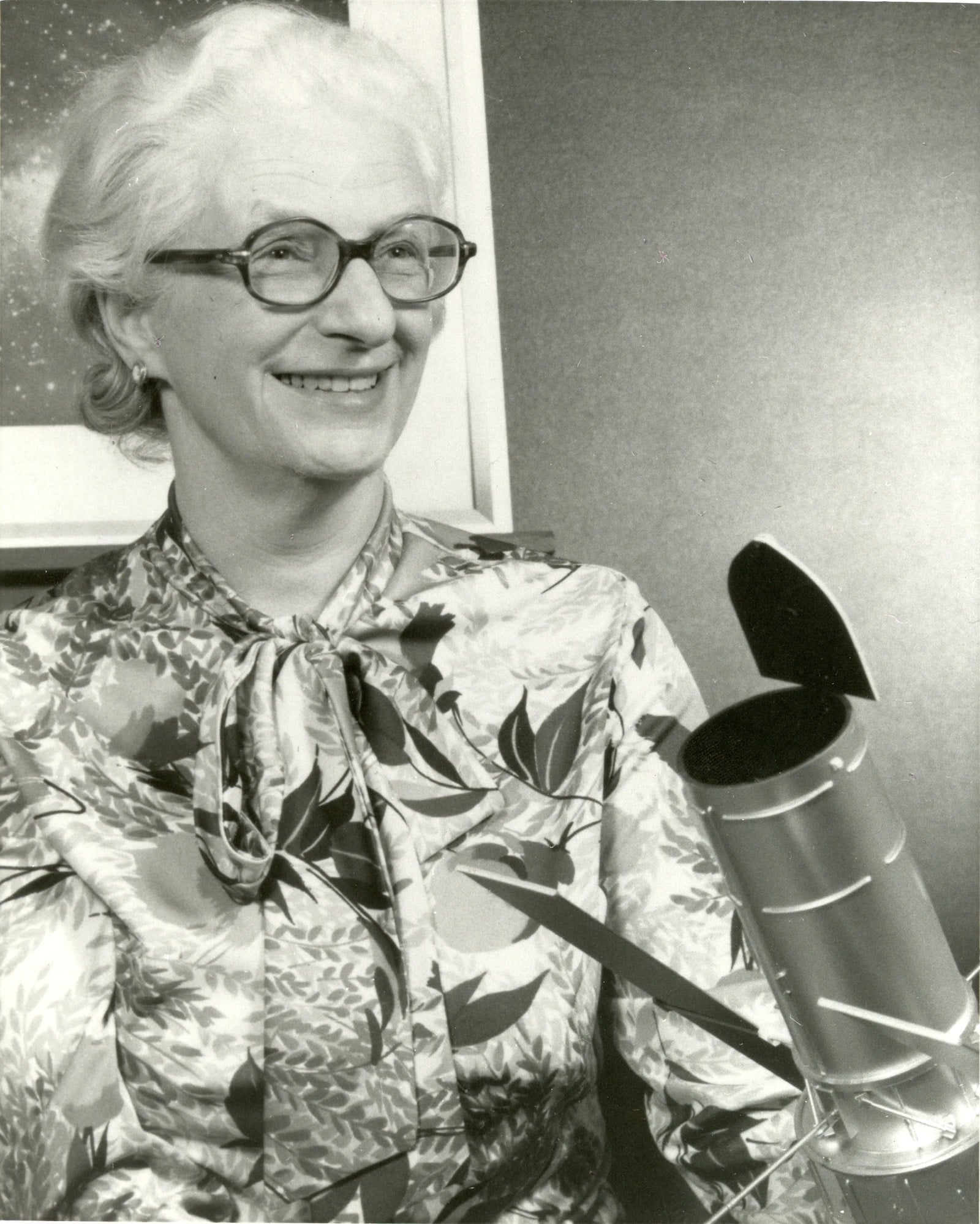
When a Falcon Heavy left Kennedy Space Center on Sunday, it carried an observatory named for a woman who had died eight years before the launch and two years before NASA put her name on the mission.
Nancy Grace Roman never saw the Nancy Grace Roman Space Telescope. She did, however, create the NASA programme that made telescopes like it possible.
Roman was the agency’s first chief of astronomy and the first woman to hold an executive position at NASA. She developed a national space-astronomy programme when the field barely existed, helped transform the Large Space Telescope from an attractive concept into a serious project and made the case for it across NASA, the White House budget system and Congress.
That telescope became Hubble. It entered orbit in 1990 and grew into a cultural symbol whose images are recognised far beyond astronomy. Roman’s role was known within NASA and the scientific community, but her name remained much less familiar than the machine she had spent years making possible.
The new observatory is an attempt to correct that imbalance. It is also a continuation of her work.
An astronomer before NASA existed
NASA’s biography of Roman begins with a child who organised friends into an astronomy club between fifth and sixth grade. By seventh grade, she had decided to become an astronomer, despite being told repeatedly that science was not a career for women.
Roman was born in Nashville, Tennessee, on 16 May 1925. Her father, Irwin Roman, was a geophysicist and her mother, Georgia Smith Roman, was a music teacher who took her outdoors to see birds, trees, flowers and constellations. Roman later said the astronomy was what stayed with her.
She earned a bachelor’s degree in astronomy from Swarthmore College in 1946 and a doctorate from the University of Chicago in 1949. At Yerkes Observatory she studied stellar spectra and the composition and motion of stars, work that established her reputation as a research astronomer.
The profession did not offer her an equal route forward. Roman saw women with years of experience denied tenure and concluded that her own prospects in academic astronomy were poor. She left for the US Naval Research Laboratory in 1955, where she entered the still-young field of radio astronomy and eventually led its microwave spectroscopy section.
The move away from a conventional academic career placed her close to the emerging government space programme. It also gave her experience with new instruments, large organisations and scientists working across institutional boundaries.
NASA offered her a blank sheet
NASA began operating on 1 October 1958. A few months later, an agency official asked Roman whether she knew anyone who might want to establish a programme in space astronomy. Roman volunteered herself.
She joined the agency in 1959. By 1960 she was serving as Chief of Astronomy and Relativity in the Office of Space Science, making her NASA’s first chief of astronomy and its first female executive.
Roman later described the attraction in direct terms: it was the chance to formulate a programme “from scratch” that could influence astronomy for decades. Taking the job meant largely giving up her own research. The scale of the opportunity outweighed that loss.
Building the programme meant more than choosing a single telescope. Roman visited astronomy departments to learn what researchers wanted to observe, explained what early spacecraft could realistically do and translated scientific priorities into missions and grants. Her responsibilities covered observations from rockets and balloons as well as a developing sequence of orbiting observatories.
Early projects did not all succeed. Orbiting Astronomical Observatory 1, which Roman was photographed beside before launch, failed after three days in orbit in 1966. Later observatories showed that precision astronomy above the atmosphere was possible. The programme acquired knowledge, instruments and communities that could support something far larger.
Hubble was not her invention
The idea of placing a major telescope above Earth’s atmosphere was older than NASA. Astronomer Lyman Spitzer had made a detailed case for such an observatory in 1946, and generations of astronomers wanted a view free from atmospheric distortion and absorption.
Roman’s contribution was not inventing the concept or designing every part of the spacecraft. It was turning a widely desired idea into a programme that engineers could build and the federal government could approve.
She brought astronomers from across the country together with NASA engineers and asked them to define a telescope that would both work technically and answer important scientific questions. In Roman’s own account, that collaboration was the beginning of the serious Hubble effort.
She continued meeting researchers to establish the telescope’s scientific objectives and minimum specifications. Those boundaries mattered when cost, size or competing institutional interests threatened to reshape the mission. NASA’s history of her Hubble work also credits Roman with helping secure charge-coupled devices, or CCDs, rather than relying on older detector technology.
A programme scientist does not polish the mirror or wire the spacecraft. Roman described her main Hubble task more plainly: she had to sell the programme.
The politics behind the “Mother of Hubble”
Roman first had to persuade NASA, then the federal budget authorities, the executive branch and Congress. She could speak the language of astronomers while understanding what engineers, administrators and lawmakers needed before committing to an expensive observatory.
Her public argument reduced the cost to a human scale. She told Congress that for roughly the price of one night at the movies each year, every American could receive 15 years of discoveries. Hubble has now delivered more than twice that span of science.
Edward Weiler, who later succeeded Roman as NASA’s chief astronomer and became Hubble’s chief scientist, gave her the nickname “Mother of Hubble”. It recognised her unusual position between scientific ambition and federal decision-making.
The nickname should not erase the collaborative nature of the telescope. Spitzer championed the concept, hundreds of scientists and engineers developed it, Congress financed it, contractors built it and astronauts later repaired and upgraded it. Roman herself said Hubble probably would have existed sooner or later without her.
She added that its timing was better because she became involved. That is a careful description of her achievement. Roman did not claim sole authorship. She accelerated the point at which a hoped-for telescope became an organised, defensible NASA mission.
Hubble became famous; Roman largely did not
Roman retired from NASA in 1979, more than a decade before Hubble launched. She remained involved with astronomical catalogues and data work, returned to NASA’s Goddard Space Flight Center as a contractor and continued following the telescope’s progress.
Hubble’s early spherical-aberration crisis could have ended as a monument to overconfidence. Instead, the 1993 servicing mission corrected its vision, and the observatory produced images and measurements that changed public expectations of space science.
Among Roman’s favourite results was the evidence that the universe’s expansion is accelerating, work that led to the 2011 Nobel Prize in Physics. It was an outcome no one could have specified when the Large Space Telescope was being organised.
Roman received major honours, including the Federal Women’s Award and NASA’s Exceptional Scientific Achievement Award. A Women of NASA LEGO set introduced her to a broader audience in 2017. Yet the Hubble name, the astronauts who serviced it and its colourful images remained vastly better known.
She died on 25 December 2018 at the age of 93. The mission now bearing her name was still called the Wide Field Infrared Survey Telescope, or WFIRST.
Why NASA put her name on WFIRST
On 20 May 2020, NASA renamed WFIRST the Nancy Grace Roman Space Telescope. The choice linked the agency’s next major wide-field observatory to the person who had established its space-astronomy programme and helped create Hubble’s institutional path.
The connection is stronger than a commemorative plaque. Roman’s namesake uses a 2.4-metre primary mirror, the same diameter as Hubble’s, but its Wide Field Instrument sees an area at least 100 times larger in a single exposure.
SpaceDaily’s account of Roman’s donated telescope hardware explains how a National Reconnaissance Office mirror transformed the mission that the astronomy community had originally proposed. A separate comparison with Hubble shows why the survey advantage comes from an enormous field of view rather than simply looking deeper.
The mission will map galaxies and cosmic structure, measure the changing expansion of the universe and conduct a census of exoplanets using gravitational microlensing. Hubble helped reveal the dark-energy problem. Roman is designed to examine that problem across a much larger statistical sample.
The name survived the mission’s political history
The renaming did not guarantee a launch. WFIRST had already survived three presidential budget proposals that sought to terminate it, and Roman later faced another major funding threat during final preparations.
SpaceDaily’s launch-eve history traced the mission from late-1990s dark-energy concepts through the 2010 decadal survey, the donated mirror, repeated cancellation proposals and its pandemic-era schedule revision.
The telescope ultimately reached the launch pad before the outer deadline in NASA’s revised plan. At 7:26 a.m. EDT on 30 August 2026, Falcon Heavy lifted off from Launch Complex 39A. The observatory separated from the rocket 31 minutes later, established communications and deployed its solar arrays and sunshade.
As SpaceDaily reported after launch, the spacecraft is now travelling towards a large halo orbit around the second Sun-Earth Lagrange point, roughly one million miles from Earth. NASA expects the journey and commissioning to take about three months, with the first images planned for early 2027.
The successful departure does not guarantee the quality of future science. The telescope still has to complete commissioning, align its optics and calibrate instruments before the surveys begin. It does mean that Roman’s name is now travelling on a working spacecraft rather than waiting on a project chart.
A name catching up with a legacy
Nancy Grace Roman’s career exposes an easily missed part of space exploration. Great observatories are not created only by novel mirrors, detectors and rockets. They also require someone to organise a community around common specifications, make compromises without surrendering the science and keep explaining why a mission deserves public money.
That work rarely produces a single photograph as memorable as a Hubble deep field. It is harder to display and easier to forget. Roman’s relative obscurity was partly a consequence of the administrative achievement that made her important.
NASA’s newest observatory now turns that history inside out. A woman once less famous than the telescope she helped make possible has become the name of its wide-field successor.
Roman said the challenge of creating a space-astronomy programme from nothing was too great to resist because it could shape the field for decades. Sixty-seven years after she accepted that challenge, one of its most ambitious descendants is on its way to a million-mile orbit with her name on it.