

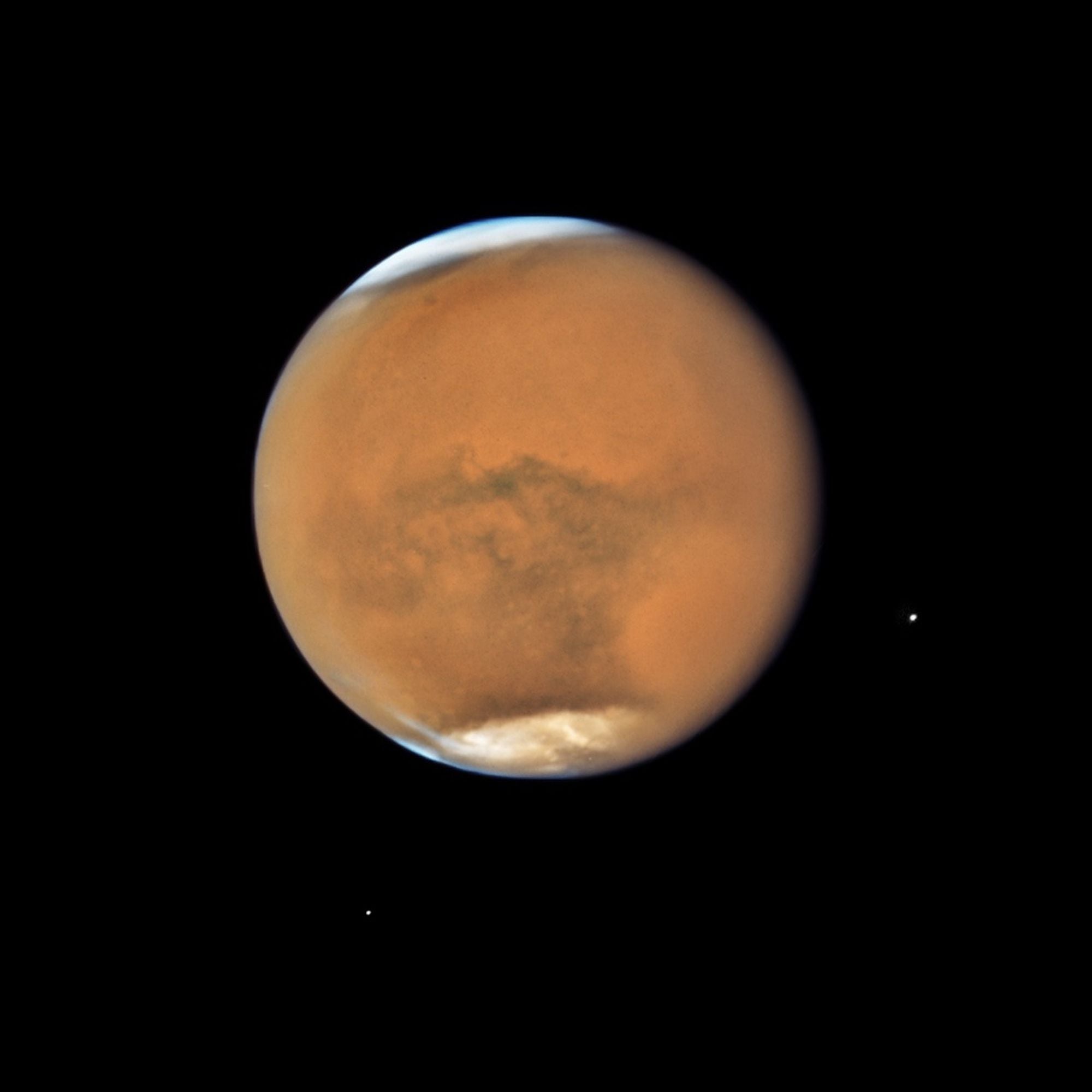
A proposal to warm Mars with engineered dust begins with a particle smaller than the width of a human hair and ends with an industry operating across a planet. In between sits an unusually large result: two climate models indicate that conductive rods about nine micrometres long could raise the Martian global-average surface temperature by more than 30 degrees.
The design is meant to solve a specific problem. Earlier terraforming schemes required vast quantities of greenhouse ingredients that are scarce on or near the Martian surface. The rods could instead be made from iron or aluminium, elements present in Martian dust and rock, then released into the atmosphere to change how radiation moves through it.
The calculation was published in Science Advances in August 2024 by Samaneh Ansari, Edwin Kite and colleagues. Their paper describes a modeled climate intervention, not a field test or an approved engineering programme. This is one study, not settled consensus. Its value lies in showing that the raw material problem may be less forbidding than assumed, while exposing a different set of constraints involving manufacture, transport, atmospheric lifetime and governance.
The distinction matters because “30 degrees” can be misread. A rise of 30 kelvin is the same temperature difference as 30 Celsius degrees. It does not mean Mars would have an average temperature of 30 degrees Celsius. It means a very cold planet could become substantially less cold.
Why ordinary greenhouse plans reached a wall
The familiar route to terraforming Mars is to release carbon dioxide, thicken the atmosphere and let the additional greenhouse effect warm the surface. The difficulty is inventory. In 2018, Bruce Jakosky and Christopher Edwards examined the accessible Martian carbon dioxide in polar ice, soil and minerals. Their analysis in Nature Astronomy concluded that it was not enough to produce the pressure and temperature required for an Earthlike surface environment using present technology.
That result is why a recent SpaceDaily examination of why Mars settlement still means sealed habitats separated a human base from a remade planet. The two are vastly different engineering propositions.
Carbon-dioxide percentage is also a poor guide to climatic power. Mars and Venus both have atmospheres that are roughly 96 percent carbon dioxide, yet their atmospheric masses and climates could scarcely be more different. Mars has a small carbon-dioxide column above each square metre. Changing the way that thin column interacts with light is the opening the nanorod proposal tries to exploit.
A rod shaped for Martian infrared
The modeled particles are conductive rods about nine micrometres long with an aspect ratio near 60 to one. The paper considered aluminium and iron. At that shape, the rods would interact strongly with wavelengths of thermal infrared radiation leaving the surface.
The mechanism has two parts. The rods would scatter some incoming sunlight forward, sending more of it toward the ground rather than back to space. They would also absorb and scatter thermal infrared radiation moving upward through spectral windows in the Martian atmosphere. The combined effect is warming.
This is not simply a proposal to make Mars dustier. Natural Martian dust commonly reduces daytime surface temperatures because its composition, size and geometry block sunlight as well as interacting with heat. The engineered particles are intended to have deliberately different optical behaviour. Brownian motion would keep their orientations random, while their long, narrow form was calculated to make them settle more than ten times more slowly than ordinary Martian dust.
The word “nanorod” describes the narrow cross-section and optical behaviour, even though the proposed length is measured in micrometres. The rods are not molecular machines. They are more like microscopic pieces of conductive glitter designed around the wavelengths Mars emits.
What the two models actually found
The team used a three-dimensional Mars global climate model and checked the result against a separate one-dimensional radiative-convective model. In the headline scenario, both indicated that sustained release at 30 litres of solid aerosol per second could produce at least 30 kelvin of global-average warming if each particle remained effective in the atmosphere for ten years.
The models did not predict a uniformly mild Mars. The planet’s present global mean surface temperature is about 210 kelvin, or roughly minus 63 degrees Celsius. Adding 30 kelvin leaves a mean near minus 33 degrees Celsius. Local temperatures vary sharply with latitude, altitude, season and time of day, so substantial warming could bring some ice-bearing regions above the melting point during favourable periods even while the annual planetary mean remains frozen.
The study also found that the particles could be more than 5,000 times as effective per unit mass as the best proposed greenhouse gases. That comparison is about radiative efficiency, not total project difficulty. It does not include a Martian mine, refinery, particle factory, power supply or dispersal network.
The ten-year lifetime is especially important. If rods fall out or cease behaving optically after one year, sustaining the same atmospheric burden would require roughly ten times the replacement throughput. If they persist longer, the required flow falls, but the intervention also becomes slower to stop.
A 2026 follow-up tested atmospheric transport
A later team led by Mark Richardson examined whether infrared-active particles released near the surface could actually spread through the atmosphere. The 2026 Geophysical Research Letters study simulated continuous release from Arcadia Planitia and, separately, Elysium Planitia in a three-dimensional Mars climate model.
The simulations found that heating by the particles could strengthen local circulation, loft the plume and help distribute material globally. That is useful support for the transport part of the original concept. It remains modeling rather than an atmospheric experiment, and its authors identify a consequential omission: particles were not allowed to agglomerate.
Agglomeration could turn many carefully shaped rods into heavier clusters with different optical properties and faster settling. The follow-up also imposed dry deposition and did not permit particles that reached the surface to be lofted again. Those choices show why “ten years airborne” cannot yet be treated as an established property. Particle coatings, oxidation, electrostatic charging, collisions and interactions with natural dust all need measurements under Mars-like pressure and temperature.
Thirty litres per second is an industrial system
The stated flow sounds modest because litres are familiar household units. Run continuously, however, 30 litres per second is about 946,000 cubic metres of solid aerosol each Earth year. If the material were aluminium at its ordinary density, that volume would have a mass of roughly 2.6 million tonnes. Iron would be heavier.
Mars may supply the elements, but it does not supply ready-made metal rods. An operating chain would have to excavate regolith, separate iron-bearing or aluminium-bearing compounds, remove oxygen and impurities, control particle dimensions, prevent clumping, move the product to release sites and power the entire process. Abundance in dust changes the logistics of feedstock; it does not make refining free.
The scale contrast with present in-situ resource use is severe. As SpaceDaily noted in its account of MOXIE’s first oxygen production on Mars, the Perseverance instrument demonstrated that a machine can turn Martian carbon dioxide into oxygen. Across all its runs it produced 122 grams. MOXIE was a deliberate small technology demonstration, not a factory, but it provides a useful reference point for the distance between proving a reaction and sustaining millions of tonnes of annual output.
The original nanorod paper proposed releasing material from pipes extending perhaps 10 to 100 metres above the ground, where turbulent updrafts are stronger. A real network would need to survive abrasive dust, cold, power interruptions and regional weather while delivering particles at controlled rates for years. A single production site might also create an intense local plume before global circulation spread it.
What thirty degrees would and would not buy
More warmth could make shallow ice easier to melt and could increase atmospheric water vapour. Water vapour is a greenhouse gas, so it might reinforce the initial warming. Water-ice clouds could add further feedback under some conditions, while darker wet ground could absorb more sunlight than bright ice.
Those feedbacks are not guaranteed to be uniformly helpful. Clouds can warm or cool depending on their height and particle size. Released water could refreeze, migrate toward cold traps or precipitate onto the surface. Natural dust could alter the rods’ distribution and radiation balance. A wetter Mars would also create weather and surface exchanges that the simplest models do not fully represent.
Pressure remains the harder boundary. Present Martian surface pressure averages only a little above the triple-point pressure of water. Even where the temperature permits melting, exposed liquid can boil, freeze or evaporate rapidly. A warmer Mars with the same thin air is not an open-air environment for people and is not automatically a stable home for surface ecosystems.
Terraforming is more than a temperature target
A 2026 analysis by JPL physicist Slava Turyshev placed the wider problem in mass and energy terms. The paper in APS Open Science calculated that each millibar of added global-average pressure requires about 3.89 quadrillion kilograms of atmosphere. Human-relevant open-air pressures therefore imply hundreds of quadrillions to quintillions of kilograms of gas, depending on the chosen composition and target.
Temperature is only one line in that ledger. A breathable environment also needs an oxygen source, a buffer gas, tolerable pressure, radiation protection, a working water cycle and long-term control of atmospheric loss and chemical sinks. SpaceDaily’s account of how Mars lost its magnetic field, much of its atmosphere and its surface waters describes the history that any durable intervention must contend with.
Nanorods do not replace the missing mass. They could, if the models and particle assumptions hold, make better climatic use of the atmosphere Mars already has. That is a meaningful distinction. It turns the first warming step from a near-impossible search for rare molecules into an immense engineering problem built around common ones.
The experiment comes long before the planet
The next useful work is small compared with the proposal. Researchers can manufacture candidate rods and measure their infrared scattering, solar transmission, oxidation, charging and tendency to stick together in Mars simulation chambers. Wind-tunnel and circulation studies can test whether realistic plumes disperse as the models predict. Climate calculations can couple the engineered particles to natural dust, clouds, water transport and surface chemistry.
Only after those tests would questions of reversibility become clearer. Under the ten-year assumption, stopping production would allow the atmospheric burden to decline over years rather than centuries. Yet settled particles would remain on the surface, and deliberately changing a planet raises questions about scientific preservation, planetary protection, possible indigenous biology and who has authority to decide.
No machinery is being assembled to carry out this plan. The present result is narrower and more interesting than a promise of terraforming. It identifies a plausible physical lever, shows what that lever might do in climate models and attaches demanding assumptions to it. The raw ingredients may already be on Mars. Nearly everything required to turn them into a controlled planetary climate system is not.