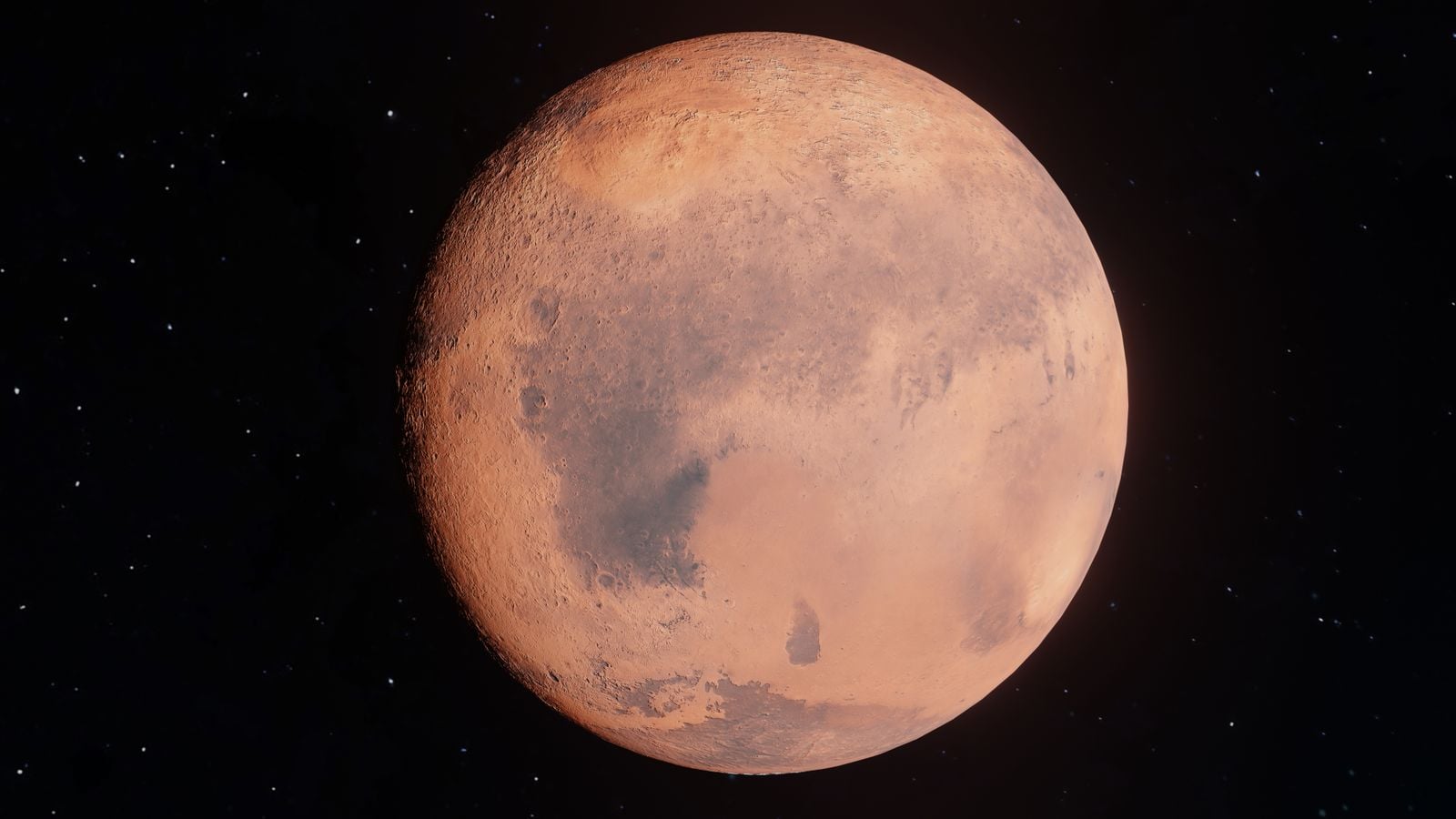
Mars is the planet we have quietly agreed to think of as our spare. It turns up in company slide decks and government roadmaps as humanity’s second home, the obvious next address. So it is worth asking, plainly, what living there would actually involve, and where the honest line sits between hard and impossible.
There are really two questions hiding inside “livability.” Could people survive on Mars, sealed inside engineered habitats? And could Mars ever be made Earth-like, so people could walk around outside? The answers are not the same, and the second one is more settled than the optimism suggests.
I am a writer with a long interest in this beat, not a planetary scientist, so treat what follows as a careful reading of the work rather than expert testimony.
What the surface is actually like
Start with the air, because it sets the terms for everything else. According to NASA’s summary of the planet, Mars has an atmosphere about 95 per cent carbon dioxide, and the surface pressure averages less than one per cent of the pressure at sea level on Earth.
That is close enough to a vacuum that water boils at body temperature. The practical meaning is stark: an unprotected person on Mars would not suffocate slowly, they would need a pressurised suit to keep their own blood and tissues from turning to vapour. Breathing gear alone would not save you.
The rest of the list is no kinder. The average temperature is around minus 60 degrees Celsius. Gravity is about 38 per cent of Earth’s. With no global magnetic field and almost no atmosphere to absorb it, radiation reaches the ground largely unchecked, and NASA’s Curiosity rover measured a surface dose of roughly 0.7 millisieverts a day, many times what we receive at the Earth’s surface. The soil itself is laced with perchlorates, chemicals that are toxic to the human thyroid and would have to be scrubbed out of anything grown in it.
There is water, but it is ice, held at the poles and in the ground. Stable liquid water cannot exist on the open surface, because the pressure is too low to hold it there.
The terraforming problem
The dream that answers all of this in one move is terraforming: thickening the atmosphere until Mars warms up and holds liquid water, turning the planet into something like a second Earth. It is a fixture of science fiction and of a certain kind of billionaire ambition.
The most careful look at whether it is possible was not encouraging. In 2018, Bruce Jakosky and Christopher Edwards published a study in Nature Astronomy that added up all the carbon dioxide still available on Mars, in the ice caps, the soil and the minerals, using two decades of spacecraft data.
Their conclusion was blunt. Even if you released every accessible source of the gas, you would raise the pressure to only about 7 per cent of Earth’s, nowhere near enough to warm the planet meaningfully, and most of that carbon dioxide is locked up in forms we could not readily mobilise anyway. Terraforming Mars, they wrote, is not possible with present-day technology.
The phrase to hold onto is present-day technology. The study is not a claim about the distant future or the laws of physics. It is a statement that the simple version of the story, warm the place up and move in, does not work with anything we currently know how to do.
So livability means habitats, not a new Earth
Set terraforming aside and the realistic picture comes into focus. Living on Mars, for the foreseeable future, means living inside sealed, pressurised habitats, probably shielded from radiation by piling Martian soil over them or building underground.
Some of the ingredients are genuinely there. Water ice can be mined for drinking, for oxygen and for rocket fuel, and the thin carbon dioxide air can be processed into breathable oxygen, something NASA’s Perseverance rover has already demonstrated on a small scale. Mars also has the advantages of being relatively close and reasonably sunlit, which makes solar power workable in a way it is not further out.
For contrast, I looked recently at whether people could live on Titan, which has the opposite trade-off: a thick, protective atmosphere and no need for a pressure suit, but brutal cold and a location far from the Sun. Neither world is comfortable. Mars is simply the one whose problems we are closest to engineering around.
What we still do not know
The largest uncertainty is not the engineering but the body. We have decades of data on humans in normal gravity and in the near-weightlessness of orbit, and essentially nothing in between. Whether people can stay healthy for years at 38 per cent of Earth’s gravity, or raise children there, is simply unknown, and it is not the kind of question a rover can answer.
The radiation exposure over a multi-year stay, the long-term handling of toxic dust, and the psychology of living sealed indoors on a dead world are all open in the same way. These are not solved problems waiting on a launch date. They are things we would be finding out as we went.
What to watch is less the promise of a terraformed Mars, which the evidence does not support, and more the unglamorous work: habitat design, radiation shielding, and the first long-duration missions that would tell us whether a human body can live under that pale sky at all.