
On 20 April 2021, one day after a helicopter made the first powered flight on another world, a second experiment aboard the Perseverance mission attempted a quieter first.
Nothing lifted from the ground. There was no camera angle that could make the event obvious. The machine was bolted inside the rover’s body, and for about two hours it simply warmed itself. Then it began taking in Martian air.
Over the next hour, MOXIE produced about 5.4 grams of oxygen. That was only enough for an astronaut to breathe during roughly ten minutes of normal activity. Yet the small output marked a change in what exploration had demonstrated. A machine had gathered material from the environment of another planet and converted it there into a substance people could use.
The distinction is worth examining closely. MOXIE did not store its oxygen, supply a person or fire a rocket. Its success was not an oxygen stockpile. It was the first physical proof on another planet that a useful consumable did not necessarily have to begin its journey on Earth.
Sol 60 began with a long warm-up
Perseverance reached Jezero Crater on 18 February 2021. MOXIE’s first production test occurred on the mission’s 60th Martian day, or sol, after the rover and its instruments had survived launch, a seven-month interplanetary flight, atmospheric entry and landing.
The experiment’s full name was the Mars Oxygen In-Situ Resource Utilization Experiment. “In situ” means using material where it is found. In this case, the material was not a mineral to be dug up or ice to be melted. It was the carbon dioxide passing around the rover.
According to NASA’s account of that first operation, MOXIE warmed for two hours before producing oxygen at an initial rate of six grams per hour. Engineers deliberately reduced the rate twice during the run to assess the instrument. The final yield was about 5.4 grams.
That sequence helps explain what a technology demonstration is for. The operators were not trying to fill an imaginary tank as quickly as possible. They were asking whether the hardware had arrived intact, whether it could reach its operating state and whether its sensors behaved as expected. An hour of controlled production was the result, not the beginning of an oxygen service.
The timing placed MOXIE beside another small passenger carried to Mars by Perseverance. SpaceDaily has previously traced how Ingenuity’s planned five-flight demonstration eventually became 72 flights. Its first took place on 19 April 2021. MOXIE followed on 20 April, giving the mission two different answers to the same broad question: could a capability proven on Earth still work in the environment for which it was intended?
The household-size comparison hides a dense hot machine
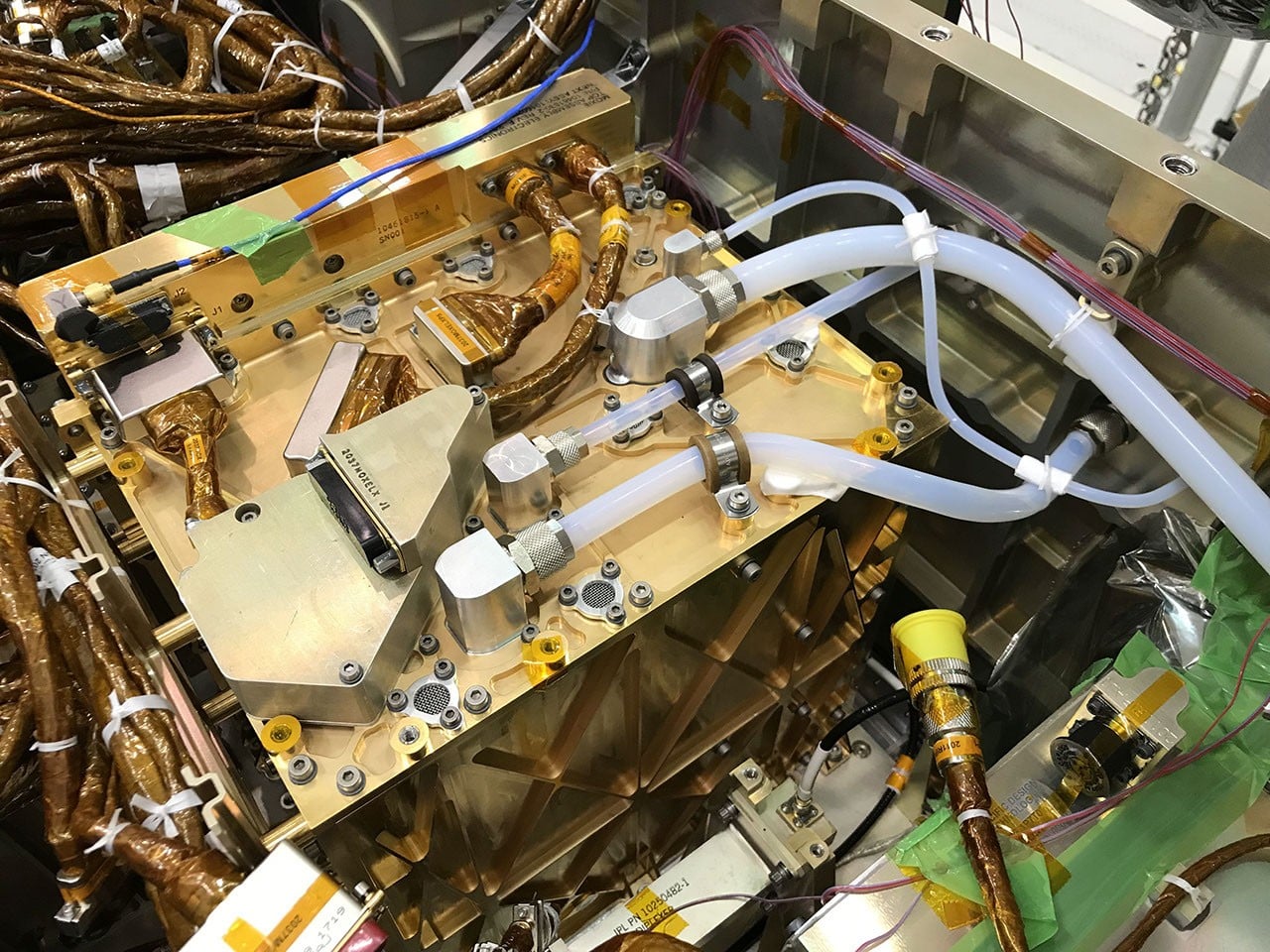
The headline calls MOXIE microwave-oven-sized. NASA’s own shorthand has varied over time: the 2021 announcement called it toaster-sized, while another agency page compares it with a car battery. The dimensions settle the friendly dispute. NASA lists the unit as 23.9 by 23.9 by 30.9 centimetres, with an Earth mass of 17.1 kilograms.
Small did not mean simple. Mars’s atmosphere supplied abundant carbon dioxide by proportion, roughly 96 per cent, but the atmosphere itself is tenuous. MOXIE could not passively breathe in a dense flow. A pump collected the thin gas, a filter protected the machinery from dust, and a compressor raised its pressure.
The gas then entered a Solid OXide Electrolyzer, usually shortened to SOXE. At around 800 degrees Celsius, the stack electrochemically removed an oxygen atom from each carbon dioxide molecule. Oxygen atoms combined into molecular oxygen, O2, while carbon monoxide left as an exhaust product.
Running an 800-degree process a short distance from other rover systems required careful thermal isolation. The unit used heat-resistant materials, including 3D-printed nickel-alloy components for the hot gas path and aerogel to reduce heat loss. A thin gold coating reflected infrared heat rather than allowing it to radiate towards Perseverance’s other hardware.
The rover supplied the shelter, power and computing around the experiment. MOXIE itself drew about 300 watts. A future oxygen plant standing alone on Mars would need those supporting systems too, which is one reason scaling the chemistry is only part of the task.
The oxygen was usable chemistry, not an operational supply
The word “usable” can do too much work if it is left undefined. MOXIE’s product was oxygen of measurable quantity and quality, the same molecule required for breathing and for oxidising rocket fuel. But the experiment was not connected to a life-support loop or propellant tank.
After measuring what it made, the system vented the oxygen back into the Martian atmosphere. The carbon monoxide and other exhaust products went out as well. No astronaut breathed those 5.4 grams, and no engine burned them.
That does not make the resource unusable. It identifies the precise level of the demonstration. MOXIE showed production at the point of need. It did not demonstrate collection, liquefaction, long-term storage, transfer or final consumption.
The peer-reviewed report on the first seven runs, published in Science Advances, said they marked the first time resource use in situ had been demonstrated on another planet. That is a stronger and narrower statement than saying humans had begun living off Mars. The machinery completed the conversion step with real Martian feedstock under real Martian pressure and temperature conditions.
Before that test, engineers had operated a close copy of MOXIE in a chamber on Earth that simulated Mars. Such work can validate design, but a chamber is still an argument about how faithfully Earth can reproduce another world. The first run replaced part of that argument with telemetry from Jezero Crater.
One historic run and a later endurance campaign answer different questions
It is easy to blend the 2021 milestone with everything MOXIE achieved afterwards. The first run answered whether oxygen could be produced at all after arrival. Later runs asked whether the method could repeat under changing seasons, atmospheric densities and times of day.
SpaceDaily’s earlier account of MOXIE’s complete 16-run campaign covers the broader result. By its final operation on 7 August 2023, the instrument had generated 122 grams in total. At peak performance it reached 12 grams per hour, double NASA’s original goal, with purity of at least 98 per cent.
Those numbers should not be folded backwards into the first hour. The 2021 run produced less and included deliberate changes in operating rate. Its importance was chronological: it crossed the boundary first. The later campaign supplied something the first test could not, evidence that the technique remained workable as Mars changed around it.
This distinction appears throughout exploration. A first operation retires the uncertainty of possibility. Repetition begins to address reliability. Neither one proves that the system is ready to carry human lives.
The largest oxygen customer on Mars would be the return rocket
Oxygen invites an image of astronauts breathing inside a habitat. For a crewed Mars architecture, however, lungs may represent the smaller demand.
NASA used a reference case in which four astronauts living and working on Mars for a year would consume about one metric tonne of oxygen. Getting the same four people off the surface could require approximately seven tonnes of rocket fuel and 25 tonnes of oxygen. The oxygen would be the oxidiser that allows the fuel to burn.
MOXIE therefore did not make rocket fuel, despite the shorthand sometimes used in popular descriptions. It made one side of a possible propellant combination. A mission using methane and oxygen, for example, would still need to bring or manufacture the methane.
The mass arithmetic explains why local oxygen is attractive. Launching tens of tonnes from Earth, landing it safely on Mars and keeping it available until departure would add mass and risk throughout the mission. Sending a smaller plant ahead to make oxygen from the atmosphere could replace some of that transported mass with time, electrical power and machinery.
NASA’s technology overview says a crew-scale generator would need to be roughly 100 times larger than the test model. Size alone is not the real specification. The plant would have to operate continuously enough to accumulate tonnes, then liquefy and store the product without unacceptable losses.
MOXIE proved a process, not a Mars base
A full production system would probably arrive before its crew. It would need to collect low-pressure air through dust, survive large temperature swings, manage high-temperature electrolysis and reject waste heat. It would require a substantial and dependable power source. It would also need enough autonomy to recognise faults and protect itself while Earth was minutes away by radio.
Only after making the oxygen would it face the parts MOXIE did not attempt: cooling the gas into liquid, maintaining a cryogenic store and transferring it to a vehicle. Mission designers would want compelling evidence that the return supply existed before committing astronauts to the surface.
None of this diminishes the experiment inside Perseverance. A technology demonstration succeeds by retiring a defined uncertainty, not by pretending the entire architecture has been built. On 20 April 2021, MOXIE established that a pump and solid-oxide stack could take the actual atmosphere of Mars and yield oxygen there.
The quantity was small. The system borrowed the rover around it. Every gram went back into the air. Yet the origin of those molecules made them different from oxygen carried across space from Earth.
For one hour on sol 60, Mars was not only a destination receiving supplies. It became the source of one.
