

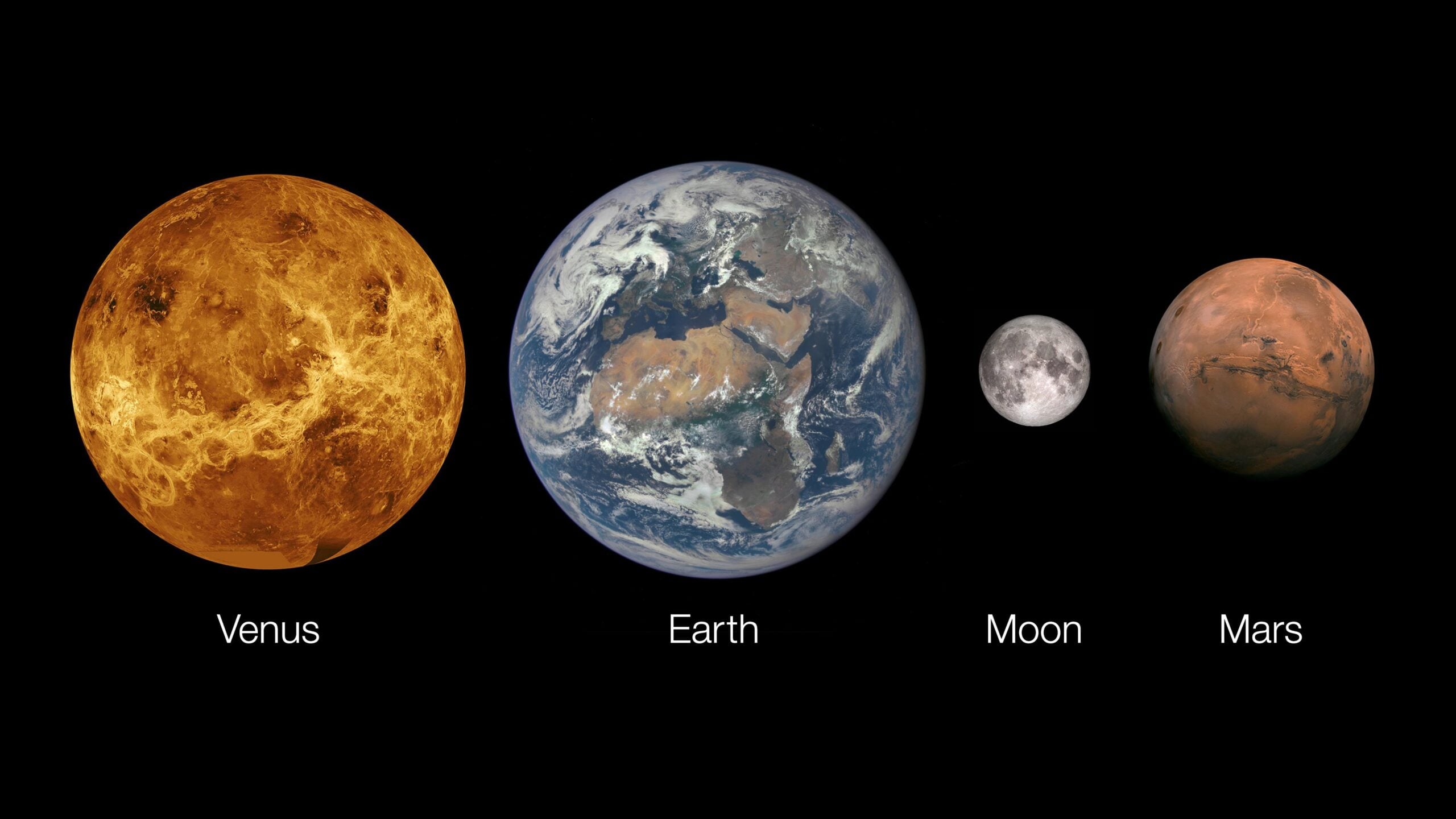
Mars and Venus offer one of planetary science’s cleanest warnings about percentages.
Carbon dioxide accounts for about 95.3 percent of the Martian atmosphere and 96.5 percent of Venus’s. Rounded to the nearest whole number, both are 96-percent carbon-dioxide worlds.
Stand at either surface, however, and the similarity disappears. Mars is a cold desert beneath air so thin that liquid water is unstable in most present conditions. Venus is hotter than Mercury and presses down with the force of an ocean nearly a kilometre deep.
Neither planet has an internally generated global magnetic field today. Both still lose atmospheric particles as sunlight and the solar wind act on their upper atmospheres. Yet Venus retains an enormous atmosphere while Mars has only a tenuous one.
That contrast does not make atmospheric escape unimportant. It shows why composition, climate, magnetism and loss cannot be reduced to one percentage or one missing shield.
Ninety-six percent says nothing about how much air there is
A mixing ratio describes how a gas is divided, not the total number of molecules above the ground.
Near Mars’s mean radius, surface pressure averages about 6.36 millibars, varying with elevation and season. Venus’s surface pressure is close to 93 bar. Put in the same units, the column pressing on Venus is roughly 15,000 times greater.
That makes the shared carbon-dioxide percentage less like two identical atmospheres and more like two containers filled with the same coloured liquid, one almost empty and the other under crushing pressure.
Nitrogen and argon also illustrate the trap. Nitrogen is only about 3.5 percent of Venus’s atmosphere, while nitrogen plus argon makes up only a few percent of Mars’s. Despite those modest shares, Venus has far more nitrogen in absolute terms than Earth, and vastly more than Mars, because its entire atmospheric reservoir is so large.
NASA’s Mars facts describe sparse air dominated by carbon dioxide, nitrogen and argon. Its Venus summary gives a pressure about 93 times Earth’s sea-level value and a surface temperature near 467 degrees Celsius. The headline’s 465 degrees is a reasonable rounded planetary average, not a universal temperature at every elevation and time.
The same greenhouse gas can sit over opposite climates
Carbon dioxide absorbs infrared radiation emitted by a planet’s surface. Calling it a greenhouse gas does not mean that a particular mixing ratio fixes a particular temperature.
Venus has an immense carbon-dioxide column, intense pressure broadening of absorption bands, sulfuric-acid clouds and continuous circulation through a deep atmosphere. It also orbits at 0.72 astronomical units, receiving almost twice the sunlight Earth receives. Heat is moved around the planet so effectively that the slowly rotating nightside remains extremely hot.
Mars orbits at 1.52 astronomical units and receives less than half Earth’s sunlight. Its atmosphere is too thin to supply a powerful global greenhouse, even though carbon dioxide dominates it. The ground can warm sharply in sunlight and cool rapidly after dark because there is little atmospheric mass to store and redistribute heat.
Carbon dioxide also changes state on Mars. A substantial portion of the atmosphere condenses as seasonal carbon-dioxide frost at the winter pole and returns to the air in spring, making surface pressure vary through the year. Venusian carbon dioxide remains part of a dense, hot fluid envelope near the surface.
So the climatic contrast is not “carbon dioxide worked on Venus but failed on Mars.” The relevant quantities include atmospheric mass, solar input, cloud physics, water, surface exchanges, pressure and the planets’ distinct histories.
No global dynamo does not mean no magnetic obstacle
Earth’s liquid outer core generates a large-scale dipole. Its magnetosphere meets the solar wind many Earth radii above most of the atmosphere, diverting much of the incoming plasma.
Venus has no detectable internally generated global field. Mars’s global dynamo ended billions of years ago, although intense magnetic patches remain frozen into ancient crust, especially in the southern hemisphere.
Neither world is simply bare neutral gas facing an unobstructed wind. Solar ultraviolet radiation ionises the upper atmosphere, making it electrically conductive. When the solar wind and its embedded magnetic field arrive, currents in the ionosphere slow and deflect the flow. The interplanetary field piles up and drapes around the planet.
The result is an induced magnetosphere with a bow shock on the sunward side, a heated magnetosheath around the obstacle and an elongated tail downstream. Venus’s barrier is largely ionospheric. Mars adds irregular crustal fields that can form local mini-magnetospheres and alter the routes particles take.
“No global magnetic field” is therefore accurate. “No magnetosphere” is not. The induced systems offer some deflection while placing the upper atmosphere close to the region where solar-wind energy and momentum are exchanged.
Mars leaks ions, atoms and occasional concentrated clouds
Atmospheric escape is a family of processes rather than one hole in the sky.
At Mars, sunlight can ionise carbon dioxide and its chemical products. Electric and magnetic fields then accelerate some ions into the magnetotail, a dayside plume or solar-wind pickup trajectories. Sputtering occurs when energetic particles strike the upper atmosphere and knock neutral atoms away. Photochemical reactions can give neutral oxygen atoms enough energy to escape without being guided by magnetic fields at all.
NASA’s MAVEN mission was designed to measure these present routes and connect them cautiously to the planet’s earlier climate. ESA’s Mars Express has supplied a longer record across changing solar conditions.
In 2026, joint MAVEN and Tianwen-1 observations directly connected Kelvin-Helmholtz plasma waves to escaping clouds of O+ and O2+. The waves form where faster solar-wind plasma shears past slower planetary ions. Space Daily’s report on the result explains the important scale distinction: local fluxes inside the clouds reached 10 to 100 times the average in familiar steady channels, but that is not 10 to 100 times the planet’s total loss.
The same paper places current oxygen escape near 6 × 1025 particles per second across major processes, with photochemical neutral escape contributing most of that estimate. The exact rate varies, and today’s thin atmosphere can limit the supply of ions available to remove.
Venus leaks from a reservoir that remains enormous
Venus sits closer to the Sun and encounters stronger solar radiation and solar-wind conditions than Mars. Its induced magnetic barrier nevertheless surrounds a far deeper atmosphere held by a planet almost as massive as Earth.
ESA’s Venus Express measured hydrogen, oxygen and helium leaving the planet. The approximate relationship between escaping hydrogen and oxygen pointed towards water as an important source of those particles, although reconstructing an ancient ocean from current escape remains model-dependent.
BepiColombo added another piece during its second Venus flyby on 10 August 2021. Its instruments detected cold O+ and C+ ions at about six Venus radii in a previously unsampled flank of the induced magnetic environment. The measured combined flux was approximately 4 ± 1 × 10⁴ ions per square centimetre per second at that location.
Space Daily covered the BepiColombo observations when the Nature Astronomy paper appeared. Carbon is heavier than hydrogen or oxygen, and the mechanism that lifted those cold ions to escape remained uncertain. Electrostatic fields, centrifugal effects and the structure of the magnetosheath are among the relevant possibilities.
Venus therefore is not retaining every molecule. It is losing particles continuously while maintaining a 93-bar atmosphere. A leak rate has meaning only beside the size of the reservoir, the rate of replenishment and the billions of years over which both changed.
A magnetic field changes escape; it does not switch it off
The simplest popular account presents a global dipole as a lid. Earth kept its atmosphere because it has one; Mars lost its atmosphere because it does not.
That account identifies genuine protective effects. A distant magnetopause prevents direct solar-wind pickup of much of the upper atmosphere and can reduce sputtering. It does not follow that a larger field always produces less total escape.
A magnetosphere intercepts the solar wind over a larger cross-section than the solid planet. Magnetic reconnection transfers some of that energy inward. Open field lines and polar cusps provide routes along which heated ions can flow out. Earth loses atmospheric ions through its polar regions despite its strong dipole.
A 2021 comparative review in Space Science Reviews described Venus and Earth as energy-limited ion-escape systems and present Mars as supply-limited. Its central conclusion was that an intrinsic dipole is not required to prevent stellar-wind-driven atmospheric loss, and in some circumstances a field can increase ion escape.
Space Daily’s earlier feature on the magnetic-shield debate made the paradox concrete: observations had found oxygen ions leaving Venus, Mars and magnetised Earth at broadly comparable rates. Those comparisons carry instrument and species limits, but they rule out treating magnetism as a binary atmosphere-preservation switch.
Neither present atmosphere is a record of escape alone
Mars is smaller than Venus, with about 38 percent of Earth’s surface gravity. Its interior cooled more rapidly, its global dynamo ended, and its volcanic replenishment diminished. Gas was lost to space, but carbon dioxide also became carbonate minerals, adsorbed into regolith and cycled into seasonal and permanent ice. Water remains in polar caps, buried ice, hydrated rock and possible deeper reservoirs.
Venus has about 90 percent of Earth’s surface gravity and a geologically active interior capable of outgassing. It retained carbon dioxide while becoming extremely dry. Hydrogen and oxygen escape matter to that history, but the present ion leak cannot by itself say how much water Venus began with or whether water was also consumed through reactions with crust and mantle.
The young Sun further complicates both stories. It emitted stronger extreme-ultraviolet radiation and a more active solar wind. The upper atmospheres, magnetic environments, volcanic supply and inventories of water and carbon were all different. Multiplying a modern escape rate by four billion years would manufacture precision rather than recover history.
Mars and Venus remain about 96 percent carbon dioxide because carbon dioxide dominates what each planet currently holds. That shared fraction hides nearly every quantity that controls climate. Their missing global fields likewise hide two active induced magnetospheres rather than magnetic emptiness.
Both worlds are leaking under the solar wind. One is nearly airless by terrestrial standards and the other has more atmosphere than its surface can comfortably bear. The difference is the clearest reason not to mistake atmospheric escape for planetary destiny.