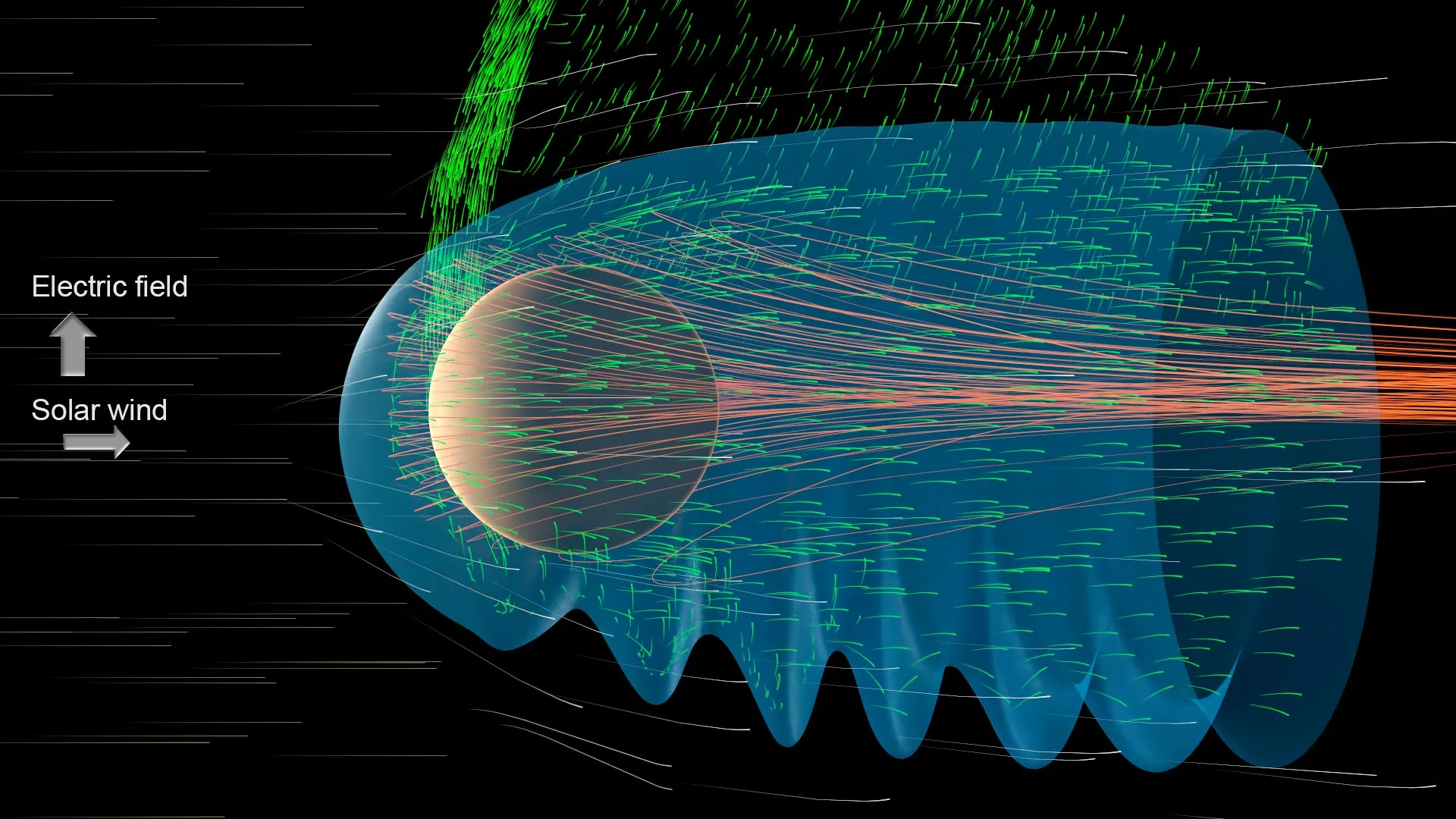
Mars is losing part of its atmosphere in clouds.
That is the clearest mental picture I took from a Boston University-led study published in Science Advances on 31 July 2026. The solar wind does not only encourage a steady outward leak of charged particles. Under the right conditions, its shear against the Martian plasma environment can raise rolling waves, gather oxygen-bearing ions into localised packets and carry them towards interplanetary space.
Inside those packets, the measured ion flux was 10 to 100 times the average flux found in Mars’s two familiar, quasi-steady ion-escape channels. That is a substantial enhancement. It is also a number that needs handling carefully.
The paper does not say that these events make Mars lose its entire atmosphere 100 times faster. It measures intense local fluxes inside transient structures, then uses an assumed geometry to estimate their total contribution. The distinction between those two claims is central to understanding what has actually been found.
Why Mars is exposed, but not magnetically empty
Earth has a global magnetic field generated inside the planet. It diverts much of the solar wind, the stream of charged particles and embedded magnetic field flowing out from the Sun.
Mars no longer has a comparable global dipole. It does have strongly magnetised patches of ancient crust, and the solar wind creates an induced magnetosphere when it meets the upper atmosphere. The boundary is therefore not simply bare air facing space. It is a changing plasma system draped in magnetic fields.
That nuance is useful because an intrinsic field is not a universal on-off switch for atmospheric survival. Venus also lacks an Earth-like dynamo yet retains an extraordinarily thick atmosphere. Planetary mass, atmospheric chemistry, solar radiation and multiple escape processes all matter. The 2026 study isolates one process operating within Mars’s induced system; it does not reduce the planet’s climate history to the absence of a shield.
At Mars today, the paper puts total oxygen escape near 6 × 1025 particles per second. Roughly 5 × 1025 of that is attributed to photochemical neutral escape, in which reactions in the upper atmosphere create energetic neutral oxygen atoms. Ion escape is a smaller part of the present total, although it may have been more important when the young Sun was more active.
A wave made by two flows sliding past
The mechanism has a familiar terrestrial analogy. Wind moving across water can make its surface roll. In a Kelvin-Helmholtz instability, neighbouring fluids moving at different speeds develop waves and vortices along their boundary.
At Mars, the relevant materials are plasmas. Fast solar-wind protons shear past slower, heavier planetary ions near the ion composition boundary, where solar-wind particles and ions from Mars’s upper atmosphere meet. The resulting nonlinear wave packets can distort the induced magnetic field, mix the populations and organise planetary ions into detached clouds.
The oxygen ions measured in this study were O+ and O2+. In one analysed event, molecular oxygen ions reached energies of about one kiloelectronvolt. The authors interpret the clouds not merely as containers but as structures involved in heating and accelerating atmospheric ions.
It took two spacecraft to separate cause from coincidence
Researchers had seen plasma clouds near Mars before. A 2016 MAVEN paper memorably described them as “plasma clouds and snowplows”, and a 2025 Nature Communications study led by the same first author reported anomalously strong, transient ion escape. What remained difficult was identifying where the clouds came from.
A lone orbiter moving through a dynamic environment has a basic problem. If it records a sudden change near Mars, was that a structure sitting in space, an event evolving in time, or a disturbance arriving in the solar wind? Without an upstream monitor, those possibilities can resemble one another in the data.
NASA’s MAVEN mission and China’s Tianwen-1 provided the required second viewpoint. When Tianwen-1 was upstream, it measured the solar wind and interplanetary magnetic field before they reached Mars. MAVEN could then sample ions, flow and magnetic fields closer to the planet at the same time.
In a representative interval on 31 July 2023, MAVEN crossed a series of clouds recurring about every two minutes. Tianwen-1 saw a broadly steady background field upstream. The clouds were therefore unlikely to be separate disturbances delivered ready-made by the solar wind. Their magnetic depletion, pressure changes, compressed upstream edges and vortex-like proton flows instead matched nonlinear Kelvin-Helmholtz wave packets generated at Mars.
Sixty-two events, all on one side
The team examined overlapping MAVEN and Tianwen-1 coverage from December 2021 to December 2023. It identified 16 isolated cloud events and 46 quasi-periodic events, 62 in all.
Every event in this selected sample appeared in what plasma physicists call the negative-electric-field, or −E, hemisphere. Most clustered near the terminator and nightside ion boundary, close to the centre of the draped magnetic field. The orientation of the solar wind’s motional electric field defines which side is −E, so this is a physical geometry rather than a permanent named half of Mars.
The authors argue that heavier planetary ions are accelerated differently on the two sides. In the −E hemisphere, a stronger velocity difference remains between planetary ions and the solar-wind protons. That makes conditions more favourable for the instability to grow. The events occurred over both strong and weak crustal fields, suggesting that local crustal magnetism was not their controlling factor.
“All” still refers to the 62 events that passed the paper’s selection criteria. Spacecraft coverage is incomplete, and detecting a cloud requires the right orbital position. The result establishes a striking asymmetry in this dataset, not a guarantee that no such structure could ever exist elsewhere.
What 10 to 100 times actually measures
For accepted events with suitable instrument coverage, most average escaping fluxes fell between 106 and 108 ions per square centimetre per second. The mean was 5.04 × 10⁷ for O+ and 3.62 × 10⁷ for O2+, while peak values approached 108 for both species.
For comparison, the paper gives an average of about 1.2 × 10⁶ ions per square centimetre per second in the magnetotail and 3.6 × 10⁵ in the dayside plume. The clouds’ local flux density is therefore roughly one to two orders of magnitude higher: 10 to 100 times.
But an intense patch is not a planet-wide rate. To turn flux per unit area into total escape, the area and duration of the structure have to be known.
The two-spacecraft geometry offered a useful constraint. In one case MAVEN saw an isolated cloud while Tianwen-1, only 0.56 Martian radii away, did not. That means the structure could be smaller than about 0.6 Martian radii, or roughly 2,000 kilometres, far below earlier single-point estimates of 2.5 to 6 Martian radii.
For a simple calculation, the authors treated a nonlinear wave packet as a cylinder with a radius of about half a Martian radius. Combining that geometry with a total heavy-ion flux near 108 per square centimetre per second produced an escape rate around 1025 ions per second. That is about ten times the dayside plume rate and comparable to the ordinary tail channel, not 100 times Mars’s total atmospheric escape.
There is a further unknown in the duty cycle. Plasma-cloud signatures on the MAVEN orbits before and after one quasi-periodic event suggest the instability can sometimes persist for at least eight hours. The observations do not yet establish how commonly that happens across seasons, solar conditions or longer spans of Martian history.
A new route out of the atmosphere, not the whole history
The geological importance is plausible but not measured directly here. Multiple lines of evidence show that early Mars had rivers, lakes, a thicker atmosphere and potentially habitable surface environments. It also once sustained an internal dynamo. The young Sun’s stronger extreme-ultraviolet output and solar wind would have made atmospheric escape more vigorous than it is now.
So a physical pathway that concentrates ion loss matters to models of how Mars changed. It may also operate at Venus and at unmagnetised rocky exoplanets. But this paper observes the present plasma environment, mostly through a two-year survey window. It does not calculate how much atmosphere Kelvin-Helmholtz waves removed over billions of years.
Nor did all of Mars’s water simply blow into space. As I discussed in an earlier SpaceDaily article on the fate of Martian water, a considerable fraction may be chemically locked into the crust, while other reservoirs may remain underground. Atmospheric escape is part of that history, not a complete accounting of it.
The next questions are therefore quantitative: which upstream conditions let these waves grow, how large and long-lived the packets are, how often they form, and how their integrated loss compares with the better-known channels. The Boston University material accompanying the paper says the researchers plan to combine further spacecraft measurements with simulations to answer them.
What the study changes now is the texture of atmospheric escape. Mars is not only bleeding ions in a thin, steady stream. Its plasma boundary can roll up under solar-wind shear, and for a while the loss leaves in concentrated waves.