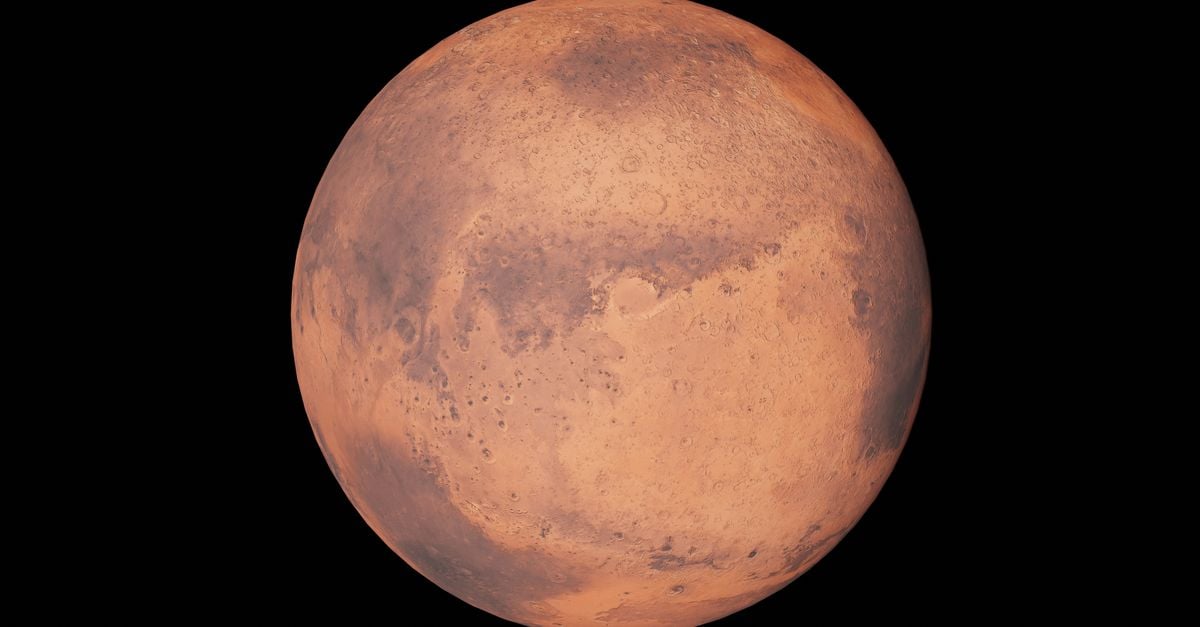
Mars today is a cold, dry desert with an atmosphere too thin to hold a puddle. It was not always this way. Billions of years ago the planet had rivers, lakes, rain and possibly an ocean across its northern lowlands.
That raises the obvious question, and it is one of the better mysteries in planetary science: where did all the water go? The answer, as it is emerging, comes in two very different parts.
I am a writer with a long interest in this beat, not a planetary scientist, so treat this as a careful reading of the evidence rather than expert testimony.
The wet Mars
The evidence that Mars was once wet is written into its surface. Orbiters and rovers have mapped dry riverbeds, branching valley networks, the flat floors of old lakes, and fans of sediment that can only have been laid down by flowing water. NASA’s Perseverance rover is currently working inside Jezero Crater precisely because it holds the delta of an ancient river, the kind of place where sediment, and any trace of past life, would have collected.
By the current reading of the record, liquid water was abundant and active on the Martian surface for the first several hundred million years, shaping the landscape until roughly 3.7 billion years ago. For that stretch, Mars was a genuinely watery world.
Then it dried out. The interesting part is that “dried out” turns out to mean two different things at once.
Part of it blew away
The first fate is loss to space, and it follows from something that happened deeper in the planet.
Early Mars had a global magnetic field, generated by a churning molten core, much as Earth’s is today. That field acted as a shield. Around 4 billion years ago, as the small planet’s interior cooled, the internal dynamo faded and the magnetic field collapsed. With the shield gone, the solar wind, the constant stream of charged particles from the Sun, could strike the upper atmosphere directly and carry it off, molecule by molecule.
NASA’s MAVEN mission was sent to measure exactly this, and it found the process still under way. Atmospheric gas is escaping Mars at a rate of roughly 100 grams a second, and the loss speeds up during solar storms. Run that backwards over billions of years and a great deal of the original air, and the water vapour it could once hold, simply bled away into space.
As the atmosphere thinned, the surface could no longer keep water liquid. What did not escape mostly froze, into the polar caps and the ground.
But a lot of it may never have left
The second fate is stranger, and it is where recent work has changed the picture. A study published in 2024 in the Proceedings of the National Academy of Sciences argued that much of Mars’s missing water may still be on the planet, just far underground.
The geophysicists Vashan Wright, Michael Manga and Matthias Morzfeld reanalysed seismic data from NASA’s InSight lander, which listened to Marsquakes for four years. As Physics World reported, the readings were best explained by a layer of fractured rock, saturated with liquid water, sitting in the middle of the Martian crust, somewhere between about 11 and 20 kilometres down. Their estimate was startling: enough water to cover the whole planet in a global ocean one to two kilometres deep, held in the cracks and pores of deep rock.
It is worth being careful here, because this is a model-based interpretation of indirect data, not a direct measurement of underground water. Later papers have argued the same seismic signals could be explained without a water-soaked crust. The finding is a strong and genuinely exciting hypothesis, not a settled fact, and even if it is right, the water sits kilometres below the surface, far out of any current reach.
Why this matters
Put the two fates together and Mars stops being simply a planet that lost its water. It becomes a planet that lost the ability to keep water on its surface, while quite possibly holding a great deal of it in hiding.
That distinction matters for the question that drives most Mars science, which is whether the planet ever hosted life, or still could. A warm, wet early Mars is a plausible cradle. A deep, wet crust, if it exists, is exactly the kind of stable, liquid environment where microbial life might persist long after the surface became hostile.
None of that tips into a claim that anything lives there. It is an argument about where to look. And it sharpens the contrast with the Mars we could actually visit, a surface I have written about as brutally hostile to human life, whatever is locked in the rock below.
What to watch
The near-term prize is the cache of samples Perseverance has been collecting in Jezero, which could confirm whether that ancient lake was ever habitable, if a mission can be funded to bring them home. Further out, resolving the deep-water question will take new seismic listening or, eventually, drilling.
For now, the honest summary is that Mars kept its secrets in two places. Some of its water is gone for good, scattered into space over billions of years. The rest, if the latest reading holds, is still down there, waiting far deeper than we can currently dig.