

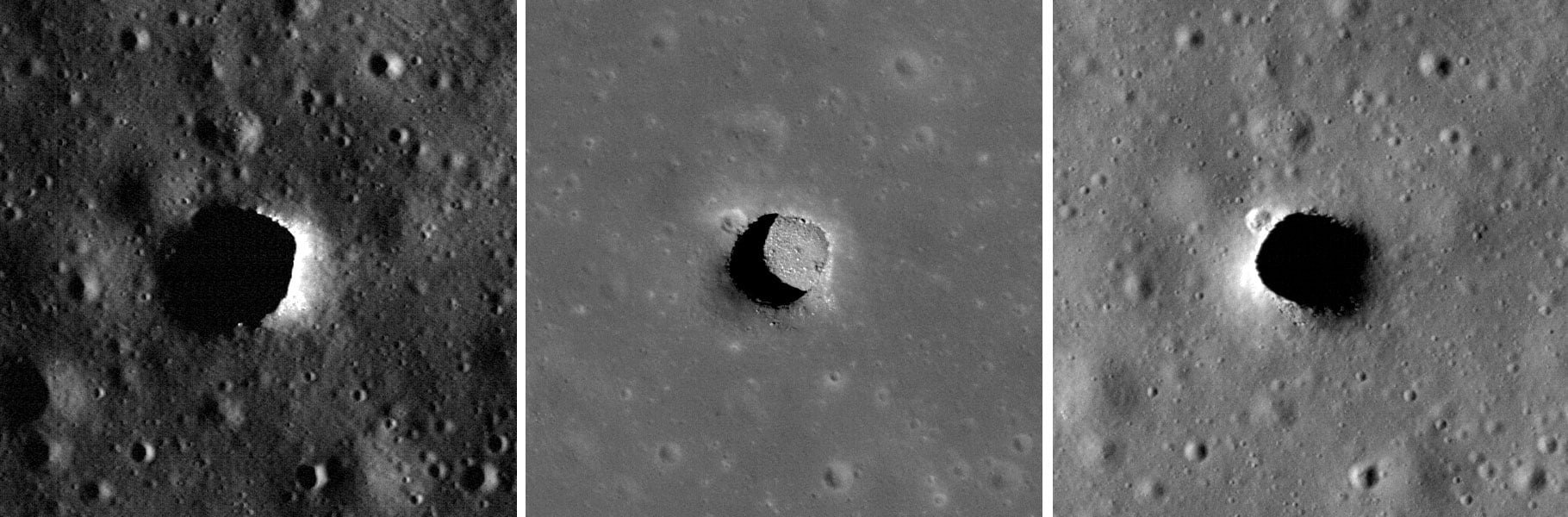
A dark opening in Mare Tranquillitatis has been visible in spacecraft images for years. What lay beyond its sunlit rim was harder to establish. It might have been only a deep collapse pit with an overhanging wall, or it might have provided access to a larger void.
Radar has now supplied the missing evidence. A reanalysis of observations made by NASA’s Lunar Reconnaissance Orbiter found a reflection extending beyond the part of the floor visible from above. Simulations showed that the signal is best explained by a cave conduit continuing underground from the base of the pit.
This is the first direct evidence that an accessible lunar pit opens into a cave. It does not reveal an underground city-sized chamber. The measured portion is only tens of metres long, and its full extent remains unknown.
The larger possibility comes from a different line of research. Models of rock under lunar gravity show that lava tubes kilometres across could remain standing under some conditions. A confirmed short conduit and a mechanically possible giant tube are both important, but they are not the same finding.
The hole was known before the cave was
Mare Tranquillitatis, the Sea of Tranquillity, is not a sea. It is a broad plain of dark basalt created by ancient volcanic eruptions on the Moon’s near side. Apollo 11 landed within the mare in 1969, although the pit lies roughly 370 kilometres northeast of the landing site.
Japan’s Kaguya spacecraft confirmed the pit in 2009. Later images from the Lunar Reconnaissance Orbiter, or LRO, showed a roughly 100-metre opening with steep or overhanging walls and a floor partly hidden by shadow and viewing geometry.
More than 200 pits have since been catalogued on the Moon. Some are simple collapse features. Others may be skylights, places where part of a cave roof fell in and exposed the void below. An overhead photograph can suggest an overhang, but it cannot follow a tunnel behind the wall.
That distinction explains why the 2024 result mattered. Scientists had persuasive geological reasons to expect lunar lava tubes, but a suspected skylight is not proof that a traversable conduit continues underground.
A 2010 radar pass carried the answer
The evidence came from the Miniature Radio-Frequency instrument, known as Mini-RF, aboard LRO. The radar illuminated the Mare Tranquillitatis pit during a 2010 observation and measured the energy scattered back towards the spacecraft.
Radar does not produce an ordinary photograph. Its echoes depend on surface angle, roughness, material and the path taken by the radio waves. At the pit, the researchers found a bright response on the side opposite the radar’s viewing direction that was difficult to generate from the known surface alone.
The international team built three-dimensional versions of the pit, sent simulated radar rays through them and changed the geometry of a possible hidden conduit. Models without a cave failed to reproduce the full observation. Models allowing radar to enter the opening, bounce from an underground floor or wall and return to orbit matched the unexplained signal.
The method was also checked against terrestrial lava-tube openings on Lanzarote, where radar observations could be compared with drone photogrammetry and underground lidar maps. That did not make the lunar reconstruction exact, but it tested whether the same kind of hidden space could produce the expected echo.
The resulting study in Nature Astronomy concluded that the pit leads into a cave conduit at least tens of metres long. NASA summarised the detected extension as more than 200 feet, or about 60 metres, from the base of the pit.
What has actually been mapped
Depending on the assumed slope, published reconstructions place the detected conduit at roughly 30 to 80 metres long. A commonly reported model is around 45 metres wide, while members of the research team have stressed that the true width could be larger.
Those figures describe the portion constrained by one radar observation. The signal may end because the cave ends, because the geometry stops reflecting energy back to the spacecraft, or because the radar cannot resolve what continues beyond it.
“Mapped” therefore means inferred by matching radar data to three-dimensional models. No camera has travelled along the cave. No lander has measured its walls, and no rover has tested the floor.
The cave interpretation is nevertheless stronger than a guess based on a dark photograph. A specific subsurface shape explains a repeatable radar anomaly, and the result survived peer review. Confirmation in remote planetary science often means converging physical evidence rather than a person or robot entering the feature.
Its origin is also described as probable rather than sampled fact. Mare Tranquillitatis is built from volcanic basalt, and the geometry resembles lava tubes on Earth, making an ancient drained lava conduit the leading explanation. Impact fracturing and later collapses may have modified the structure.
How a lunar lava tube forms
A fluid lava flow can cool first at its upper surface and edges. The hardened crust becomes an insulating shell while molten rock continues moving underneath. If the supply weakens and the liquid drains away, it can leave a long hollow passage.
Earth contains many such tubes, especially in basaltic volcanic terrain. They are usually limited to metres or tens of metres across because gravity loads the roof and broken rock eventually falls.
The Moon changes that balance. Surface gravity is about one-sixth of Earth’s, so each block in a cave roof weighs much less. The dry lunar environment also lacks rivers, rain, groundwater and biological weathering that can enlarge fractures and weaken terrestrial caves.
The absence of active erosion does not make a tube permanent. Moonquakes, thermal cycling and impacts can still fracture rock. The pit itself exists because some part of the roof failed.
Where the kilometre-wide claim comes from
A 2017 study in Icarus used finite-element models to ask how large an empty lunar lava tube could be before its roof failed. The team varied tube width, roof thickness and the initial stresses within basaltic rock.
Under favourable assumptions, the models allowed tubes a kilometre or more wide beneath roofs only a few metres thick. At the most expansive end, a tube about five kilometres wide could remain stable with roughly 500 metres of overlying rock and a near-lithostatic stress state.
That five-kilometre case also assumed a particular arched geometry, a three-to-one width-to-height ratio and rock properties appropriate to lunar maria. The result established mechanical plausibility. It did not show that eruptions ever produced a tube of that size or that one exists beneath Mare Tranquillitatis.
More recent work has made the picture less tidy. A 2024 analysis allowing irregular cross-sections found that variable geometry can reduce stability and that thin roofs are unlikely to support cavities hundreds of metres wide in many cases. Its estimates for tubes beneath several known skylights ranged from about 65 to 285 metres.
Both conclusions can be true. Lunar gravity permits much larger caves than are common on Earth, but maximum size depends sharply on roof depth, rock strength, shape, fractures and the stresses left behind as lava cooled.
Why an underground shelter is so attractive
The Moon offers no atmosphere thick enough to stop high-energy radiation or burn up micrometeoroids. Its surface also moves through a long day-night cycle that drives extreme temperature swings. A cave roof provides shielding simply by placing metres of rock between people and space.
Earlier SpaceDaily reporting examined thermal measurements of lunar pits, including evidence that permanently shaded areas can remain near 17°C while exposed terrain swings from intense heat to deep cold. The stable zone is not warm air. It is rock in vacuum whose temperature changes far less.
The same mass could absorb radiation and stop small, fast particles before they reach a habitat. That complements SpaceDaily’s recent analysis of micrometeoroid shielding for an Artemis-era base. Engineered shields can handle most surface impacts; an intact cave roof could provide a much deeper first layer of protection.
A large tube might also provide room for pressurised modules, laboratories, storage and roads without requiring every structure to carry its own blanket of excavated regolith. Even a smaller cave could shelter equipment or provide a protected construction site.
That is the origin of the settlement comparison. A tube hundreds of metres or kilometres across could contain an enormous usable volume. It is a statement about capacity in theory, not evidence that planners have found a cavern ready for occupation.
A cave is not a finished base
Any lunar cave remains a vacuum. Astronauts would still need sealed pressure vessels, oxygen, water, power, temperature control, radiation monitoring and reliable escape routes. Pressurising an entire natural cave would be far more difficult than placing smaller habitats inside it.
The roof would need structural assessment at scales orbital radar cannot provide. Loose blocks, hidden cracks and impact damage could turn a naturally shielded site into a rockfall hazard. Dust on the floor may be sharp, electrostatic and difficult to keep outside living areas.
Access may be the first engineering obstacle. The Mare Tranquillitatis pit is deep, its walls are steep, and the inferred conduit slopes away from the opening. Cargo systems would need to lower machines and people safely while maintaining power and communications below the rim.
The location also differs from the lunar south pole favoured by current exploration plans. Mare Tranquillitatis offers familiar terrain and an extraordinary cave target, but it does not provide the same access to persistently illuminated ridges or suspected water ice in permanently shadowed polar craters.
A useful cave must therefore be judged as part of a complete logistics system. Volume and shielding matter, but so do landing safety, sunlight, communications, resources, distance from other assets and the ability to evacuate.
The next visitor should be a robot
Orbital radar has taken the investigation as far as one distant viewing geometry allows. The next decisive measurements need to come from the rim and interior.
A surface mission could map the pit with lidar, ground-penetrating radar and high-resolution cameras. Tethered probes might descend the wall while relaying power and data to a lander above. Small autonomous robots could then measure the cave’s length, ceiling, boulder fields and branches.
Seismometers and gravimeters could search for voids beyond the visible conduit. Rock-strength measurements would test the assumptions used in stability models. Radiation and temperature sensors would show how much practical shelter the cave supplies through the lunar day.
Exploration would also answer scientific questions that have nothing to do with settlement. Exposed walls could preserve a vertical record of lava flows, revealing episodes of lunar volcanism that are difficult to separate at the surface. Protected material may retain a cleaner record of solar particles, impacts and volatile movement.
A doorway, not yet a destination
The Mare Tranquillitatis result closes one long-running question. At least one lunar pit is not merely a hole ending in rubble. It opens into a genuine subsurface conduit.
It leaves the larger questions open. Researchers do not know how far the cave runs, whether it branches, how sound its roof is or whether giant tubes predicted by mechanical models exist anywhere on the Moon.
The settlement idea belongs to that gap between confirmation and possibility. Tens of mapped metres demonstrate that natural underground shelter is real. Kilometre-scale models show that the Moon could, under the right geological conditions, hide spaces vastly larger.
Before anyone can call one of those spaces a home, a robot must cross the threshold and discover what the radar could not see.