
A future Moon base could be struck by micrometeoroids up to 23,000 times a year, according to a new modelling study. Read without context, that number sounds like an outpost being peppered into failure. It is not what the calculation says.
The figure counts contacts with the outside of a large notional structure, including particles with masses as small as one microgram. It does not mean 23,000 holes, emergencies or even visible scars. After the researchers applied a model of an aluminium Whipple shield, the estimated rate of particles capable of penetrating fell to between 0.024 and 0.037 per year. That works out to roughly one potential penetration every 27 to 42 years.
The analysis appears in a November 2025 arXiv preprint. Its authors describe the paper as submitted for publication, but the available version has not yet been peer reviewed. The results are therefore best read as an early engineering estimate, not a guarantee that a particular lunar habitat will survive for a particular number of years.
What 23,000 impacts actually means
The team modelled a rectangular structure measuring 100 × 100 × 10 metres, a footprint and scale they compared with the International Space Station. It is a convenient bounding shape for a calculation, not an approved NASA design for the lunar surface.
The simulated projectiles ranged from one microgram to 10 grams. At the small end, many would be better understood as tiny grains rather than miniature rocks. All were counted when they intersected the modelled exterior. That is why the annual total can be large while the dangerous subset remains extremely small.
Speed still makes even a small mass consequential because impact energy rises with the square of velocity. NASA says lunar meteoroids arrive at speeds from about 20 to more than 72 kilometres per second. The 72-kilometre-per-second figure is the upper end of that environmental range, not the typical speed of each of the 15,000 to 23,000 impacts and not a claim that every fast particle could penetrate a shield.
A thousand simulated bases around the Moon
The researchers used NASA’s Meteoroid Engineering Model 3, or MEM 3, to estimate the direction, speed and mass distribution of particles around the Moon. They placed 1,000 base locations across the lunar sphere using a Fibonacci distribution and sampled the environment at 30 points through a 27.2122-day lunar draconic period.
The calculation returned between 15,000 and 23,000 exterior impacts per year, depending on location. The team has also released the analysis code and input workflow, making it possible for other researchers to inspect the assumptions or test different configurations.
There is a spatial approximation built into the result. The simulation fixed the Moon in a J2000 orientation and did not include libration of up to about seven degrees. The authors estimate that this can shift an apparent surface location by roughly 200 kilometres, comparable with the separation between nearby simulated sites. The broad geographic pattern is more meaningful than a claim about one exact patch of ground.
Why the poles receive fewer impacts
The model produced its lowest annual rates near the lunar poles and its highest rate near the sub-Earth longitude, with about a factor of 1.6 between quieter and busier locations. That near-side maximum may sound counterintuitive. Earth can block trajectories, but its gravity also bends incoming paths and concentrates the flux. For this modelled micrometeoroid population, gravitational focusing outweighed geometric shielding.
The polar result is relevant because the lunar south pole is the focus of Artemis planning. NASA has studied the region in unusually fine detail and narrowed crewed landing options to nine candidate regions. A future sustained outpost may benefit from the lower background flux in the paper, but landing-site selection also depends on illumination, terrain, communications and access to scientifically valuable material.
Even within the study, the south-pole number is not a site forecast. It is a model result averaged over an assumed geometry and background environment. A final habitat could have a different area, orientation, distribution of modules and collection of vulnerable surfaces.
How a Whipple shield turns one projectile into a cloud
A Whipple shield does not try to stop a hypervelocity grain with a single thick plate. It places a relatively thin sacrificial bumper ahead of a stronger rear wall, with empty space between them. The initial collision fragments or vaporises the projectile and part of the bumper. The resulting debris cloud spreads before reaching the rear wall, distributing its energy over a much wider area.
Versions of this approach protect spacecraft from micrometeoroids and orbital debris. Inspection remains part of the equation because material, thickness and impact angle affect what damage looks like. NASA research discussed previously by SpaceDaily has examined ways to scan impact damage and verify material properties in space, work that becomes especially important when replacement panels are far from Earth.
The Artemis paper says specific shielding plans for a future lunar base are not yet known. Its authors therefore assumed an aluminium Whipple configuration informed by contemporary NASA spacecraft protection and used a ballistic-limit equation to ask which modelled projectiles could exceed that shield’s capacity.
Where 99.9997 per cent comes from
Under the paper’s assumptions, the median critical projectile mass was 10-1.16 grams, or about 0.069 grams. Approximately 99.9997 per cent of the simulated particles had masses below that derived threshold. This is the origin of the shielding percentage in the headline.
It is a population statistic, not a universal efficiency rating printed on a shield. The critical mass changes with impact speed, angle, density and shield construction. A particle below the median can still arrive under a more demanding combination of conditions, while one above it is not certain to penetrate under every combination.
A simple sampling calculation in the paper produced about 0.045 potential penetrations a year, or one every 22 years. When the team reran MEM 3 specifically for particles above the critical mass, it estimated 0.024 to 0.037 penetrating impacts per year across locations. The lower south-pole result corresponds to about one event every 42 years; the upper end corresponds to about one every 27 years.
What the model does not guarantee
MEM 3 is a practical engineering tool, but it is not a census of every future grain. The authors note that the model has historically reproduced spacecraft impact records within only a factor of about two to three. That range alone is large enough to matter when designing a habitat intended for long service.
The study describes the baseline sporadic environment. NASA notes that meteor showers can substantially increase lunar impact rates for a time. The paper also does not model a satellite or spacecraft breaking apart near the Moon, an event that could temporarily change the local population.
Other hazards sit beyond the headline calculation: secondary ejecta thrown up by nearby surface impacts, ageing materials, seams around windows and airlocks, shield degradation after repeated hits, exposed radiators, surface vehicles and spacesuits. The study also does not experimentally validate a finished Artemis habitat, because no such final habitat and protection system has been specified.
A design number, not a forecast of catastrophe
The practical lesson is that a dramatic exterior-contact count can coexist with a much smaller penetration risk. That does not make micrometeoroids unimportant. It turns the problem into a set of engineering choices about shield mass, acceptable risk, inspection, repair and redundancy.
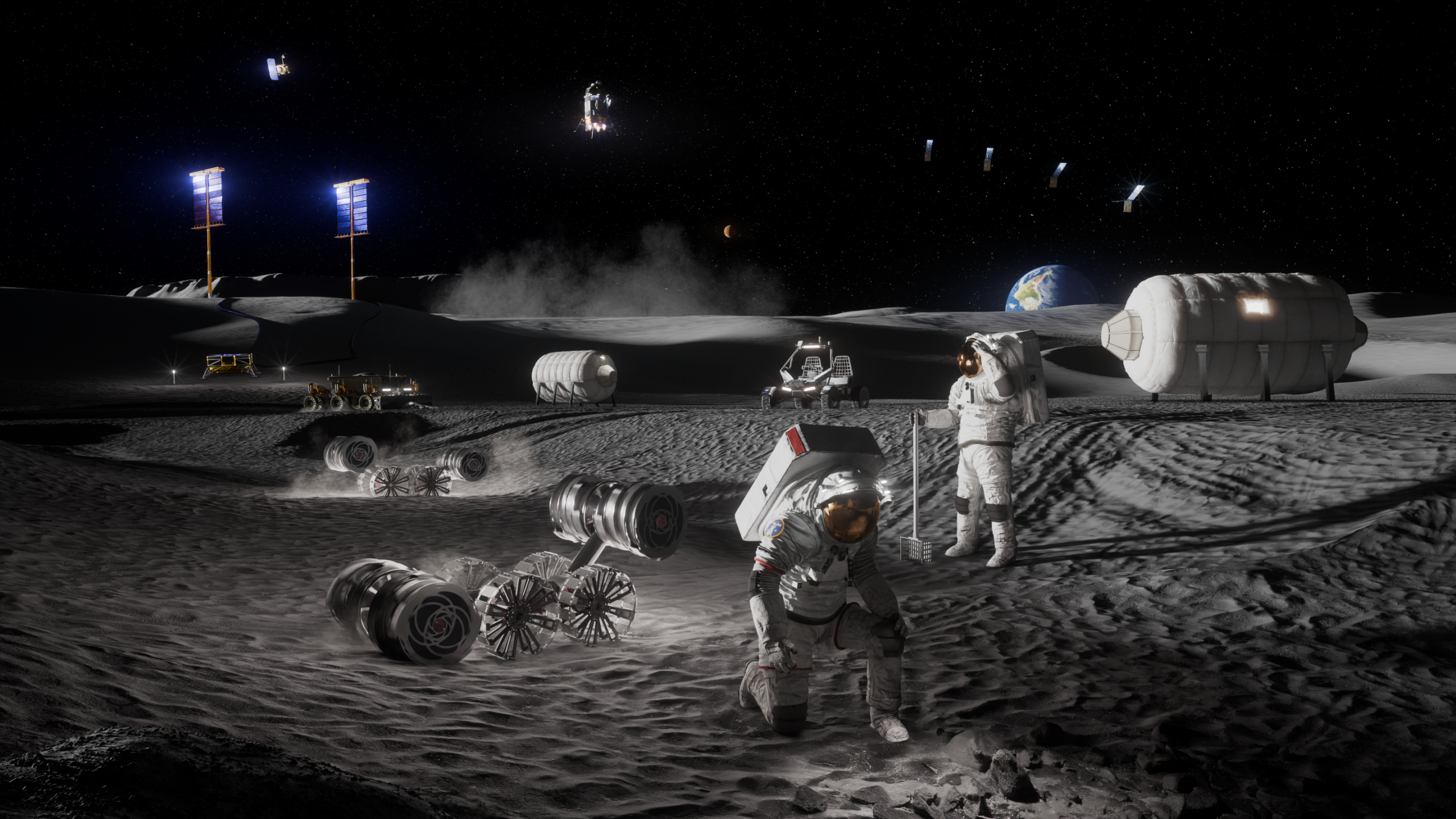
NASA’s current Moon Base concept imagery shows habitats, rovers, cargo systems, astronauts and power equipment spread across the surface. A real outpost will not be one simple rectangular box. Each element will present a different area, orientation, consequence of failure and opportunity for protection.
The important number is not 23,000 touches on the outside of a base. It is the much smaller, still uncertain rate at which a real shielded habitat might be penetrated, and the engineering work needed to keep that rate acceptably low.