

The Moon’s surface imposes a slow, punishing thermal cycle. A location in sunlight can reach about 127 degrees Celsius during a lunar day that lasts roughly two Earth weeks. Through the equally long night, exposed ground can fall to about minus 173 degrees.
Deep shadow changes that calculation. A team led by UCLA planetary scientist Tyler Horvath found that protected parts of certain lunar pits remain close to 17 degrees Celsius, with only small variation. Their modelling also predicts that a cave connected to such a pit could hold a similarly steady temperature throughout the lunar year.
That is a powerful argument for building below ground, where a natural rock roof can moderate temperature and screen other hazards. It is not evidence that NASA has chosen an underground base, nor proof that every lunar pit opens into a safe cave. The result identifies an unusually favourable thermal environment and a destination worth investigating.
The Moon’s long day drives the extreme swing
With almost no atmosphere to redistribute heat, lunar ground responds directly to sunlight and darkness. The Sun remains above the horizon for about 15 Earth days at many locations, then disappears for another 15. Loose regolith warms rapidly in daylight and radiates energy into space after sunset.
NASA uses the 127°C to minus 173°C range when contrasting exposed terrain with shaded pits. Actual temperature depends on latitude, slope, local time, rock abundance and illumination. The figures are representative surface extremes, not values reached by every point on the Moon.
A habitat on open ground must survive that cycling while keeping people, batteries, electronics and life-support fluids within narrower limits. Insulation, radiators, heaters and power storage all add mass. Repeated expansion and contraction also fatigue materials and connections.
A pit does not remove the vacuum, but its geometry changes which surfaces can see the Sun and cold space. That produces a natural thermal buffer before engineers add any machinery.
Diviner measured the pit, then models filled the darkness
Horvath processed observations from the Diviner Lunar Radiometer Experiment aboard NASA’s Lunar Reconnaissance Orbiter. Diviner measures infrared energy emitted by the surface, allowing scientists to infer temperature. It has mapped the Moon through repeated day and night passes since LRO entered orbit in 2009.
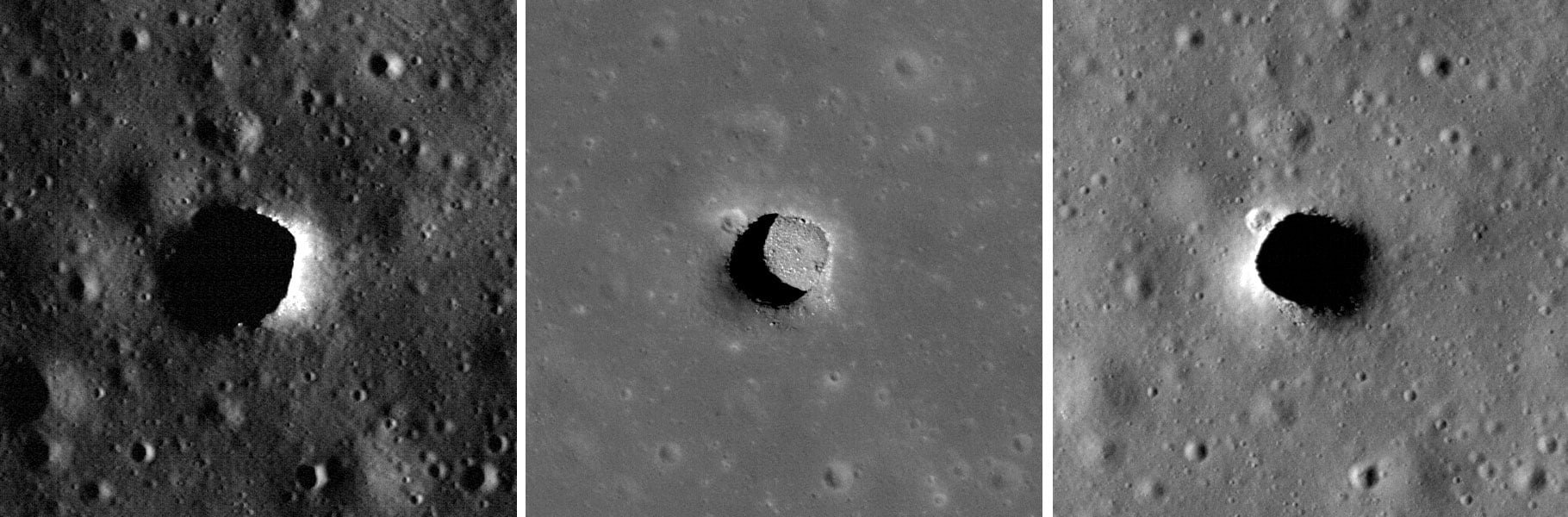
The study concentrated on pits in Mare Tranquillitatis and Mare Ingenii. The Tranquillitatis feature is near the equator and roughly 100 metres deep, with a floor about the length and width of a football field. Its walls, sunlit floor and shadowed overhang generate a thermal pattern that Diviner can distinguish even though the pit is smaller than an individual measurement footprint.
The peer-reviewed Geophysical Research Letters study matched those observations with two-dimensional simulations of rock, regolith, sunlight and radiative heat exchange. The results showed that visible pits remain much warmer at night than surrounding terrain. They also predicted that material beyond the opening in permanent shadow would remain near 290 kelvin, approximately 17°C.
That number is not a thermometer reading taken inside an underground chamber. Diviner cannot look sideways beneath an overhang. The 17°C cave environment is a model result constrained by orbital thermal data, while the shaded pit signature is observed. A future robot would need to carry sensors below the rim to test the prediction directly.
A lunar cave behaves like a radiative cavity
The steady temperature is not supplied by geothermal warmth or an atmosphere. It emerges from geometry. An exposed surface has a broad view of the Sun in daytime and a broad view of cold space at night. Inside a cave, most surfaces see other rock.
Heat absorbed near the entrance is exchanged among walls, ceiling and floor. Rock stores heat more effectively than fine lunar dust, and the opening provides only a limited path through which radiation can enter or escape. When the internal area is large compared with the skylight, the cave approaches a nearly uniform radiative equilibrium.
This same geometry creates extremes elsewhere in the pit. The paper calculates that sunlit surfaces within the Tranquillitatis pit can exceed 415 kelvin because reflected and emitted energy becomes partly trapped. “The pit is 17°C” is therefore too broad. The mild zone lies in permanent shade and in a sufficiently large attached cavity, not across every wall and floor.
The UCLA account describes the protected region as lunar “sweater weather”, an intuitive comparison for temperature alone. An unpressurised vacuum at 17°C remains instantly lethal to an unprotected person.
The openings may lead into ancient lava tubes
Pits were first identified on the Moon in 2009. Some occur in impact melt, while a smaller group in volcanic plains probably formed when sections of lava-tube roof collapsed. Molten rock once flowed beneath a hardened crust; after the flow drained away, it left a tunnel that could persist for billions of years.
Orbital images reveal overhangs at several mare pits. The Lunar Reconnaissance Orbiter Camera gallery shows that the Tranquillitatis pit floor extends at least 25 metres beneath the visible surface. That proves a recess, not a vast continuous tunnel. The void could end shortly beyond the imaged area.
Researchers have catalogued hundreds of lunar pits, but only a minority appear likely to be collapsed lava tubes. A 2022 morphology survey emphasised the major unknowns: the size and stability of each void, its formation history and whether a robot can reach it safely.
Earlier SpaceDaily reporting examined candidate skylights near the lunar north pole. The warm pits in the UCLA work are low-latitude features, so their settlement advantages must be weighed against the polar access to water ice and prolonged sunlight that drives many current exploration plans.
Natural shelter reduces risk but does not make a base
Temperature is only the first advantage. A sufficiently thick roof could reduce exposure to galactic cosmic rays, solar particle events and micrometeorite impacts. It could also limit contamination by electrically charged dust lofted near the surface and protect equipment from direct ultraviolet radiation.
Every benefit introduces an engineering question. A pit may have unstable walls or loose boulders. Landing beside it and lowering tonnes of habitat hardware through a narrow opening could be harder than placing modules on level ground. Crews would need reliable access, lighting, communications, emergency escape and structural maps.
The cave contains no breathable atmosphere. Turning part of a lava tube into one pressurised room would require seals able to withstand outward force across cracks and porous rock. A more likely early approach would place conventional pressure vessels inside the shelter, using the cave as a protective outer building rather than attempting to fill the whole void with air.
Power also becomes complicated underground. Solar arrays need exposure above the rim, with cables or stored energy brought down to the habitat. Water and other resources may be distant. These constraints are why the headline says humanity’s first permanent lunar address “may” be underground rather than predicting that it will be.
A robot must inspect the address before anyone moves in
The next decisive measurement cannot come from a conventional overhead image. A robotic scout could descend by tether, rappel down a wall or deploy small hopping and rolling machines. It would map the void with lidar and radar, measure radiation and temperature, inspect fractures and determine whether the cave continues beyond the entrance.
Later thermal modelling has expanded the question to latitude, pit shape and the survival of volatile compounds. A 2023 study of lunar pit environments showed that not all caves share the same conditions and that colder high-latitude locations may preserve ice even when equatorial caves offer milder habitat temperatures.
The scientific reward would extend beyond settlement. Lava-tube walls may expose stacked flows that record the Moon’s volcanic history. Shielded surfaces could preserve ancient material with less disturbance from impacts and radiation. A cave mission would study both a potential home and an archive.
Seventeen degrees Celsius makes the darkness inviting, but it is only a calculated starting point. Before the first permanent lunar address can be written below ground, a robot must discover whether there is a stable room at the end of the shaft.