

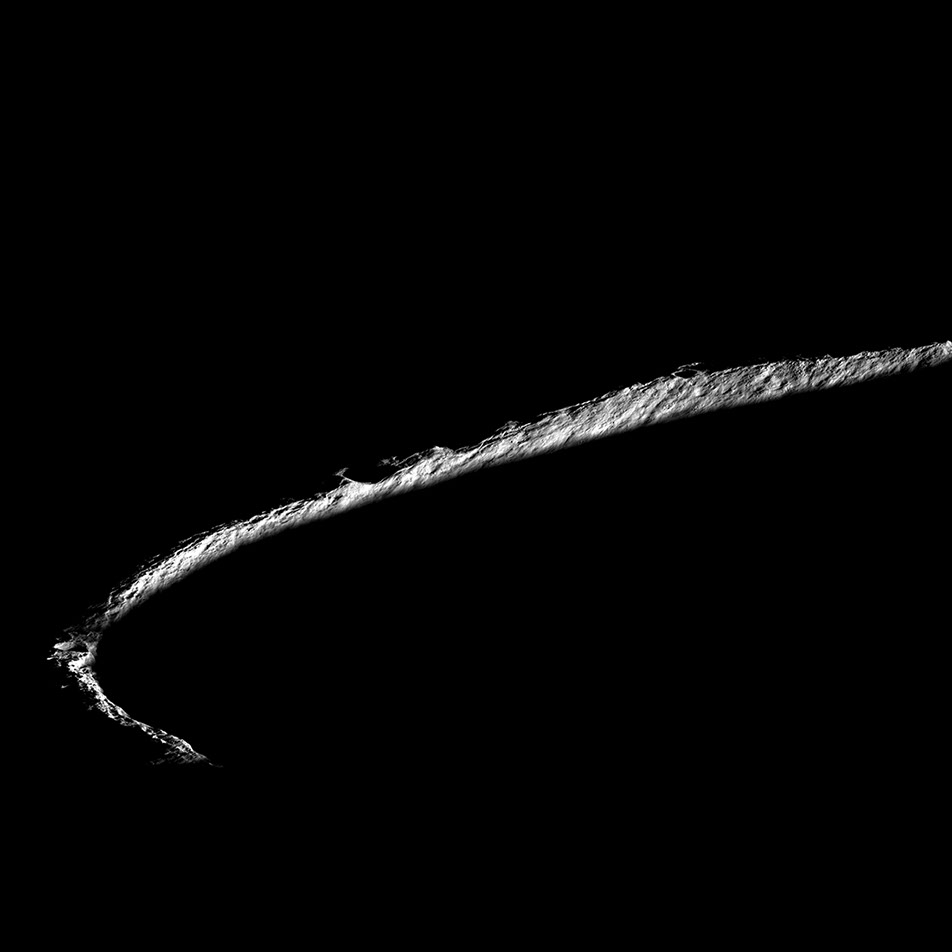
China has built Chang’e‑7 around a boundary only a small machine may be able to cross: from lunar ground selected partly for sunlight into a crater interior where direct sunlight never arrives.
The mission is more than a rover. Its main spacecraft comprises an orbiter, lander, rover and mini-flying probe, usually described as a hopper. The surface elements are intended for the Moon’s south-polar region, and Chinese mission papers increasingly place the work around Shackleton crater. The hopper would leave illuminated terrain, enter permanent shadow and analyse a soil sample for water and other volatile compounds.
But this is now a spacecraft waiting on Earth, not an experiment operating on the Moon. On 23 August 2026, two days before this article was scheduled, Chinese authorities said Chang’e‑7 did not meet launch conditions and could not fly in its planned window this year. They did not identify a technical cause or announce a replacement date.
The delay makes precision especially important. The vehicle has been built and its scientific plan is unusually ambitious. It has not landed, its hopper has not entered Shackleton, and no Chang’e‑7 measurement has yet confirmed ice there.
Chang’e‑7 divides one investigation among five platforms
Chang’e‑7 belongs to the fourth phase of China’s lunar exploration programme, following missions that demonstrated orbiting, landing, roving and sample return. Its communication relay is Queqiao‑2, launched in March 2024. The main probe adds the orbiter, lander, rover and mini-flying vehicle.
A mission overview in National Science Review lists 18 scientific payloads distributed across those five platforms. The arrangement is not decorative complexity. It allows the mission to connect regional context with measurements taken at individual pieces of ground.
The orbiter is meant to survey surface composition, topography, temperatures, magnetic and plasma conditions, and the distribution of hydrogen and other elements. The lander can remain at a fixed reference point. The rover can inspect accessible terrain around it. The hopper is reserved for the place where wheels, sunlight and ordinary thermal design begin to fail.
That layered approach addresses a persistent problem in lunar science. An orbital neutron detector can reveal a hydrogen-rich area tens of kilometres wide, but not necessarily whether a particular square metre contains frost, buried grains, hydrated minerals or ice-cemented soil. An in-place analyser can answer a narrower question at one location, while the orbiter shows how representative that location might be.
Shackleton offers light and darkness almost side by side
Shackleton crater is roughly 21 kilometres across and lies almost exactly at the lunar south pole. The Moon’s rotational axis is tilted by only about 1.5 degrees, compared with Earth’s 23.4 degrees. The Sun therefore stays close to the lunar polar horizon rather than climbing high through the sky.
Topography turns that grazing light into a sharp patchwork. Peaks and raised sections of Shackleton’s rim can see the Sun for unusually long periods. Much of its deep interior receives none. NASA’s illustrated description of the crater says three points on the rim are collectively illuminated for more than 90 per cent of the year, while the interior is perpetually shadowed.
Space Daily’s earlier examination of the Moon’s 354-hour night and south-polar illumination explains why “near-continuous” is not the same as continuous. Distant peaks can block the low Sun. A promising site still needs batteries, heaters and survival plans for darkness. Illumination also varies with the exact slope and season.
Shackleton is consequently a compelling candidate rather than a publicly fixed landing coordinate. Chinese presentations in 2023 placed the pre-selected region near Shackleton and Shoemaker craters and said the specific site remained under study. More recent instrument work describes exploration around Shackleton’s rim, while a 2026 conference abstract says the hopper would compare sunlit ground with permanent shadow there. “Probably close to Shackleton” is a fair reading of the public plan. “Definitely landing at a published point beside Shackleton” would go beyond it.
A hopper can cross terrain that a rover may not
The word “hopper” can suggest a spring-powered jump. Chang’e‑7’s mini-flying probe is closer to a small powered spacecraft capable of taking off and landing at selected points. Chinese researchers have described active shock absorption to help it touch down on sloping terrain.
That mobility answers a geometric problem. A wheeled rover descending toward a permanently shadowed crater may encounter steep slopes, loose regolith, rocks and darkness that makes both navigation and power difficult. The hopper does not make those hazards disappear, but it can avoid having to drive a continuous route through all of them.
The scientific payload is a Lunar soil Water molecule Analyser, abbreviated LUWA in recent papers and also rendered LSWMA in earlier English-language work. According to a 2026 calibration paper in the Chinese Journal of Space Science, its operational chain would drill or collect soil, seal the sample, heat it and analyse the gases released.
Three analytical systems share the work. A tunable-diode laser spectrometer is designed to measure water and hydrogen isotope ratios. A time-of-flight mass spectrometer can separate molecules by mass. A differential optical absorption instrument adds another way to identify volatile species. The designers have tested a complete sequence with simulated lunar soil because each transfer step can lose water or alter the apparent concentration.
Earlier prototype work described samples from the surface or from drilling as deep as one metre. That is an instrument capability and collection concept, not a promise that every hopper stop will produce a one-metre core. Power, temperature, slope, soil behaviour and the vehicle’s actual condition would determine what can be attempted after landing.
Remote sensing found the case for ice, not a uniform glacier
The search does not begin from zero. Lunar Prospector detected suppressed neutron counts near the poles, a signal consistent with hydrogen in the upper soil. Chandrayaan‑1 data identified exposed water-ice signatures in some cold polar pixels. The Lunar Reconnaissance Orbiter mapped temperatures, reflectance and hydrogen-related patterns. In 2009, NASA’s LCROSS mission struck Cabeus crater and detected water in the excavated plume.
Together, those results make polar water ice a well-supported conclusion. They do not show a clean sheet of ice beneath every permanently dark crater. The deposits appear patchy, and their physical form remains one of the important unknowns. Water might coat individual grains, fill pores, cement regolith together, form small buried concentrations or exist at levels too low for practical recovery.
The difference matters because “hydrogen detected from orbit” and “water ice measured in a sealed soil sample” are not interchangeable statements. Hydrogen can occur in hydroxyl bound to minerals, in molecular water or in ice. A neutron detector has a broad footprint and does not directly see a crystal of H2O. LUWA is intended to heat actual material and measure what comes out.
It is also why a single successful sample would not map the entire crater. The result would describe one location and one depth interval. The orbiter and rover could provide context, and multiple hopper measurements would improve the picture, but the south pole would remain a large and uneven landscape.
The oldest ice question is subtler than the oldest crater
The title’s reference to ice surviving since before animals appeared on Earth is physically plausible, but it needs a boundary. No sample from Shackleton has been dated, and the age of a crater is not automatically the age of every molecule trapped inside it.
Water reaches or forms on the Moon through several routes. Comets and hydrated asteroids can deliver it in impacts. Ancient lunar volcanism released gases from the interior. Hydrogen in the solar wind can react with oxygen in surface minerals. Once liberated, a water molecule may make short ballistic hops across the surface until sunlight destroys it, it escapes to space or it lands in a place cold enough to hold it.
Permanent shadow has its own history. A 2023 Science Advances reconstruction of ancient lunar lighting found that most present-day permanently shadowed area appeared within the past 2.2 billion years, after changes in the Moon’s orbital and rotational state. Shackleton may contain an exceptionally old cold trap, but even its shadow evolved.
A 2026 Nature Astronomy study using ultraviolet starlight reflected from polar shadows added observational evidence. Older permanent shadows tended to contain a larger exposed-ice fraction. The authors concluded that lunar polar ice has accumulated over at least about 1.5 billion years rather than arriving entirely in one recent event.
Animals have existed for hundreds of millions of years, so material retained for one or several billion years would indeed predate them. Yet a cold trap can gain, lose, bury, excavate and remix ice over time. Some molecules may be ancient, others recent. Establishing an origin requires composition, geological context and isotope measurements, not age by association.
An isotope ratio can narrow the source without naming it perfectly
LUWA’s measurement of deuterium relative to ordinary hydrogen is central to that origin question. Different reservoirs and chemical processes can leave different D/H ratios. Cometary water, water released from the Moon’s interior and water assembled partly from solar-wind hydrogen need not look identical.
The result will not be a simple barcode. Sources overlap. Water can migrate and fractionate as it freezes, warms or escapes. Impacts overturn the regolith and mix material from different times. The instrument itself must correct for water lost during sampling, transfer and heating, which is why the ground calibration work pays so much attention to memory effects and background contamination.
The practical interest is easier to state but harder to realise. Water can supply drinking water, oxygen and hydrogen. Space Daily previously looked at laboratory efforts to release water from Chang’e‑5 soil and feed it into useful reactions. A confirmed ice-bearing sample at the pole would still be many engineering steps away from an economical resource. Machinery would have to excavate, heat and process abrasive soil in extreme cold while receiving little or no solar power.
In that sense, Chang’e‑7 is first a prospecting and origin mission. It may inform later use, including China’s planned International Lunar Research Station and the follow-on Chang’e‑8 technology mission, but its analyser is not a production plant.
The launch delay freezes the most important verb in the future tense
China’s recent lunar record explains why the mission attracts attention. Chang’e‑4 made the first soft landing on the far side. Chang’e‑5 returned young basalt from the near side. In 2024, Chang’e‑6 brought back the first samples from the far side, a sequence described in Space Daily’s account of that 1.9-kilogram return.
Chang’e‑7 attempts a different kind of first for the programme: matching wide orbital surveys to direct chemical measurements from a permanent shadow near the south pole. The hopper is the hinge in that design. Without it, the best-lit landing terrain and the coldest scientific target remain separated by a difficult descent.
The official postponement notice was only two sentences long. It said the mission had failed to meet launch conditions after a comprehensive assessment made in the interest of prudence, reliability and mission success. It did not say whether the limiting condition was weather, the Long March 5 rocket, the spacecraft or something else. Reports that assign a cause are therefore interpretations unless China releases more detail.
The careful status is simple. Chang’e‑7 has been built, integrated and prepared for a south-pole mission. Shackleton is the strongest publicly documented target region, not a final coordinate disclosed to the world. The hopper is designed to enter permanent shadow and search for water ice, but it has not performed that flight. The 2026 launch window has passed, and the next attempt has not been officially dated.
If the mission eventually reaches the crater, its best result need not be a photogenic block of ice. A thin frost, ice-cemented grains, a buried concentration, an unexpected isotope ratio or even a carefully bounded absence at one site would all improve the map. The point of sending the hopper into the dark is to replace a broad signal seen from orbit with material that can be drilled, heated and measured.