
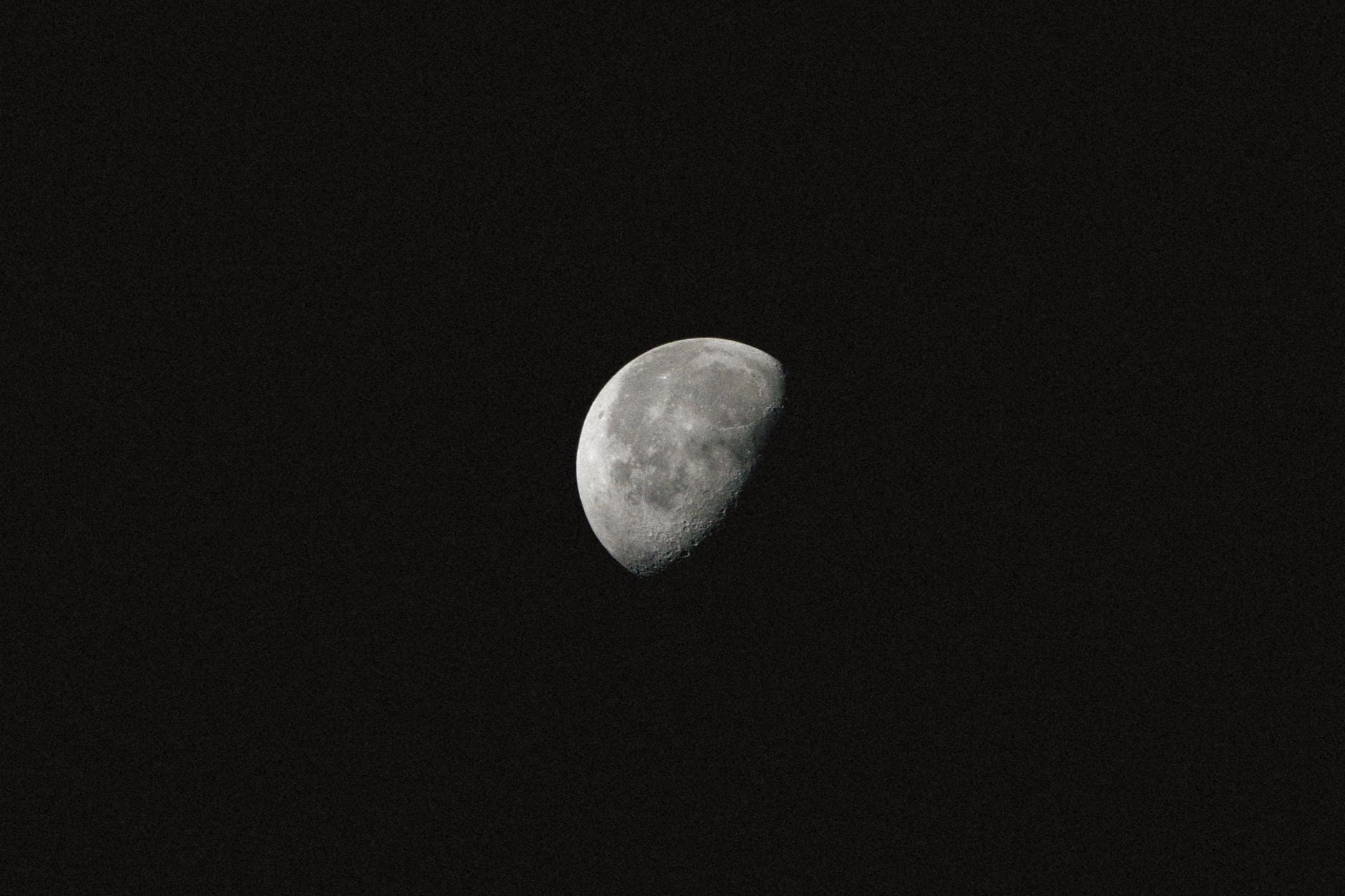
Researchers working with material returned by China’s Chang’e-5 mission reported on 16 July 2025 that they had used concentrated light to release water from lunar soil and feed it directly into reactions producing oxygen, hydrogen and carbon monoxide.
The result, published in the journal Joule, was a laboratory demonstration, not a water-and-fuel plant operating on the Moon. Its significance is more precise: the team joined lunar water extraction and chemical conversion inside one photothermal process, reducing the number of separate stages that a future lunar installation might need.
Sunlight supplied the heat, while lunar soil did two jobs
The paper by Junchuan Sun and colleagues describes a reactor that concentrates light and converts it into heat. Heating releases water associated with the soil. Components of the regolith, especially the iron-titanium mineral ilmenite, then help catalyse reactions between that water and carbon dioxide.
The products were oxygen, hydrogen and carbon monoxide. Oxygen could serve life-support systems, once purified to the required standard, and is also the oxidiser that accounts for most of the mass in many chemical propellant combinations. Hydrogen can itself be used as fuel. Hydrogen and carbon monoxide together form synthesis gas, a feedstock that can be converted into other fuels.
That chemistry is why the result is commonly described as producing breathable oxygen and rocket fuel. The distinction is worth keeping: the experiment produced oxygen and fuel ingredients. It did not fill and qualify a rocket’s propellant tanks, and it did not show that the gases were ready to breathe.
Carbon dioxide is another input. The Moon has no useful ambient atmosphere from which to collect it, so the paper envisages using carbon dioxide recovered from astronauts’ exhaled air. In outline, the loop is elegant. Sunlight supplies energy, regolith supplies water and catalytic minerals, and a habitat supplies waste carbon dioxide that would need to be removed from its air in any case.
Chang’e-5 returned dry soil that was not entirely waterless
Chang’e-5 landed in northern Oceanus Procellarum in December 2020 and returned 1.731 kilograms of material to Earth. Subsequent measurements established that this mid-latitude soil was very dry by terrestrial standards but contained hydrogen-bearing species.
A 2022 study in Nature Communications reported a mean hydroxyl content of 28.5 parts per million at the landing site. A separate in-situ analysis in Science Advances estimated values up to 120 parts per million in nearby regolith. Those measurements do not describe a buried lake. Lunar water can occur as hydroxyl or molecular water associated with minerals and glass, while richer ice deposits are thought to exist in some permanently shadowed polar regions.
The 2025 team analysed allocated Chang’e-5 material and conducted feasibility work with simulated Chang’e lunar soil. Returned samples are too scarce to consume freely in large reactor trials, so simulants remain necessary. Real soil ties the chemistry to an actual lunar composition; simulant tests show how the proposed process behaves with more material. Neither, on its own, reproduces operating machinery in lunar vacuum and gravity.
The $83,000 gallon is an illustrative launch estimate
The Joule paper says that lifting one gallon of water into space costs about $83,000. A US gallon of water has a mass of approximately 3.8 kilograms, so the estimate corresponds to roughly $22,000 per kilogram.
It should not be read as a current universal tariff for delivery to the Moon. The real cost varies with the launch vehicle, destination, payload configuration and accounting method. Sending a useful payload to the lunar surface also involves more than reaching low Earth orbit. The $83,000 figure is best understood as the study’s estimate of the mass penalty, not a standing price offered by a launch provider.
The underlying argument remains sound. Water is heavy, crews need it continuously, and some of it is also an input for oxygen and propellant. Every kilogram produced locally is a kilogram that may not have to travel through Earth’s gravity well, leaving launch capacity for equipment that cannot be made from lunar soil.
NASA groups this work under in-situ resource utilisation, or ISRU. Its programme targets local production of water, breathable air, propellants and construction material. NASA also says the location, concentration and accessibility of lunar volatiles are not yet characterised well enough to design extraction systems with confidence.
A chemistry result still needs a mine, refinery and storage system
The authors explicitly say their current catalytic performance is insufficient to support human life beyond Earth. They identify low gravity, radiation, severe temperature changes and non-uniform regolith as barriers. Crew-generated carbon dioxide may also be too limited to support all the oxygen and fuel production that a base would require.
A working plant would need to excavate and move abrasive dust without ruining bearings or seals. Its concentrators and optical surfaces would have to remain clean. Gases would have to be separated, measured, purified, compressed or liquefied, and stored through long temperature cycles. Equipment would need to operate remotely and survive failures without a repair depot nearby.
Water quality is a system problem of its own. A NASA assessment of propellant production from lunar water treats extraction, capture, filtration, purification, electrolysis and gas drying as connected steps. It notes, for example, that proton-exchange-membrane electrolysers require highly purified and deionised water, while solid-oxide systems can accept less-pure water but operate at much higher temperatures.
The Sun team’s integrated process does not remove all of that infrastructure. It suggests that the front end could be simplified because the soil is not merely discarded after heating. The same material can be a water source, a solar heat absorber and a catalyst for making useful gases.
What would count as the next result
The next persuasive step is not another claim about lunar self-sufficiency. It is sustained operation in a chamber that reproduces lunar vacuum, dust behaviour, radiation exposure and temperature cycling, followed by a small surface demonstration with measured energy use and product purity.
NASA’s PRIME-1 mission showed in March 2025 how unforgiving that transition can be. Its drill and mass spectrometer operated after landing near the lunar south pole, but the lander came to rest on its side and its surface mission lasted about ten hours rather than the planned ten days. The instruments worked, yet the mission did not confirm local lunar water.
That is the scale of the distinction. The July 2025 paper established a credible piece of chemistry using lunar material, sunlight and carbon dioxide. It did not eliminate the need to ship water from Earth today. It showed why, if engineers can turn the reactor into a durable end-to-end system, future crews may one day ship much less of it.
