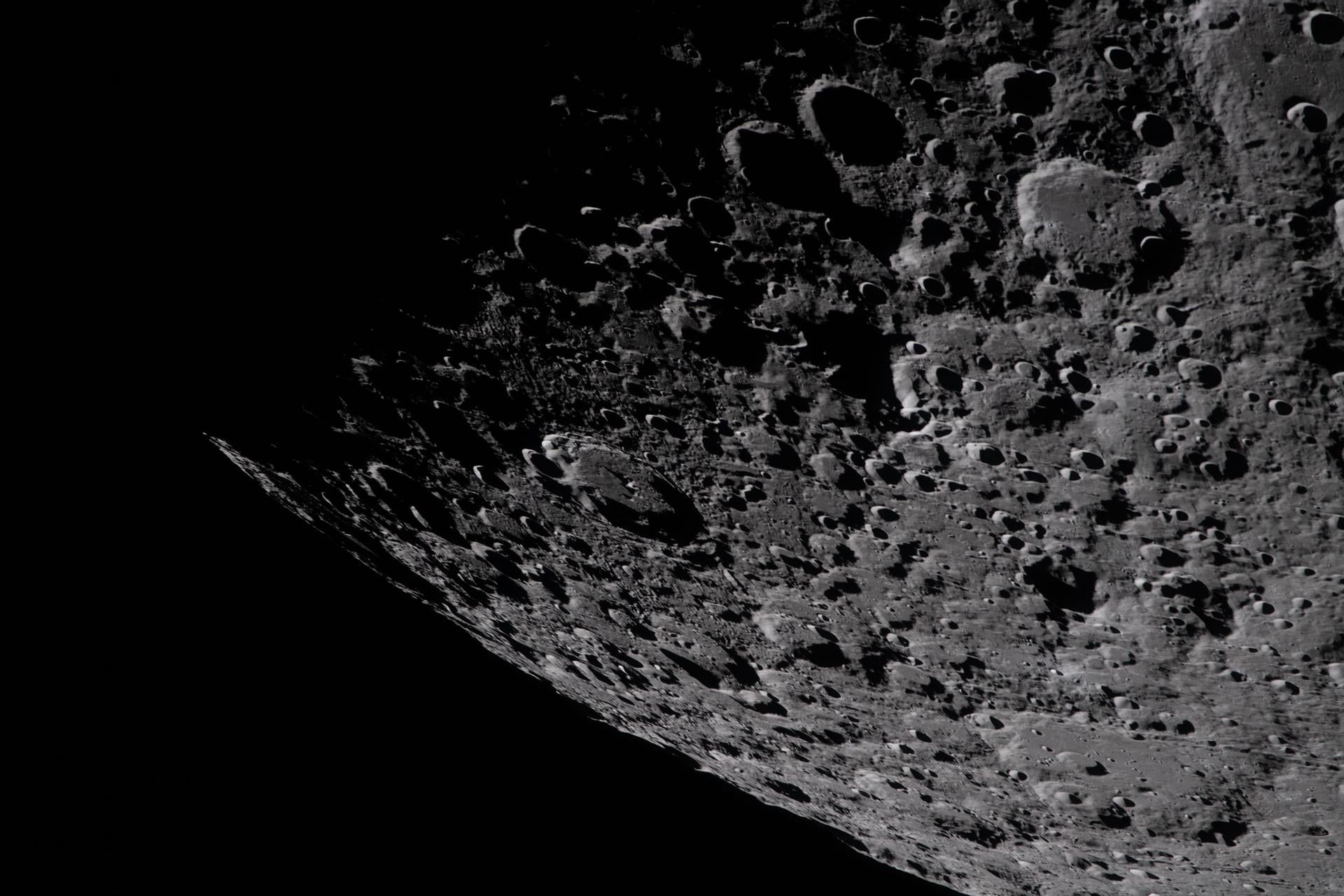
A lunar sunset is less like the end of an Earth day than the start of a two-week emergency. Across most of the Moon, the Sun then remains below the horizon for about 354 hours. A machine that lands just after dusk does not need to survive one cold night. It must endure nearly 15 Earth days without sunlight.
That one fact reaches into almost every part of a lunar mission: battery mass, heater design, landing date, operating schedule and the odds that a spacecraft wakes up again. It also explains why engineers keep studying narrow ridges and raised ground near the lunar south pole, where local terrain can keep the Sun in view far longer than it would be elsewhere.
Why a lunar night lasts 354 hours
The Moon takes about 27.3 days to rotate relative to the distant stars. But while it rotates, the Moon and Earth are also moving around the Sun, so it takes about 29.5 Earth days for the Sun to return to the same point in the lunar sky. A NASA thermal-design paper puts that solar cycle at roughly 708 hours: about 354 hours of daylight followed by 354 hours of darkness at ordinary lunar locations.
This is more than an elegant bit of orbital arithmetic. It becomes the clock around which surface missions are built. When I wrote about Chandrayaan-3’s landing in the southern lunar highlands, one detail that stayed with me was how its lander and rover campaign was designed for one lunar day, roughly 14 Earth days. On the Moon, daylight is an operating season.
There is no single lunar-night temperature
NASA’s broad Moon Facts guide says the surface can fall to about −173°C in darkness. A current NASA lunar weather explainer, meanwhile, gives about −133°C for equatorial night and temperatures below −246°C inside deep, permanently shadowed polar craters.
Those numbers are not really competing answers. Temperature depends on latitude, slope, local time, the physical properties of the regolith and exactly what an instrument or model is measuring. The Moon has no substantial atmosphere or ocean to redistribute heat. Once sunlight disappears, the upper surface loses energy by radiation while the shallow subsurface responds more slowly.
So −173°C is a useful broad lunar-night benchmark, not a temperature stamped across the whole Moon. The real thermal environment has to be calculated for the precise landing site and mission season.
The south pole breaks the simple day-night pattern
The Moon’s spin axis is tilted by only about 1.5 degrees. Near the poles, the Sun consequently skims around the horizon instead of rising high overhead. A ridge can catch that grazing light for long stretches, even while the floor of a neighbouring crater never sees direct sunlight at all.
I find it most useful to picture the south pole not as a bright cap, but as a tightly folded patchwork of light and shadow. NASA’s current south-polar environment guide describes rare areas with extended illumination and milder temperature ranges, alongside deep shadows, steep slopes and rough terrain. The same geometry that offers solar power also makes landing and navigation harder.
Near-continuous sunlight is not eternal sunlight
The romantic old phrase “peaks of eternal light” hides too much engineering detail. NASA’s long-term south-pole illumination mapping says very few sites receive near-continuous sunlight. Whether a point is lit depends on centimetres and metres of elevation, the height of a solar panel, the surrounding horizon and where the Moon is in longer cycles that alter the Sun’s apparent path.
An older NASA study of candidate sites around Shackleton crater makes the limitation concrete. In its worst-case analysis, one promising site averaged 71 per cent illumination over a lunar day, while proposed systems still required enough stored energy to cover dark intervals of roughly 73 to 117 hours, depending on the configuration.
That is much easier than 354 hours, but it is certainly not eternal.
Why engineers still want the bright ridges
Every extra hour of sunlight is an hour when solar arrays can generate electricity and heaters do not have to lean as heavily on stored power. Longer-lit ground can reduce battery mass, soften temperature swings and give robots or crews more time to work. Its proximity to permanently shadowed craters also matters because those cold traps may preserve water ice and other volatile material.
But a site cannot be chosen by illumination alone. The low Sun throws long shadows that can conceal rocks and distort slopes. A narrow ridge with excellent sunlight may offer nowhere safe to land, while a smooth plain may sit in darkness too long. Communications with Earth, access to scientific targets and the route between them all have to fit the same map.
Sunlight reduces the storage problem; it does not remove it
Even at a carefully selected polar site, batteries, regenerative fuel cells or another source must bridge the inevitable gaps. NASA’s current lunar surface technology work includes both energy storage and fission surface power, which can operate regardless of sunlight. A durable outpost may ultimately use several of these systems together rather than betting everything on one unusually bright ridge.
The south pole is attractive not because lunar night vanishes there, but because the right patch of terrain can turn a 354-hour blackout into a series of shorter, manageable interruptions.
Mission planners are not looking for endless daylight. They are looking for darkness they can engineer around.