

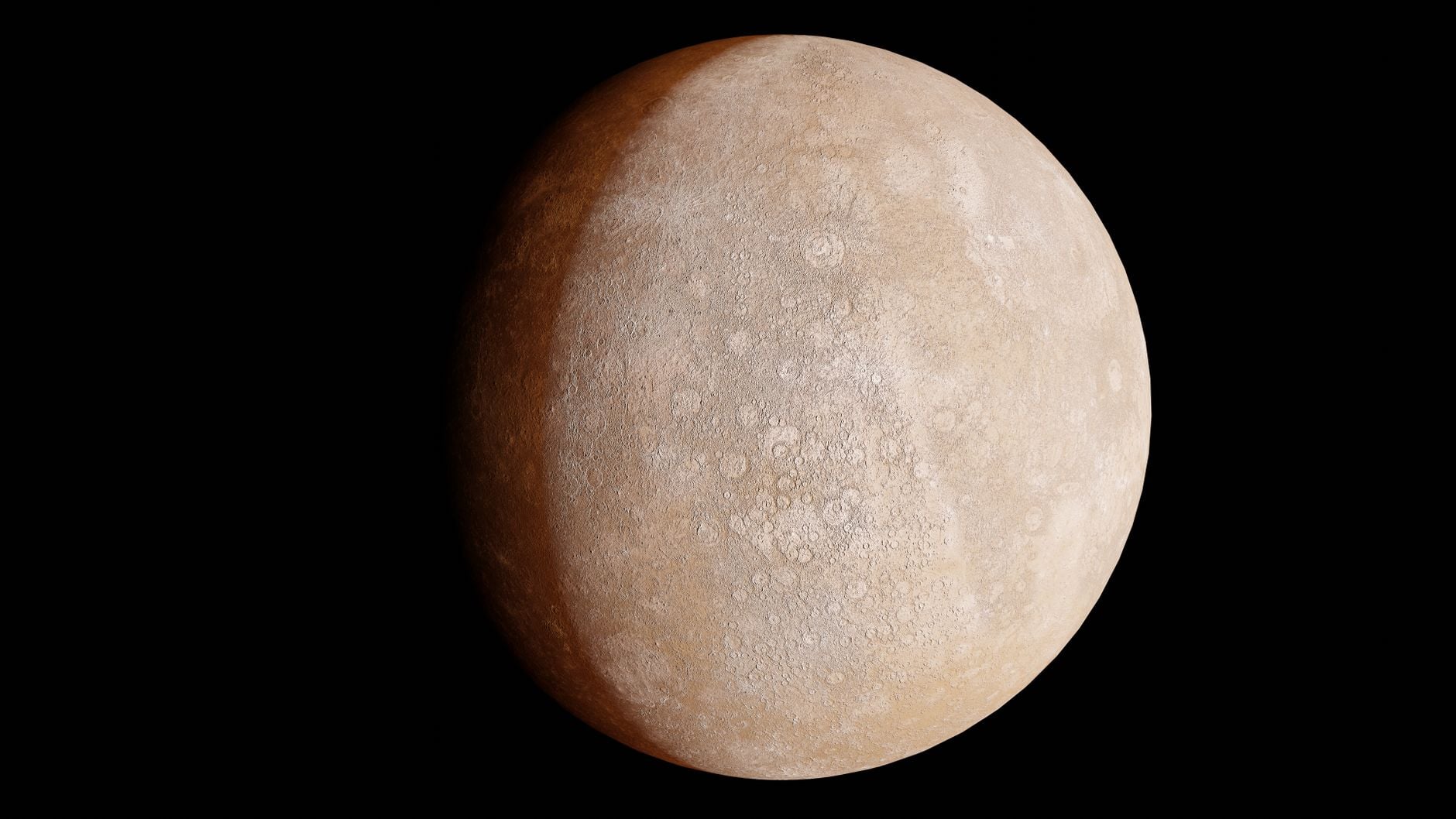
BepiColombo reached Mercury for the first time in October 2021. Then it left. It returned in June 2022, June 2023, September 2024, December 2024 and January 2025, passing close enough on the final visit to photograph crater floors near the planet’s north pole.
After all six encounters, the spacecraft still did not enter orbit.
That is not a record of failed arrivals. Each pass was a precisely aimed braking manoeuvre in an eight-year effort to make arrival possible. The joint European-Japanese mission launched on 20 October 2018 and is now scheduled to enter Mercury orbit on 21 November 2026. By then it will have completed one Earth flyby, two at Venus and six at Mercury, as well as years of low-thrust electric propulsion.
The oddity is that Mercury is not especially far away by planetary standards. The problem is the Sun. A spacecraft going inward falls faster and faster, while Mercury is too small to capture a visitor that comes racing past.
A spacecraft carries Earth’s orbit with it
When a rocket leaves Earth, it does not begin from rest beside the Sun. Earth is travelling around our star at about 29.8 kilometres per second, and the departing spacecraft inherits almost all that sideways motion. It starts in a heliocentric orbit much like Earth’s, even after it has escaped Earth’s local gravity.
Mercury follows a much smaller and more eccentric orbit. Its average distance from the Sun is only about 39 per cent of Earth’s, and it moves at roughly 47.4 kilometres per second on average. Reaching that inner path requires BepiColombo to reduce its orbital energy and angular momentum. In the simplest terms, it must brake against the direction in which Earth carried it.
Braking near Earth lowers the opposite side of the spacecraft’s solar orbit. It then falls towards the Sun, converting gravitational potential energy into kinetic energy as it goes. The craft can therefore have less total orbital energy and still be moving faster at Mercury’s distance. ESA’s explanation of why Mercury takes so long to reach compares the journey to falling down a cliff millions of kilometres high while trying to land softly on a moving target partway down.
The apparent paradox disappears once the frame of reference is named. “Faster” might mean speed around the Sun. “Slow enough” means speed relative to Mercury at the meeting point. BepiColombo needs plenty of heliocentric speed because Mercury itself is moving quickly, but the two velocity vectors must be close enough in both size and direction for the planet and the spacecraft’s engines to complete capture.
Crossing Mercury’s orbit is not the same as arriving
A fast journey is possible if the spacecraft only has to pass Mercury. NASA’s Mariner 10 reached the planet 147 days after launch in 1973. It made three flybys and continued around the Sun, providing the first close images but never becoming a satellite of Mercury.
An idealised transfer illustrates the difficulty. If Earth and Mercury had circular, coplanar orbits and a spacecraft followed the lowest-energy transfer ellipse between them, it would reach Mercury’s distance moving at roughly 57 kilometres per second around the Sun. A circular Mercury at that distance moves at about 48 kilometres per second. The difference is close to 10 kilometres per second even before the real planet’s eccentric orbit and encounter geometry are considered.
Mercury’s escape speed at the surface is only about 4.3 kilometres per second and weaker higher up. Its gravity can bend an incoming path, but it cannot simply swallow a spacecraft arriving with a large excess velocity. Without enough propulsion to remove that speed, the vehicle swings past and leaves again. Carrying the propellant for a single immense braking burn would require more tanks, which require more launch mass, which in turn requires still more propellant.
The first spacecraft to solve this problem and remain was NASA’s MESSENGER. Its six-and-a-half-year journey used one Earth flyby, two at Venus and three at Mercury before orbit insertion in March 2011. The history makes BepiColombo’s long cruise less anomalous. Mercury is nearby enough to visit quickly, but expensive enough in velocity change that orbiters take the scenic route.
Nine flybys turned planets into a braking system
BepiColombo’s sequence began with Earth on 10 April 2020, followed by Venus on 15 October 2020 and 10 August 2021. Six Mercury encounters then followed between October 2021 and January 2025. The complete route combines those nine flybys with solar-electric thrust arcs from the Mercury Transfer Module.
A gravity assist is often described as a slingshot that makes spacecraft faster. That is only half the technique. It can add or remove heliocentric energy depending on which side of a moving planet the spacecraft passes and the direction of the encounter.
In an idealised planet-centred view, BepiColombo falls towards the planet, speeds up, curves around it and slows by the same amount while climbing away. Its incoming and outgoing speeds far from the planet are almost equal, but the direction has changed. The planet itself is moving around the Sun, so changing the direction of the spacecraft’s planet-relative velocity changes the combined velocity seen from the Sun. ESA’s gravity-assist guide describes the result as an exchange of orbital energy with the planet.
The exchange does obey conservation of momentum. Earth, Venus or Mercury receives the energy BepiColombo sheds, but the planet is so much more massive that its resulting change cannot be usefully measured. For a four-tonne spacecraft, the same transaction can substantially alter the size and period of its solar orbit.
By the fourth Mercury flyby, the goal was to bring BepiColombo’s orbital period around the Sun close to Mercury’s 88 days. The fifth and sixth encounters refined the route and set up the final approach. In January 2025, SpaceDaily covered the sixth Mercury pass, when the spacecraft came within 295 kilometres of the surface and completed its ninth planetary gravity assist.
The faint blue engines worked between the encounters
Planetary flybys are powerful but intermittent. Their dates and geometry are set by the movement of entire worlds. Between them, BepiColombo needed a much finer and more persistent way to reshape its trajectory.
The Mercury Transfer Module carried four QinetiQ T6 solar-electric thrusters. Power from large solar arrays ionised xenon gas, and electric fields accelerated the positively charged ions out of the engines at very high speed. The exhaust produced a faint blue glow. Each engine’s push was tiny compared with a chemical rocket, but it could be sustained for weeks or months while using relatively little propellant.
The mission accumulated more than 15,000 hours of electric-propulsion operations. Rather than perform one dramatic burn, it applied a small velocity change continuously, adjusting the timing and location of the next planetary encounter. A missed flyby by even a modest distance could put the spacecraft on the wrong side of the planet or leave it unable to reach the following appointment.
That system also explains why the cruise became longer than originally planned. In April 2024, engineers found unexpected electrical currents between the transfer module’s solar array and its power-distribution unit, leaving less power available to the thrusters. ESA’s flight-dynamics team designed a lower-thrust route that preserved the scientific mission but moved orbit insertion from December 2025 to November 2026.
As SpaceDaily reported during the fourth Mercury flyby, the revised path sent BepiColombo only 165 kilometres above the surface, 35 kilometres closer than the earlier plan. The encounter and the final two flybys supplied some of the trajectory change the weakened electric system could no longer provide on the original schedule.
At 15:24 Central European Summer Time on 15 June 2026, the transfer module’s ion engines switched off permanently. ESA’s current arrival update says the long low-thrust cruise is complete. From here, the mission changes from gradual orbit shaping to a sequence of separations and chemical-engine manoeuvres.
Orbit insertion is a three-month arrival, not one finish line
BepiColombo is commonly discussed as one spacecraft, but the cruise stack contains several. ESA’s Mercury Transfer Module has carried ESA’s Mercury Planetary Orbiter, or MPO, and JAXA’s Mercury Magnetospheric Orbiter, called Mio. A sunshield and interface structure protects Mio during the journey.
On 3 September 2026, the spent transfer module is scheduled to separate. The remaining MPO-Mio stack will use MPO’s chemical propulsion system to adjust the approach. The critical Mercury orbit-insertion manoeuvre is set for 21 November, eight years, one month and one day after launch. That burn should leave the combined spacecraft gravitationally bound to Mercury, but it will not yet place either orbiter in its final working orbit.
The current ESA timeline has Mio separating on 9 December, followed by removal of its protective interface structure on 16 December. MPO will then use a series of burns to lower and refine its own polar orbit through March 2027. Commissioning follows, with routine science scheduled to begin in April.
The drawn-out sequence protects both spacecraft and places them in complementary orbits. MPO will map Mercury’s surface and composition, measure its gravity, topography and thermal emission, and probe its large iron-rich interior. Mio will concentrate on the magnetic field, plasma, dust and solar wind. Flying two instrumented spacecraft at once lets scientists separate changes in time from differences between locations within Mercury’s compact and rapidly changing magnetic environment.
The flybys were previews of a much deeper investigation
The cruise was designed mainly to deliver the orbiters, but it has already produced science. Instruments that could operate while the spacecraft remained stacked sampled Mercury’s particles, magnetic field and thin exosphere. Monitoring cameras intended partly to check spacecraft hardware returned close views of craters, volcanic plains and tectonic features.
The final flyby looked across the northern terrain towards permanently shadowed craters. That connects directly with one question SpaceDaily examined in our recent article on Mercury’s polar water ice. BepiColombo should improve maps of the deposits and their surroundings, particularly in the less thoroughly observed south polar region.
The planet’s motion also shapes the environment the orbiters will encounter. Mercury travels through a highly eccentric orbit while rotating three times for every two revolutions of the Sun. As our explanation of its 176-Earth-day solar day noted, orbital speed becomes so great near perihelion that the Sun can appear to stop and reverse in the Mercurian sky. That changing distance from the Sun also exposes the spacecraft and planet to a strongly varying heat and solar-wind environment.
BepiColombo could have crossed Mercury’s orbit many years ago. What required nine flybys and more than eight years was arriving with the right velocity, disposing of the transfer hardware, becoming bound to the planet and placing two different observatories where they can work. The long journey is not the time required to reach Mercury. It is the time required to avoid merely flying past it.