
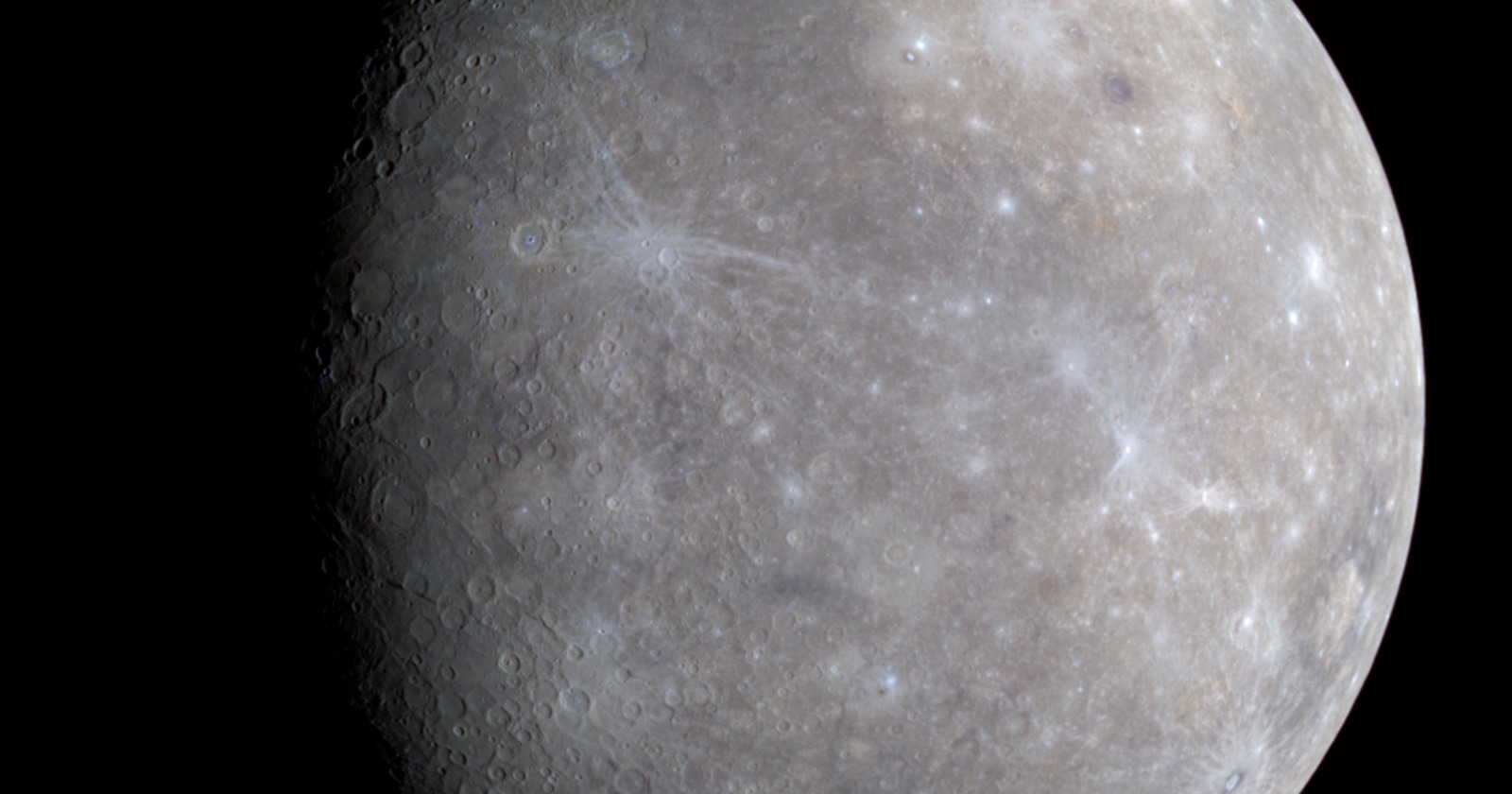
Mercury is the fastest planet in the solar system, racing around the Sun once every 88 Earth days. That is its year. Its day, counted the way we count ours, from one sunrise to the next, is far longer. According to NASA, “one Mercury solar day (one full day-night cycle) equals 176 Earth days,” which is just over two complete Mercury years.
Read that again, because it inverts the usual relationship between a day and a year. On Earth a year holds 365 days. On Mercury a single day holds two years. The Sun would rise, the planet would circle the Sun twice, and only then would the Sun rise again over the same patch of ground.
A day measured two ways
The strangeness comes from the difference between spinning and orbiting, two motions we rarely have to separate because Earth keeps them tidy. A “day” can mean two things. One is how long the planet takes to turn once on its axis against the background stars. The other is how long the Sun takes to return to the same spot in the sky, which depends on the spin and the orbit working together.
Mercury, NASA notes, “spins slowly on its axis and completes one rotation every 59 Earth days.” That is its turn against the stars. But while it turns, it is also sprinting around the Sun every 88 days, and the two motions combine. By the time a given spot on Mercury faces the Sun again, the planet has moved a long way along its orbit, and the spin has to catch up. The net result, the Mercury facts page reports, is a sunrise-to-sunrise day of 176 Earth days.
So Mercury has a short year and a long day, and both statements are true at once because they measure different things. The 88-day figure is the orbit. The 176-day figure is the Sun’s round trip across Mercury’s sky.
The spin that radar caught
For most of the twentieth century, astronomers assumed Mercury kept one face permanently toward the Sun, the way the Moon keeps one face toward Earth. That assumption was wrong, and it took bouncing radio waves off the planet to prove it. In 1965, Gordon Pettengill and Rolf Dyce used the giant Arecibo radio dish in Puerto Rico to make a radar determination of the rotation of Mercury, and found the planet turning once every 59 days, not once per orbit.
The number was a surprise, and an Italian astronomer, Giuseppe Colombo, spotted what it meant. Fifty-nine is almost exactly two-thirds of 88. Mercury was not locked one-to-one with the Sun. It was locked three-to-two: the planet turns three times on its axis for every two trips around the Sun. Astronomers call this a 3:2 spin-orbit resonance, a stable rhythm set up by the Sun’s gravity tugging on a planet whose orbit is unusually stretched.
That resonance is the machinery behind the headline. Three spins per two orbits is the same fact, viewed from the axis instead of the sky, that produces a solar day of two Mercury years.
A sun that rises, stops, and turns back
The resonance does something even stranger to the view from the ground. Mercury’s orbit is, in NASA’s words, “highly eccentric,” a stretched egg rather than a circle, and near its closest approach the planet moves so fast that its orbital motion briefly outruns its spin. For an observer on the surface, NASA describes the consequence directly: “the morning Sun appears to rise briefly, set, and rise again from some parts of the planet’s surface.” The same thing happens in reverse at sunset elsewhere.
The Sun, in other words, does not simply track across Mercury’s sky. In certain places it climbs, halts, slides backward, then resumes, all within a single 176-day day. The long day is not just long. In places it doubles back on itself.
None of this is driven by anything exotic. It is the plain geometry of a fast, lopsided orbit combined with a slow spin held in a two-thirds rhythm, observed and measured rather than inferred.
What a long day does to the ground
A day measured in months is not just a curiosity of the calendar. It shapes the surface. Each patch of Mercury is turned toward the Sun for weeks at a stretch, then away for weeks more. With almost no atmosphere to move heat around or hold it overnight, the temperature swings are enormous. NASA gives daytime highs that “can reach highs of 800°F (430°C)” and nighttime lows that “can dip as low as -290°F (-180°C)” on the same world.
That gap, more than 600 degrees Celsius between noon and the dead of night, is a direct consequence of the slow spin and the missing air. A faster day would even things out, the way Earth’s 24-hour turn keeps our nights from collapsing to those extremes. Mercury’s long day leaves each hemisphere baking or freezing for a punishing stretch before relief comes.
What this does and does not prove
The claim is precise, and the precision matters. “Day” here means the solar day, sunrise to sunrise, which NASA gives as 176 Earth days. Mercury’s rotation against the stars, the sidereal day, is the shorter 59 days. Anyone comparing Mercury’s “day” to its “year” has to say which day they mean. The headline fact, the one longer than two years, is the solar day, and that is the figure NASA states.
“Just over two years” is also exact rather than rounded for effect. Two Mercury years would be 176 Earth days against an 88-day orbit, and NASA’s own phrasing is “just over two years on Mercury.” The relationship is not a tidy coincidence forced into a round number. It is the direct arithmetic of the 3:2 resonance, and it comes out a hair above two because the orbit is 87.97 days, not a flat 88.
What the fact does not show is anything mystical about Mercury. The planet is not frozen with one face to the Sun, as older texts claimed, and it is not tumbling randomly. It sits in one of the most stable, best-measured rhythms in the solar system, first pinned down by radar sixty years ago and confirmed many times since. The wonder is in the geometry, not in any gap in the science.
A clock that keeps its own time
It helps to drop the Earth habit of treating a day as the small unit and a year as the large one. On Mercury the two have swapped scale. The year is the quick beat, 88 days, gone before a single sunrise can repeat. The day is the long one, 176 days, two years wide, with the Sun occasionally pausing and stepping backward across the sky in the middle of it.
Stand on that surface, if anything could, and the ordinary words would mislead you. You would wait through two full years for the morning to come around again.
