Space, science, and the human mind. Since 1995.
Space Daily Editorial Team
Editorial Team

Space Daily Editorial Team

Editorial Team

The Space Daily Editorial Team produces content across our two editorial pillars: space industry news and Mind & Meaning. We cover launches, missions, satellites, defense, and the technology of getting humans to space, alongside the psychology of ambition, isolation, and meaning under extremes. Articles reflect our team's collective editorial process, source verification, drafting, technical review, and editing, rather than a single writer's work. Space Daily takes editorial responsibility for content under this byline. For more on how we work, see our editorial policy.

Culture

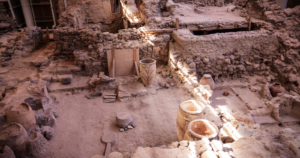
The earliest known cave paintings, recently dated to at least 45,500 years old on the Indonesian island of Sulawesi, depict a wild pig and several human-animal hybrid figures — and the discovery has pushed the timeline of complex symbolic thinking back so far that most of the standard textbook narratives about when humans started being recognizably modern are now being quietly rewritten

In December 2017, a team of researchers led by Adam Brumm and Maxime Aubert of Griffith University, working with Indonesian archaeologists, climbed into a remote limestone cave called Leang Tedongnge on the Indonesian island of Sulawesi.

Science

The Arecibo radio telescope broadcast a single 3-minute message toward star cluster M13 in 1974, and because M13 is 25,000 light-years away, any reply would take 50,000 years to arrive, meaning the people who sent it knew with certainty no one alive would ever hear an answer.

In 1974, scientists at the Arecibo Observatory broadcast a 1,679-bit binary message toward the globular cluster M13, knowing the signal would take 25,000 years to arrive and any reply would take another 25,000 to return. Here's what was in the message, why they sent it anyway, and where the signal is right now.

Science

The James Webb Space Telescope is parked a million miles from Earth at a gravitational balance point so precarious it has to fire its thrusters every three weeks just to stay there, and when its fuel runs out around 2040 it will drift away forever with no possibility of refueling or rescue.

The James Webb Space Telescope sits at a gravitational balance point a million miles from Earth, firing its thrusters on a regular cadence to stay in place. When its propellant runs out, no rescue mission exists to save it.

Human Behaviour

Indigenous Amazonian shamans identified the specific combination of two plants required to make ayahuasca active orally — a pairing that stands as what may be one of the most unlikely discoveries in the history of human botany, given there are roughly 80,000 plant species in the Amazon

The Amazon contains roughly 80,000 plant species, and ayahuasca requires precisely two of them combined in a way that defies straightforward botanical reasoning — a fact that has puzzled pharmacologists for decades.

Tech Space

The Opportunity rover survived on Mars for 14 years — roughly 55 times longer than its 90-day design mission — before a 2018 global dust storm so vast it turned “day into night” across the entire planet buried its solar panels, and despite NASA sending more than 1,000 recovery commands afterward, the rover never woke up

In January 2004, a golf-cart-sized robot bounced down through the atmosphere of Mars on a cluster of airbags, rolled to a stop, and started doing what it was sent to do.