

The Antikythera mechanism is a hand-cranked bronze calculator built around the first century BCE, recovered from a Roman-era shipwreck off the small Aegean island of Antikythera in 1901, and capable of predicting solar and lunar eclipses, tracking the irregular orbit of the Moon, and modelling the positions of the known planets. Nothing of comparable mechanical sophistication shows up in the surviving archaeological record for roughly the next 1,400 years.
That is the part that keeps historians of technology up at night. The gears are not crude. They are cut by hand from sheet bronze into triangular teeth, meshed in trains that compute astronomical ratios with the patience of an orrery. When sponge divers pulled the corroded lump from the seabed at a depth of about 45 metres, no one in 1901 had any idea what the green concretion contained.

What the divers actually found
The wreck off Antikythera sat in deep water between Crete and the Peloponnese, on a shipping lane Roman traders used to move Greek loot back to Italy. The cargo included bronze and marble statues, glassware, amphorae, and coins. Among the encrusted fragments lifted to the surface in 1901 was a corroded mass roughly the size of a shoebox. It sat largely ignored in the National Archaeological Museum in Athens until 1902, when Greek politician Spyridon Stais noticed a gear embedded in the corrosion and his cousin Valerios Stais, the museum director, began the first study of the fragment.
The lump eventually split apart, revealing the unmistakable shape of gear wheels with triangular teeth arranged in nested trains. The device had been hand-cranked. A user turned a knob on the side and the dials on the front and back faces rotated to show the position of the Sun, the phase of the Moon, the date in multiple overlapping calendars, and the predicted timing of eclipses.
Thirty-plus gears that should not exist
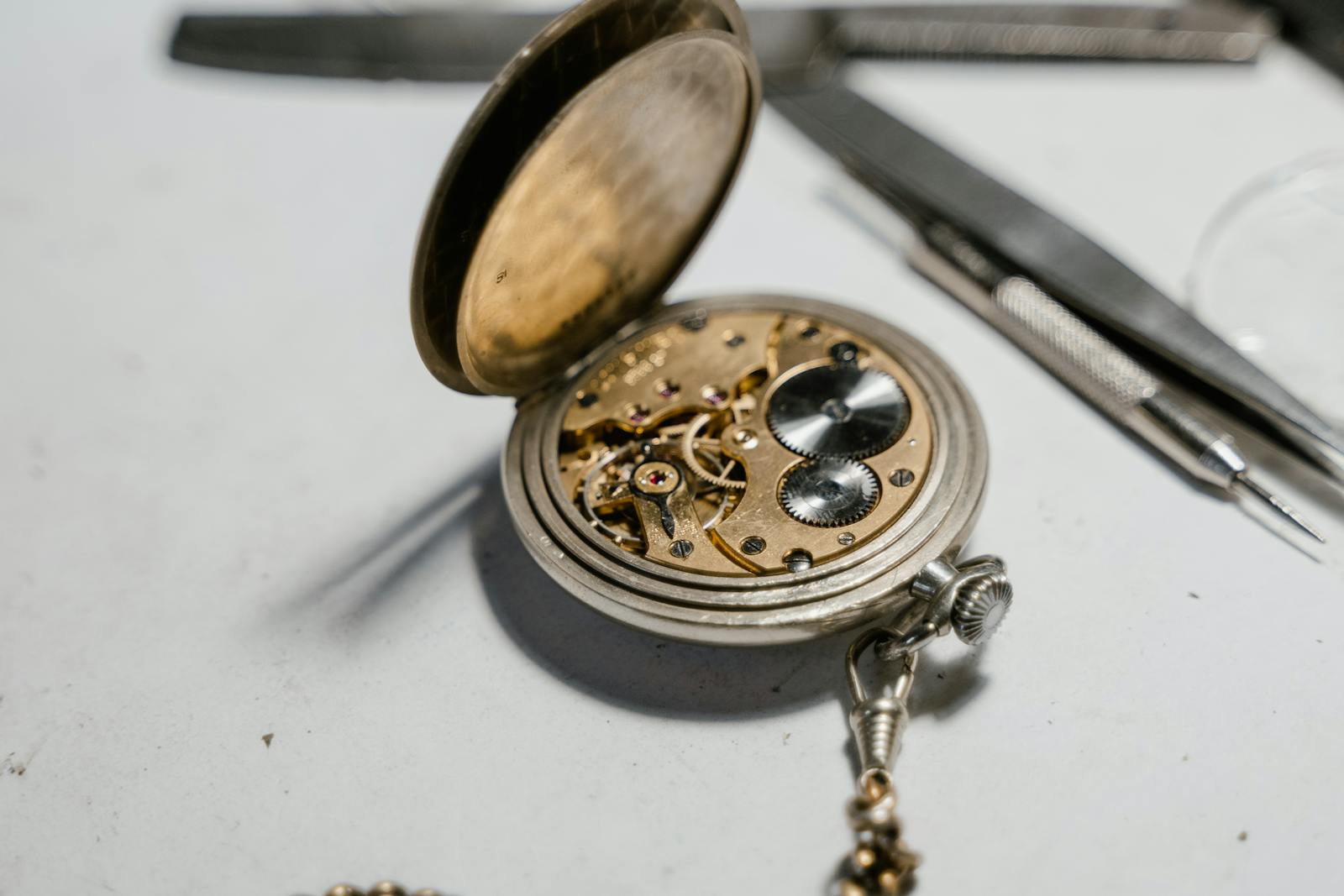
At least 30 gears survive, and reconstructions based on X-ray tomography suggest the original device held closer to 37 hand-cut bronze wheels packed into a wooden case roughly 34 centimetres tall. The largest gear is about 14 centimetres across. The teeth were filed individually. The ratios between gears encode astronomical periods that Babylonian and Greek astronomers had been refining for centuries.
One pair of gears mounted on an offset pin reproduces the irregular speed of the Moon across the sky, the so-called lunar anomaly first described by the Greek astronomer Hipparchus in the second century BCE. The Moon does not orbit Earth in a perfect circle. It speeds up near perigee and slows near apogee. The mechanism models that variation with a pin-and-slot coupling that wobbles one gear against another. It is a mechanical solution to a problem in celestial geometry, worked out two thousand years before Newton.
What it actually computed
Turn the crank forward by one day and the front dial advances one notch on the zodiac. The Moon pointer creeps along at its real, uneven rate. A small ball, half black and half silver, rotates inside a window to show the lunar phase. On the back of the device, two spiral dials track longer cycles: the Metonic cycle of 235 lunar months that brings the Moon back to the same phase on the same date every 19 years, and the Saros cycle of 18 years and 11 days that astronomers used to predict eclipses.
If the Saros pointer landed on a glyph, an eclipse was due. The glyph specified whether it would be solar or lunar, roughly when in the day it would happen, and sometimes the colour of the Moon during totality. A 2024 study from the University of Glasgow used Bayesian statistics and techniques borrowed from LIGO gravitational-wave analysis to determine that the calendar ring on the front of the device most likely contained 354 or 355 holes, matching the Greek lunar year rather than the 365 days of the Egyptian solar calendar.
The Glasgow analysis also showed that the surviving holes were positioned with remarkable precision, with an average radial variation of only 0.028 millimetres from a perfect circle of radius 77.1 millimetres. That is accuracy on the scale of a fraction of a human hair, executed in bronze, by hand, in a workshop somewhere in the Hellenistic Mediterranean.
Who built it
No one knows for certain. The leading candidates are circles connected to Archimedes of Syracuse, who died in 212 BCE and was credited by Cicero with building a similar device that modelled the heavens, and Hipparchus of Rhodes, whose lunar theory the mechanism so faithfully reproduces. Rhodes was a known centre for astronomical instrument making in the late Hellenistic period. The ship that carried the device sank between roughly 70 and 50 BCE, plausibly en route from an Aegean port toward Rome.
Space Daily has covered the long puzzle of why no comparable machine survives for centuries afterwards, as if a whole engineering tradition fell off a cliff. There is no obvious successor in Roman Egypt, Byzantium, or early medieval Europe. Mechanical clocks of comparable gear complexity do not appear in the European record until the astronomical clocks of the 14th century, more than a millennium later.
The 1,400-year gap
The earliest European clockwork that approaches the Antikythera mechanism in gear count and astronomical ambition is Richard of Wallingford’s astronomical clock at St Albans Abbey, designed in the late 1320s and completed about two decades after his death in 1336, and Giovanni de’ Dondi’s astrarium, built in Padua between 1348 and 1364. Both are roughly 1,400 years later than the shipwreck. Both are credited as engineering marvels of the late medieval period. Neither is obviously more sophisticated than what a Greek workshop apparently produced in the first century BCE.
The Islamic world preserved more continuity. Astrolabes, geared calendar devices, and water-driven astronomical machines appear in the work of al-Biruni and the Banu Musa brothers between the 9th and 11th centuries. But even those instruments rarely match the gear-train complexity of the Antikythera device. The Greek machine used epicyclic and pin-and-slot gearing to compute the irregular motions of the Sun, Moon and planets. That trick does not reappear cleanly in the historical record until the European Renaissance.
Why did the tradition die? Possibilities include the collapse of Hellenistic patronage networks under Roman rule, the loss of specialised workshops as wealth shifted, and the simple fact that a single device that took a master craftsman years to build may have had a handful of customers in the entire Mediterranean. When the customers vanished, the skill vanished. There may have been other Antikythera mechanisms. They corroded in attics, or were melted down for bronze, or sank in shipwrecks that were never found.
How researchers cracked it open
Modern understanding of the device comes from a sequence of imaging campaigns. In 2005 the Antikythera Mechanism Research Project used a custom-built 8-tonne X-ray tomography machine called Bladerunner, built by the British firm X-Tek Systems and shipped to Athens, to scan the fragments at micron resolution. The machine ran at 450 kilovolts and had originally been developed to inspect turbine blades for hairline cracks. The scans revealed thousands of previously invisible Greek inscriptions on the inner surfaces, an instruction manual etched into the bronze itself.
Those inscriptions described the dials, named the planets, and laid out eclipse predictions. A 2021 reconstruction by a team at University College London, led by Tony Freeth, used the inscriptions to propose a complete model of the front display showing all five planets known to the Greeks, the Sun, the Moon, and the lunar nodes.
The Glasgow team’s 2024 result, published in The Horological Journal, settled a long-running argument about whether the calendar ring tracked 365 days, 360 days, or roughly 354. The answer came from an unlikely route. Chris Budiselic, an Australian machinist who runs the YouTube channel Clickspring and was building a working replica using period-appropriate tools, led a 2020 paper in the same journal that measured the surviving holes and proposed a lunar-year reading. Graham Woan and Joseph Bayley at Glasgow then took the Budiselic et al. measurements and ran them through the same Bayesian inference tools and Markov Chain Monte Carlo methods Woan’s group uses on LIGO gravitational-wave data. The lunar-year answer fell out cleanly, with 354 or 355 holes hundreds of times more probable than the 360-hole alternative. Independent reconstructions of the mechanical cosmos have continued to refine the gear ratios since.
What it tells you about the people who built it
The Greeks who built this device understood that the heavens were governed by combinable cycles. They could not have known why the Moon’s orbit was irregular. Kepler would not publish his laws of planetary motion for another sixteen centuries. But they had measured the irregularity carefully enough to model it mechanically, and they had the metallurgical and machining skill to cut hundreds of teeth at exactly the right ratios.
This is not the popular picture of antiquity. The Roman-era world is usually remembered for marble, aqueducts, legions, and oratory. The Antikythera mechanism is a reminder that the same civilisation contained workshops where someone sat at a bench and filed bronze gear teeth to a tolerance that would be respectable in a 19th-century pocket watch.
The device is currently displayed at the National Archaeological Museum in Athens, a few hundred kilometres from the seabed where it spent two millennia. Recent coverage of the Glasgow team’s work has revived public interest in the device, and replicas based on the latest scans now circulate among horologists and museum collections.
A small object that rewrites a timeline
The Antikythera mechanism does not prove that ancient Greeks had computers in any modern sense. It had no programmable logic, no memory, no branching. It was a special-purpose calculator, like a slide rule or an orrery. But it did one thing that no other surviving object from the ancient world does. It encoded the motion of the heavens in meshed gears and let a user turn a crank to see the future.
Hand it to a Roman senator in 60 BCE and he could find out when the next lunar eclipse would happen. Hand it to a medieval monk in 800 CE and the same query would not have a tool to answer it for another five hundred years.
The shipwreck is still there. Excavations resumed in 2012 under the joint sponsorship of the Greek Ministry of Culture and the Woods Hole Oceanographic Institution, and divers have continued to recover fragments of the cargo, including pieces of additional bronze statuary and what may be parts of a second mechanism, though that last claim remains contested. If a sibling device exists in the silt off Antikythera, it has been waiting two thousand years to be found.
