
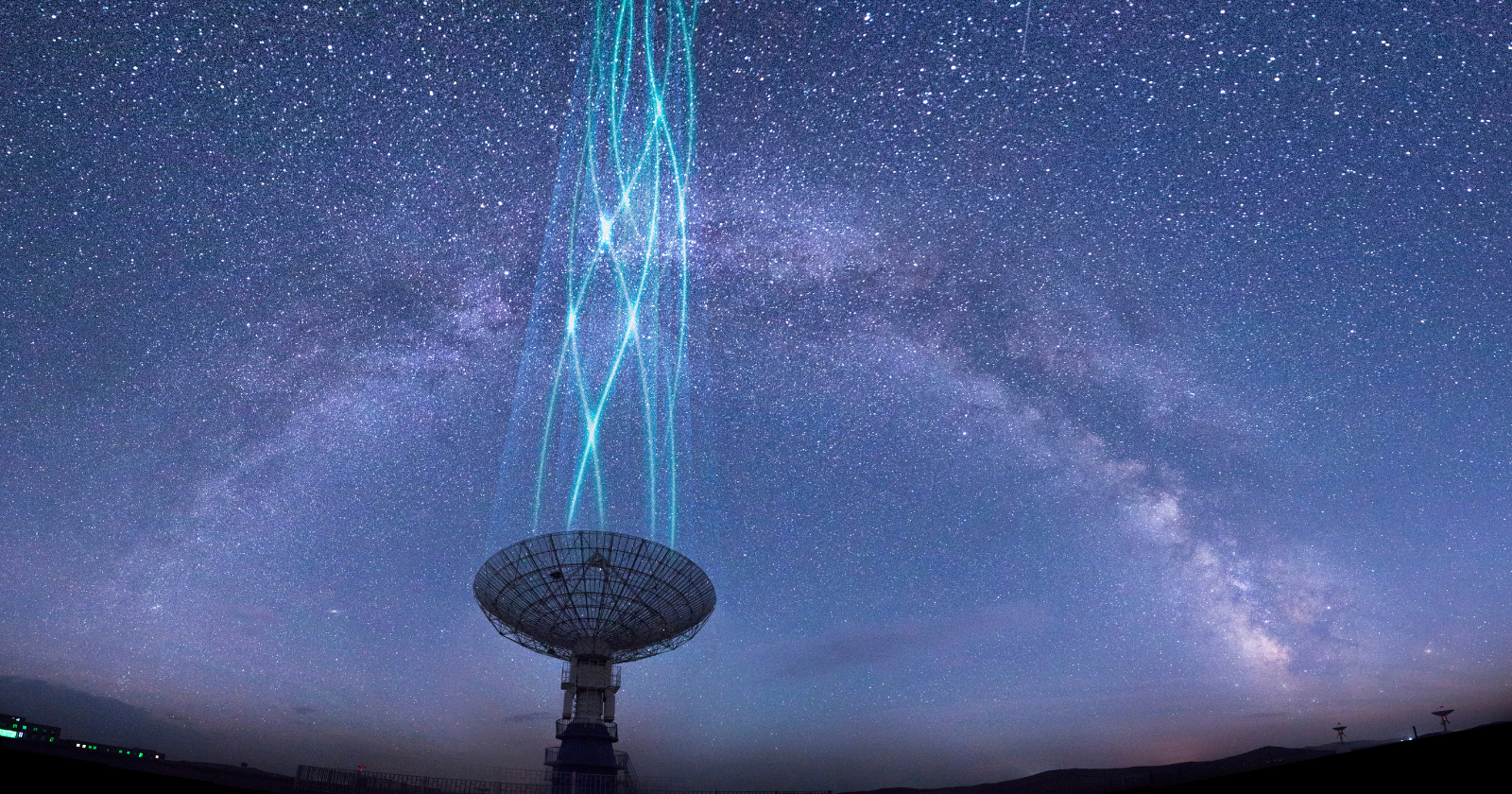
In the autumn of 1967, a doctoral student at the University of Cambridge noticed a recurring smudge on a roll of chart paper. The student was Jocelyn Bell, later Jocelyn Bell Burnell. The chart paper carried the output of a radio telescope she had helped to build over the previous two years. The smudge, which she had seen before coming from the same patch of sky, turned out to be a signal pulsing roughly once every 1.3 seconds, holding a regularity that no familiar radio source was expected to produce.
The instrument was the Interplanetary Scintillation Array at the Mullard Radio Astronomy Observatory, built under Antony Hewish to study quasars by the way their radio light flickers as it crosses the solar wind. It wrote its output onto long rolls of chart paper, and reading those rolls was Bell’s job. The pulsing source did not behave like a quasar, a known star, or any familiar form of interference. Before anyone could say what it was, the team gave it a working label: LGM-1, for little green men.
Why the regularity was the problem
The label was half a joke and half a genuine question. A signal that pulses about once a second is not strange by itself. What unsettled the group was the precision. The gap between pulses held steady to a degree that, by the standards of 1967, looked more like engineering than astronomy.
Natural radio sources tend to drift, vary, or flare. A source that kept time as if to a clock raised, reluctantly, the question of whether something had made it. The team did not rush that idea into print. They worked against it. They checked the terrestrial explanations first, satellites, radar, faults in the equipment, and ruled them out. They also considered whether the signal might come from a planet circling another star, which would have left a particular fingerprint in the timing. The name LGM-1 stood in for a hypothesis they wanted to eliminate, not one they wanted to believe.
The second source settled it
The clearest argument against an artificial origin was found by Bell. Shortly before Christmas 1967, still working through the charts, she identified a second pulsing source. It had a different period and came from an entirely different part of the sky.
More followed.
Two unconnected civilisations, on opposite sides of the sky, producing the same kind of signal in the same observing programme, was not a credible picture. Several independent sources scattered across the galaxy, all sharing the same odd behaviour, pointed the other way. Whatever produced the pulses was a natural class of object, not a message. Bell has since described the second detection as a relief, because it took the little green men out of the problem.
What the pulses actually were
The discovery was published in Nature on 24 February 1968, under the title Observation of a Rapidly Pulsating Radio Source, with Hewish as first author and Bell second. The paper set out the timing and the signal carefully and suggested the source might be a compact star, a white dwarf or a neutron star, without claiming to have settled the mechanism.
The explanation that held came within months. Thomas Gold, at Cornell, argued in a 1968 Nature paper, Rotating Neutron Stars as the Origin of the Pulsating Radio Sources, that the source was a rotating neutron star: the dense remnant of a collapsed massive star, only a few tens of kilometres across, spinning quickly and carrying a strong magnetic field. Such a star emits beams of radio waves from its magnetic poles. If the magnetic axis is tilted away from the rotation axis, the beam sweeps around as the star turns, and an observer who happens to lie in its path receives a pulse once per rotation. The comparison usually drawn is to a lighthouse. Franco Pacini had argued along related lines shortly before the discovery, in work on the energy source of the Crab Nebula.
Neutron stars were not a new idea. Walter Baade and Fritz Zwicky had proposed them in 1934 as a possible product of supernovae. For more than thirty years the idea remained a theoretical suggestion with no observed example. The pulsing sources gave it something to attach to. The object behind LGM-1, now catalogued as PSR B1919+21, is a rotating neutron star with a period of about 1.337 seconds.
The Nobel that left out the discoverer
In 1974 the Nobel Prize in Physics went to Antony Hewish and Martin Ryle, with the citation crediting Hewish for his decisive role in the discovery of pulsars. Bell, who had helped build the array, read the charts, identified the first source, and found the evidence that ruled out an artificial origin, was not named. The omission was criticised at the time, including by the astronomer Fred Hoyle.
Bell Burnell’s own position has been consistent and widely reported. She has said she does not regard herself as having been wronged, has pointed out that doctoral students were not generally recognised by the prize in that era, and has declined to treat the episode as a grievance. In 2018 she was awarded the Special Breakthrough Prize in Fundamental Physics, and donated the entire £2.3 million prize to the Institute of Physics to create the Bell Burnell Graduate Scholarship Fund, which supports doctoral students from groups under-represented in physics.
What the episode is worth remembering for
It is tempting to read the LGM-1 story as a near miss, a moment when astronomers almost mistook a star for a signal. In our reading it is closer to the opposite. The Cambridge group treated an unfamiliar and suspiciously regular signal as a problem to be eliminated rather than a discovery to be announced. They held back the dramatic explanation until the evidence had closed it off.
The careful version turned out to be the more interesting one.
Pulsars are now ordinary tools of astronomy. Several thousand have been catalogued. Their pulses are steady enough to serve as natural clocks, accurate enough that timing them has been used to confirm the existence of gravitational radiation and, in recent years, to search for a faint background of gravitational waves crossing the galaxy. That search is still going on.
