
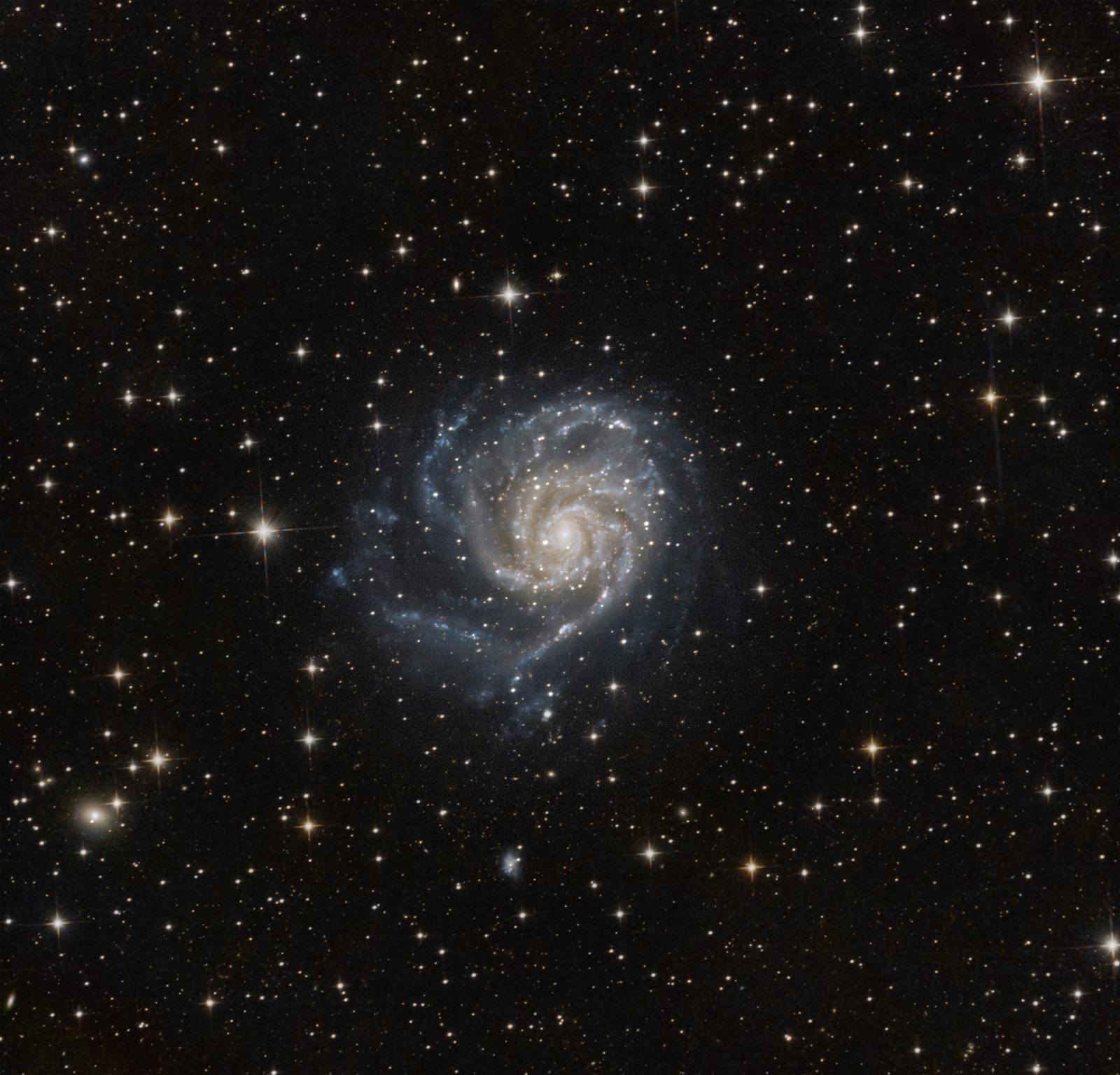
The Hubble Space Telescope was launched on April 24, 1990, aboard the Space Shuttle Discovery, in what was, at the time, the largest single scientific instrument ever placed in orbit. The telescope had been twenty years in development. It had cost approximately 1.5 billion dollars. Its central component, a 2.4-meter primary mirror polished to the most exacting tolerances optical manufacturers knew how to produce, had been the subject of years of meticulous fabrication work at the Perkin-Elmer Corporation in Connecticut. The mirror was supposed to be the smoothest large optical surface ever produced by human hands.
Two months after launch, on June 27, 1990, NASA announced that it had been ground to the wrong shape. The error was tiny. It was also catastrophic.
What 2.2 micrometers means in a telescope mirror
It is worth being precise about what the defect was, because it tends to get described in vaguer terms than the physics warrants.
The mirror’s outer edge had been polished too flat by about 2.2 micrometers. NASA Science’s documentation of the defect describes the measurement directly. A micrometer is one millionth of a meter. The total error of 2.2 micrometers is, in absolute terms, around one-fiftieth the width of a single human hair. At the level of any reasonable visual inspection, the mirror looked perfect. At the level any reasonable visual inspection could detect, it was perfect.
The problem is that telescope mirrors are not calibrated to the level of any reasonable visual inspection. They are calibrated to wavelengths of light, which are themselves measured in tenths of micrometers. An error of 2.2 micrometers on the surface of a 2.4-meter mirror is, in the relevant units, much larger than the wavelengths of the light the mirror is supposed to be focusing. The error produced, in the optical system, exactly the kind of distortion telescope mirrors are designed to avoid.
The defect is called spherical aberration. It occurs when light hitting the outer edge of the mirror focuses at a slightly different point than the light hitting the center. The result is that no single focal point exists where the entire mirror’s light converges sharply. The result, more accurately, is a continuous range of focal points across which the light is smeared. The smearing produced, in Hubble’s images, a characteristic halo around every star and a soft blur across every object the telescope was attempting to photograph.
What followed the announcement
The announcement landed as a national embarrassment for NASA. The framing was accurate. The agency had just spent 1.5 billion dollars on a telescope producing images about equivalent to what a good ground-based telescope could produce on a clear night. Taxpayers, journalists, and political adversaries were not patient about the situation.
The cause of the defect, as the Hubble Space Telescope Optical Systems Board of Investigation determined across the months following the announcement, was a calibration error in the equipment Perkin-Elmer had used to test the mirror during fabrication. The testing equipment had been incorrectly assembled. The incorrectly assembled equipment had, across the years of polishing work, consistently reported that the mirror was the correct shape when it was not. CBS News’s reporting on the failure investigation notes that NASA associate administrator Lennard Fisk described the situation in stark terms when he first learned of it: “Space science just had its Challenger accident.”
The mirror could not be replaced in orbit. It was the structural core of the telescope. Replacing it would have meant replacing the telescope itself. The question was not whether the mirror could be fixed, but whether the optical system around it could be modified to compensate for the defect.
The engineering response
The response was more elegant than the public reckoning gave it credit for.
Engineers determined that the spherical aberration in the primary mirror was mathematically characterizable. The error followed a specific predictable pattern that could, in principle, be exactly cancelled out by introducing a corresponding error of opposite sign somewhere downstream in the optical path. The downstream error would, when combined with the original mirror error, produce a corrected light path that arrived at the scientific instruments without the smearing.
Two solutions emerged. NASA Goddard’s documentation of the corrective optics package describes both. The first was to replace one of the telescope’s primary cameras, the Wide Field and Planetary Camera, with a new version called WFPC2, which would have the corrective optics built directly into the new camera itself. The second was a telephone-booth-sized device called COSTAR, the Corrective Optics Space Telescope Axial Replacement, which would be installed in one of the telescope’s instrument bays and would extend ten small corrective mirrors on deployable arms into the light paths of the remaining instruments. The mirrors on COSTAR were each about the size of a nickel coin. They had been ground to exactly the opposite error from the primary mirror’s defect, so that the combined system would produce the corrected focal point the original design had been built around.
Both solutions had to be installed simultaneously, by astronauts, in orbit, on a telescope that had not been designed to be repaired in this way. The task was more demanding than anything spacecraft servicing missions had previously attempted.
What STS-61 did
The Space Shuttle Endeavour launched on December 2, 1993, with seven astronauts aboard, including the European astronaut Claude Nicollier. The mission was designated STS-61. Its primary objective was to catch the Hubble Space Telescope with the shuttle’s robotic arm, secure it in the cargo bay, install COSTAR and WFPC2, replace the solar arrays, change out gyroscope hardware, install a new computer co-processor, and redeploy the telescope into orbit, all within an eleven-day mission window.
The astronauts performed five back-to-back spacewalks across the mission, totaling 35 hours and 28 minutes of cumulative extravehicular activity. The number of spacewalks was about double anything that had previously been conducted on a single shuttle mission. NASA’s mission documentation describes how the crew alternated spacewalks in pairs, with one team resting while the other worked, to prevent exhaustion. The repairs proceeded across the eleven days without major incident. Endeavour redeployed the Hubble Space Telescope on December 13, 1993, and returned to Earth two days later.
What the corrected telescope produced
The first images from the repaired telescope arrived on January 13, 1994. They demonstrated that the corrective optics had worked exactly as the engineering models had predicted. The spherical aberration was gone. The star images were point sources rather than haloed blurs. Astronomers were looking at the first sharp images the Hubble Space Telescope had ever produced.
The implications, across the decades that followed, were considerable. Hubble went on to produce some of the most scientifically productive astronomical observations in the history of the discipline. Its images of distant galaxies, of nebulae, of the deep field that revealed thousands of galaxies in a tiny patch of apparently empty sky, became some of the most widely circulated scientific images of the modern period. The telescope has contributed to more than 21,000 peer-reviewed scientific papers across its operational life so far.
COSTAR itself was removed from the telescope during the fifth servicing mission in May 2009, by which point all the original scientific instruments it had been correcting had themselves been replaced by newer instruments with internal corrective optics. NASA’s transfer announcement documents that COSTAR is now on display at the Smithsonian’s National Air and Space Museum in Washington, D.C.
Final words
The Hubble Space Telescope launched in April 1990 with a primary mirror that had been ground to the wrong shape by 2.2 micrometers, an error about one-fiftieth the width of a human hair, but large enough to render the 1.5-billion-dollar telescope unable to perform the precision imaging it had been designed for. The error was the result of a calibration mistake in the testing equipment used during fabrication, which had gone undetected because the cheaper bid that produced the mirror had not included the independent verification checks the rejected bid would have.
The fix arrived three and a half years later, in December 1993, when seven astronauts aboard the Space Shuttle Endeavour installed corrective optics in orbit. The fix worked. Hubble has, in the decades since, produced what is by most measures the most scientifically productive astronomical work in the history of the discipline.
The story is usually told as a tale of redemption. That framing is partly accurate, and partly less attentive than the underlying engineering deserves. What the story shows is that errors at the scale of micrometers can produce failures at the scale of billions of dollars, and that fixing those failures, when fixing them is even possible, requires the kind of patient ongoing engineering work that public attention is much less inclined to admire than the dramatic moments of launch and failure that bracket the work on either side. The work is what produced the correction. The correction is what produced the science. The science is most of what the visible Hubble legacy actually consists of.
