
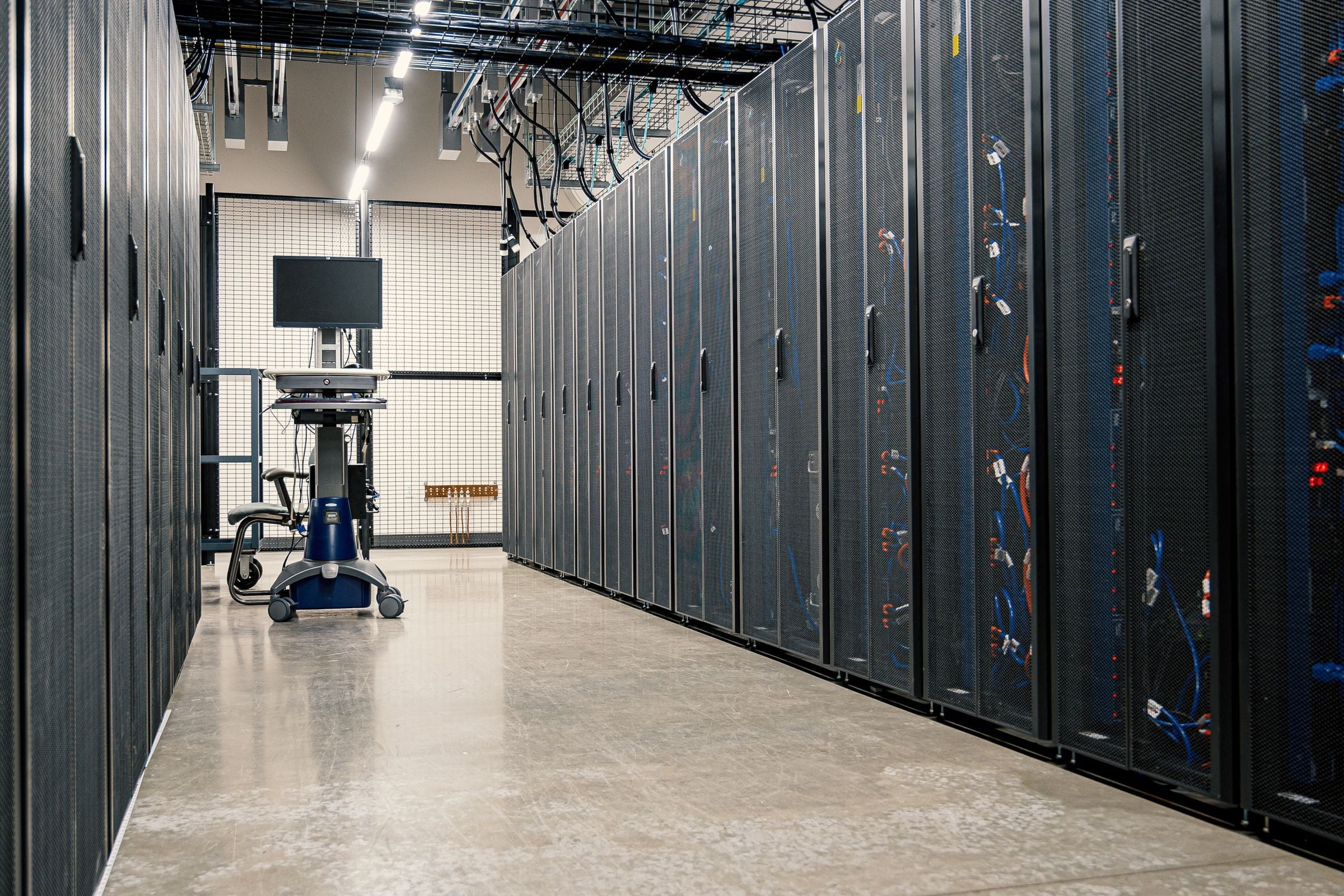
A data-centre developer can acquire land, obtain planning permission and still have no reliable date for the electricity needed to switch on the servers. In the most constrained parts of Britain and North America, the power infrastructure can take longer to deliver than the computing equipment it is supposed to serve.
That mismatch has become part of the pitch for orbital computing. If a company can book a launch, attach processors to a satellite and power them from solar arrays, it may place some working compute in orbit before a terrestrial project receives a large grid connection.
The comparison is real, but it is not even. A small orbital demonstration is not equivalent to a 100-megawatt campus. Space avoids a town’s zoning process and a utility connection queue only by accepting launch, radiation, communications, thermal-control and orbital-regulation problems instead.
The longest British power dates reach into the late 2030s
In evidence to a UK parliamentary committee in April 2026, data-centre developer Clinton Hasell said the next tranche of power for an AI campus in Harlow had been quoted for 2037. The site had capacity, planning and land, he said, but no certainty about when the electricity would arrive.
Matthew Evans of techUK told the same hearing that most operators faced waits of roughly three to eight years. He described one project inside the M25 whose connection date slipped by more than a decade, while calling that particular case extreme.
Those examples do not mean every British data centre waits 15 years. The phrase “five to 15 years” describes the difficult end of the market, where physical reinforcement, queue congestion and later revisions can push a connection well beyond a normal building programme. Other projects connect faster, especially where capacity already exists.
The essential problem is sequencing. A developer may know where a building will stand, what equipment it will contain and who will use it long before the network can promise the power needed to operate it.
Britain’s queue has become larger than plausible demand
A 2026 UK government consultation said the transmission demand queue stood at 96 gigawatts when it closed to new applications at the end of June 2025, with another 29 gigawatts waiting at distribution level.
About 140 data centres accounted for roughly 50 gigawatts in the transmission queue alone. The total demand queue had grown by 460 percent in six months, a pace the government said suggested speculative activity was inflating the pipeline and obscuring the viable projects.
This is not simply a line of completed data centres politely waiting for a switch to be thrown. Some applications represent serious projects with land, customers and finance. Others reserve a place before key pieces are secured. A first-come system can allow a stalled or speculative application to delay a project that is ready to proceed.
Ofgem is therefore consulting on commitment fees and milestones. Developers could be required to show a credible end user, procurement of long-lead electrical equipment such as switchgear, and the financial and technical ability to finish the centre. Projects that fail the tests could lose their place.
That reform matters to the orbital comparison. Space is not competing with a permanently frozen British grid. It is competing with a terrestrial system being redesigned because long waits have become politically and economically costly.
North America has its own time-to-power problem
The details differ across US and Canadian grids, utilities and local planning systems. There is no single North American queue. A July 2026 review by the Center for Strategic and International Studies nevertheless found that developers in some US regions could wait as long as seven years to bring large loads such as data centres online.
JLL’s 2026 global data-centre outlook put the average wait for a grid connection in primary markets above four years. Other industry research separates the timelines further: an AI centre may be permitted and built in roughly 18 to 36 months, while the new generation and transmission needed to support it can take five to ten years.
The delay is not only an administrative queue number. A large campus may require a substation, transformers, high-voltage lines and new generation. Each element can have its own land negotiation, environmental review, procurement cycle and construction schedule. Large transformers and switchgear cannot always be ordered at short notice, even after approval arrives.
The imbalance is structural. Computing hardware develops on a product cycle measured in months and a few years. Power networks are planned as public infrastructure intended to operate for decades. AI demand can change faster than a transmission plan can be consulted on, financed and built.
Community consent now sits on the critical path
Large data centres can bring investment, construction work and tax revenue. They can also concentrate demands for land, electricity and sometimes water, while requiring new transmission corridors or on-site generation.
Residents may reasonably ask who pays for network upgrades, whether household bills will rise, how much water cooling will use, what continuous noise will sound like and whether farmland or other local uses are being displaced. A project that appears nationally strategic can still impose costs within one town or county.
An Electric Power Research Institute study published in 2026 described community opposition as a quantifiable delivery risk. It reviewed cases in which resistance contributed to cancellations, delays, blockages, zoning actions and broader policy changes in North America and Europe.
Opposition should not be reduced to irrational obstruction. Public consultation exists because the people living beside major infrastructure carry consequences that do not appear in a developer’s construction schedule. Orbital companies are exploiting a time difference partly created by legitimate public decisions about local costs.
The commercial effect is still the same. A delayed permit or rejected transmission route can strand land and equipment while the market for the intended processors moves on to a newer generation.
Orbital companies compare a launch manifest with a connection date
Orbital Compute, a Los Angeles startup, says its Pathfinder mission is planned for 2027 and a purpose-built Orbital-1 satellite for 2028. The company presents low Earth orbit as a place where solar energy can be collected without waiting for a utility to reinforce the local grid.
That calendar is the centre of the time argument. From a 2026 starting point, a pathfinder can plausibly reach orbit before a quoted 2031, 2033 or 2037 connection date arrives. Google’s Project Suncatcher demonstration, Starcloud’s first GPU mission and other small orbital-compute projects reinforce the idea that hardware can be tested within an ordinary launch programme.
SpaceDaily previously examined the same thesis through Cowboy Space’s filing for up to 20,000 computing satellites. Its underlying bet was not that orbit is cheap property. It was that a satellite may avoid years spent waiting for terrestrial power, transmission upgrades and local approval.
The launch route also has a form of modularity. A company can fly one payload, learn from it and add nodes later. A terrestrial hyperscale campus often requires substantial power and civil infrastructure before the first large block of servers can earn revenue.
Yet the comparison can be made to look better than it is by choosing different finish lines. “In orbit” may mean a single GPU operating for a demonstration. “Connected” on Earth may mean hundreds of megawatts available continuously to a completed campus. One proves a subsystem; the other supports an industrial service.
A launch can beat the queue while delivering far less power
A 100-megawatt terrestrial AI centre can draw as much electricity as a small city. An early computing satellite may supply kilowatts to its processors. Even an ambitious megawatt-class orbital node remains two orders of magnitude below the terrestrial comparison.
Scaling requires more than adding server mass. Every processor needs electrical conversion, shielding, communications and a structure that survives launch. Solar arrays must collect the energy. Batteries or reduced workloads must cover eclipse periods. Radiators must reject nearly every watt as heat.
SpaceDaily’s earlier technical examination of orbital data centres showed why abundant sunlight is only the beginning. Vacuum prevents ordinary convective cooling. Heat must travel through plates, fluid loops or heat pipes to large emitting surfaces with a useful view of cold space.
Networking creates another scale boundary. AI training clusters repeatedly exchange large parameter and activation streams among accelerators. A constellation must reproduce some of that traffic through precisely pointed optical links while also sending useful results to Earth. Clouds can interrupt optical downlinks, and radio capacity is finite.
A small orbital machine can therefore become operational quickly without becoming a substitute for a hyperscale centre. It wins a calendar comparison before it wins a capacity comparison.
Space removes one permitting system and creates another
An orbital server does not need a local planning board to approve a warehouse. It still needs a launch licence, spectrum rights, orbital authorisation, conjunction planning and a credible end-of-life disposal plan. Ground stations must be built and permitted somewhere.
A single demonstration can fit within familiar licensing practice. A commercial constellation containing thousands of large power-generating and heat-radiating spacecraft is a different regulatory object. It changes collision risk, radio use, atmospheric re-entry and the visual and infrared foreground seen by observatories.
SpaceDaily’s recent analysis of SpaceX’s application for up to one million orbital data-centre satellites examined one consequence of that scale. In a 2026 model, satellites could outnumber natural stars visible to the unaided eye for substantial combinations of location, season and time if the fleet were built with the assumed size and reflectivity.
Moving the facility above the atmosphere does not remove neighbours. It changes them. Astronomers, other satellite operators, launch ranges, spectrum users and everyone who shares the night sky enter the approval question.
Nor are orbital approvals necessarily permanent advantages. Regulation commonly follows deployment. A collision, uncontrolled re-entry or severe astronomical impact could add new requirements after companies have designed hardware around lighter rules.
The business case is really the cost of waiting
JLL’s 2026 report on data centres in space framed a useful threshold. If grid delays in major markets extend beyond five years, or community resistance materially restricts investment, the opportunity cost of delayed terrestrial deployment may exceed the premium of an orbital alternative.
The report did not declare orbit cheaper today. Its argument was conditional. The longer valuable processors and contracted demand sit behind an unavailable power connection, the more a costly route that starts earlier can be worth.
Consider a simplified choice. One project has much lower construction and operating costs but cannot begin for seven years. Another is expensive, smaller and technically risky but produces sellable inference capacity in two. The relevant comparison includes five years of foregone service, not merely the price of concrete against the price of a rocket.
That logic cuts both ways. Faster grid connections, dedicated power plants, better use of regions with spare network capacity, behind-the-meter generation or flexible computing that reduces peak demand could improve the terrestrial option before orbital systems reach commercial scale.
Space gains value from delay on Earth. If clean, reliable terrestrial power arrives in two years, launching tonnes of solar arrays, shielding and radiators looks harder to justify. If a viable site cannot receive power for a decade, the orbital route has more time to improve.
The first useful workloads may already begin above Earth
The most convincing early market is not necessarily serving every chatbot request from orbit. Satellites already generate images, radar observations and scientific measurements. Processing those data beside the sensor can turn a large raw stream into a compact alert or product before transmission to the ground.
That use avoids part of the communications penalty because the input begins in orbit. A wildfire detector, storm classifier or crop-monitoring model may need to return only a result and selected imagery, rather than every unprocessed pixel.
Inference also divides more easily than tightly coupled model training. A stored model can accept a relatively small request and return a compact answer, while training may require thousands of accelerators to exchange enormous amounts of data with precise timing. Orbital Compute says its first mission will focus on inference.
This creates a route that does not require immediately matching a terrestrial hyperscale campus. Orbital systems can first perform space-native work, prove their power and thermal architecture, then test whether Earth-facing services justify larger deployments.
It also explains why an orbital computer can be commercially relevant before it is a data centre in the familiar terrestrial sense. The first value may come from placing modest processing beside scarce space data, not from moving an entire cloud region above the atmosphere.
A satellite may beat a queue before it beats a data centre
The five-to-15-year comparison captures real constrained cases, not a universal construction schedule. Grid reforms may shorten some waits. Some terrestrial centres will connect using existing capacity, dedicated generation or locations chosen specifically for abundant power.
Orbital companies have nevertheless identified a genuine opening. A launch booked for 2027 or 2028 can arrive before electricity promised in the 2030s. The first hardware may therefore beat the queue.
What it will not automatically beat is the capacity, maintainability, cost and network performance of a completed data centre on Earth. Comparing a pathfinder’s launch date with a hyperscale connection date is useful only if the enormous difference in delivered computing is kept visible.
The race is between two incomplete infrastructures: a terrestrial project waiting for power, and an orbital project still learning how to turn sunlight, radiators and launches into a dependable computing service. Space may be quicker to the first working server. It has not yet shown that it is quicker to the same amount of useful compute.
