
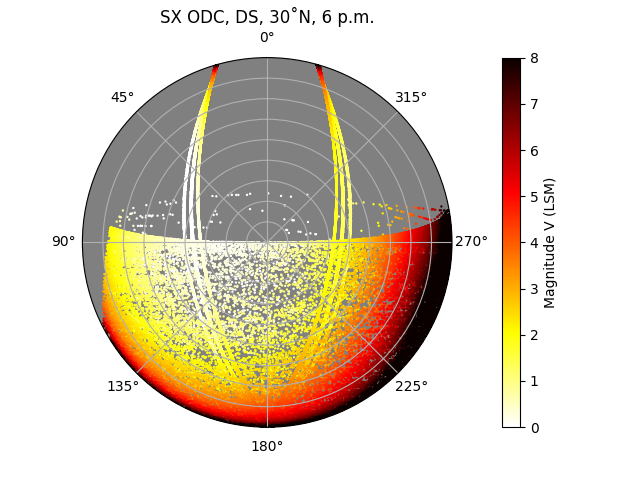
A million satellites is difficult to picture as an orbital system. Aaron Boley, Samantha Lawler and Hanno Rein tried a more immediate translation: what would a person standing on Earth actually see if SpaceX deployed the orbital AI data-centre network described in its 2026 regulatory filings?
The answer in their simulation is not a uniformly bright sky. It is stranger and more structured. Dense arcs and broad fields of sunlit spacecraft would sweep through twilight and parts of the night. At some places and times, satellites visible to the unaided eye would outnumber the natural stars.
The result comes from Rings in the Sky, a preprint submitted on 3 August 2026. It has not yet completed peer review. Its three authors modelled corporate proposals rather than hardware already in orbit, and their starkest conclusions depend on taking the proposed fleet sizes seriously.
The million is an application ceiling, not an approved fleet
SpaceX applied to the US Federal Communications Commission on 30 January 2026 for authority to launch and operate up to one million orbital data-centre satellites. The FCC accepted the application for filing on 4 February and opened it for public comment.
Acceptance for filing is an administrative step. It does not authorize one million launches, certify the architecture as safe, or demonstrate that SpaceX can manufacture and deploy the system. Companies also routinely request more orbital capacity than they eventually use.
The public notice describes satellites between 500 and 2,000 kilometres altitude, using sun-synchronous and 30-degree-inclination orbits and communicating largely through optical inter-satellite links. SpaceX calls the system a route to solar-powered computing for AI, machine learning and edge applications.
Space Daily made the same boundary explicit in its earlier look at the fleet’s atmospheric footprint: one million is an upper limit in an application, not a launch schedule. The new sky model is therefore an “if built as filed” experiment, not a prediction that the maximum fleet will certainly exist.
Why orbital data centres form rings near dawn and dusk
AI computing consumes large amounts of electricity, and an orbital machine must obtain that power from solar arrays while shedding waste heat through radiators. Several proposed systems favour Sun-synchronous orbits that keep a nearly fixed orientation to the Sun.
For maximum illumination, the attractive geometry follows the terminator, the moving boundary between Earth’s day and night sides. Groups of satellites then concentrate in orbital planes that preserve that relationship. From the ground they can project as coherent arcs or rings, rather than the more evenly dispersed points familiar from current communications constellations.
SpaceX’s model is more complicated than a single ring. Boley, Lawler and Rein reconstructed an X-shaped pair of Sun-synchronous ring families plus a dense band of satellites near 30 degrees inclination. The available filing does not list every final orbit, so the authors supplemented its representative shells with public technical information and made their inferred configurations available with the paper.
There is even an ambiguity inside SpaceX’s supplemental data. The stated system total is one million, while the individual configuration entries add to 1,198,120. The researchers discuss that discrepancy rather than quietly treating the architecture as exact.
The satellites in the model are enormous and simplified
The team used a cross-sectional area of about 800 square metres for each SpaceX orbital data-centre spacecraft. SpaceX supplied that figure in a later regulatory update, covering the satellite body, solar arrays and radiators.
That scale is consistent with the reason this problem drew attention before the new preprint appeared. Space Daily’s earlier examination of SpaceX’s first AI data-centre design described a deployed span of about 70 metres, wider than a Boeing 747-8, with substantial radiator area required to dispose of heat.
Area alone does not determine brightness. A black surface, a mirror, a solar cell and a white radiator can return very different amounts of sunlight toward an observer. Orientation matters too. The same panel may be inconspicuous from one direction and briefly brilliant from another.
For a transparent reference case, the authors treated each spacecraft as a Lambertian sphere, an idealized object that scatters light diffusely. They multiplied the 800-square-metre area by an assumed reflectivity of 0.2, then calculated visual magnitude from satellite range, Sun angle and atmospheric extinction.
This is not a high-fidelity optical model of AI1. The final materials, shapes, attitudes and brightness-control practices are not public in enough detail to build one. The researchers’ calculation is better read as: if objects this large return light approximately like the stated reference, this is the visible population the filed orbital geometry produces.
At the worst selected time, 79,000 satellites compete with 500 stars
The paper tested both tightly aligned orbital nodes and a relaxed version spread by up to 10 degrees. It also ran two independently developed simulation codes. Both produced consistent large-scale behaviour.
For an observer at 30 degrees north or south during local winter, the tight SpaceX model placed about 79,000 satellites brighter than visual magnitude 5 above 10 degrees elevation at 6 pm. The relaxed configuration produced about 75,000.
A comparable snapshot from the Yale Bright Star Catalogue contained roughly 500 natural stars brighter than magnitude 5 after atmospheric extinction was included. Across the entire local sky, including the lowest 10 degrees above the horizon, the model counted roughly 98,000 qualifying SpaceX satellites in the tight case and 93,000 in the relaxed case.
Those numbers are deliberately chosen from a severe geometry. They do not mean 79,000 satellites would remain visible over every observer from dusk until dawn. Magnitude 5 also represents a moderately light-polluted naked-eye limit; a truly dark site can reveal fainter stars.
The geographical pattern is still broad. The paper finds tens of thousands of bright spacecraft could be sunlit near sunset from almost every position on Earth in every season. At low and middle latitudes, the densest ring structures move across the sky around local 6 pm and 6 am. Near 50 degrees latitude in winter, parts of the rings would enter an already dark sky. Poleward of 60 degrees, a segment could remain visible through the long winter night.
This is the precise meaning of “satellites could outnumber stars.” It is a result for substantial combinations of latitude, season and time, not a claim that the natural sky disappears continuously everywhere.
The business case contains its own shadow problem
Near-continuous sunlight is part of the appeal of moving computing into orbit. Space Daily recently examined why orbital AI data centres seek abundant solar power and enormous radiators. The new model points out that the public architectures do not actually keep every spacecraft illuminated all year.
In the researchers’ spherical-Earth approximation, a polar-terminator Sun-synchronous orbit must be above roughly 1,400 kilometres to avoid eclipse seasons. Many proposed data-centre orbits are lower. They would pass in and out of Earth’s shadow, forcing the spacecraft to use batteries, reduce computing loads or accept large thermal cycles.
That technical complication also changes their appearance. A satellite in Earth’s shadow is not reflecting direct sunlight and will be optically faint from the ground. Bright arcs form and vanish as the orbital rings enter and leave illumination.
Naked-eye visibility is not the limit for astronomy
A satellite does not need to be visible to a person to damage an astronomical exposure. Survey telescopes collect light from objects far below the unaided-eye threshold. A moving spacecraft can draw a trail, saturate detector pixels, create optical ghosts or produce a glint that resembles a brief astrophysical event.
This problem is especially awkward for the Vera C. Rubin Observatory, which repeatedly photographs wide areas of sky in search of anything that moves or changes. Space Daily’s recent guide to Rubin’s 40-second imaging cadence and millions of nightly alerts explains why clean repeated frames matter: the survey is designed to notice small differences, precisely the domain in which a dense moving foreground becomes costly.
Optical trails are only one channel. High-power computing satellites must radiate heat, making their large thermal panels persistent infrared sources. Their electronics may leak unintended radio emission, while communications links occupy spectrum. Earth’s shadow can switch off reflected visible light, but it does not switch off waste heat or every radio-frequency effect.
An independent 2026 analysis from the European Southern Observatory reached a compatible broader warning: very large proposed constellations can produce pervasive trails and raise the sky background, with effects determined by both satellite number and individual brightness.
Why the present fleet changes how the proposal is judged
One million remains an extraordinary number. It is roughly two orders of magnitude beyond the largest operating constellation. But the baseline has moved quickly enough that astronomers no longer treat very large filings as purely rhetorical.
On 19 August 2026, Starlink passed 11,000 satellites in orbit. As Space Daily reported after that crossing, a single network now accounts for roughly two-thirds of all active spacecraft around Earth. At the start of 2019, fewer than 2,000 active satellites belonging to every operator combined were in orbit.
The one-million proposal is still more than 90 times Starlink’s current in-orbit population. Manufacturing it, launching it, controlling conjunctions and replacing spacecraft on five-year lifetimes would be a separate industrial problem. None of those obstacles disappears because an orbital shell can be drawn in a filing.
Yet the recent growth establishes why mitigation cannot be postponed until the full fleet appears. Satellite constellations are assembled in thousands of incremental launches. By the time a visual effect is obvious across the world, the capital, factories and orbital traffic supporting it may already be deeply committed.
The result can change, but only if the assumptions change
There are several ways the simulated future may never arrive. The FCC could authorize far fewer spacecraft. SpaceX could deploy only a fraction of what it requested. The orbital distribution could be redesigned. Computing economics may favour terrestrial centres. The hardware may evolve before the first operational unit flies.
Brightness mitigation is the most direct optical lever. Carefully chosen coatings, panel angles, sunshades and operating attitudes can reduce light sent toward Earth. The paper acknowledges that SpaceX and other operators have attempted this with existing constellations, with mixed results.
Scale makes the required performance unforgiving. Boley, Lawler and Rein conclude that a full SpaceX orbital data-centre fleet would need to be dimmed by orders of magnitude below their Lambertian reference. A small percentage of failed or tumbling satellites could also create frequent bright glints when the total population is measured in hundreds of thousands.
The preprint is advocacy as well as modelling: its authors argue for firm limits, brightness commitments and regulatory oversight. Readers need not accept every policy conclusion to see the calculation’s value. Its assumptions are stated, two codes are available, and the output can be tested against whatever hardware and orbits SpaceX eventually discloses.
For now, no ring of AI data centres crosses the evening sky. The one-million system is an application under review, and the modeled spacecraft are idealizations. But if the filed scale, large cross-sections and reference reflectivity survive into deployment, the familiar distinction between stars and satellites would no longer be a matter of spotting the occasional moving point. For broad portions of place, season and night, the artificial points would become the majority.