
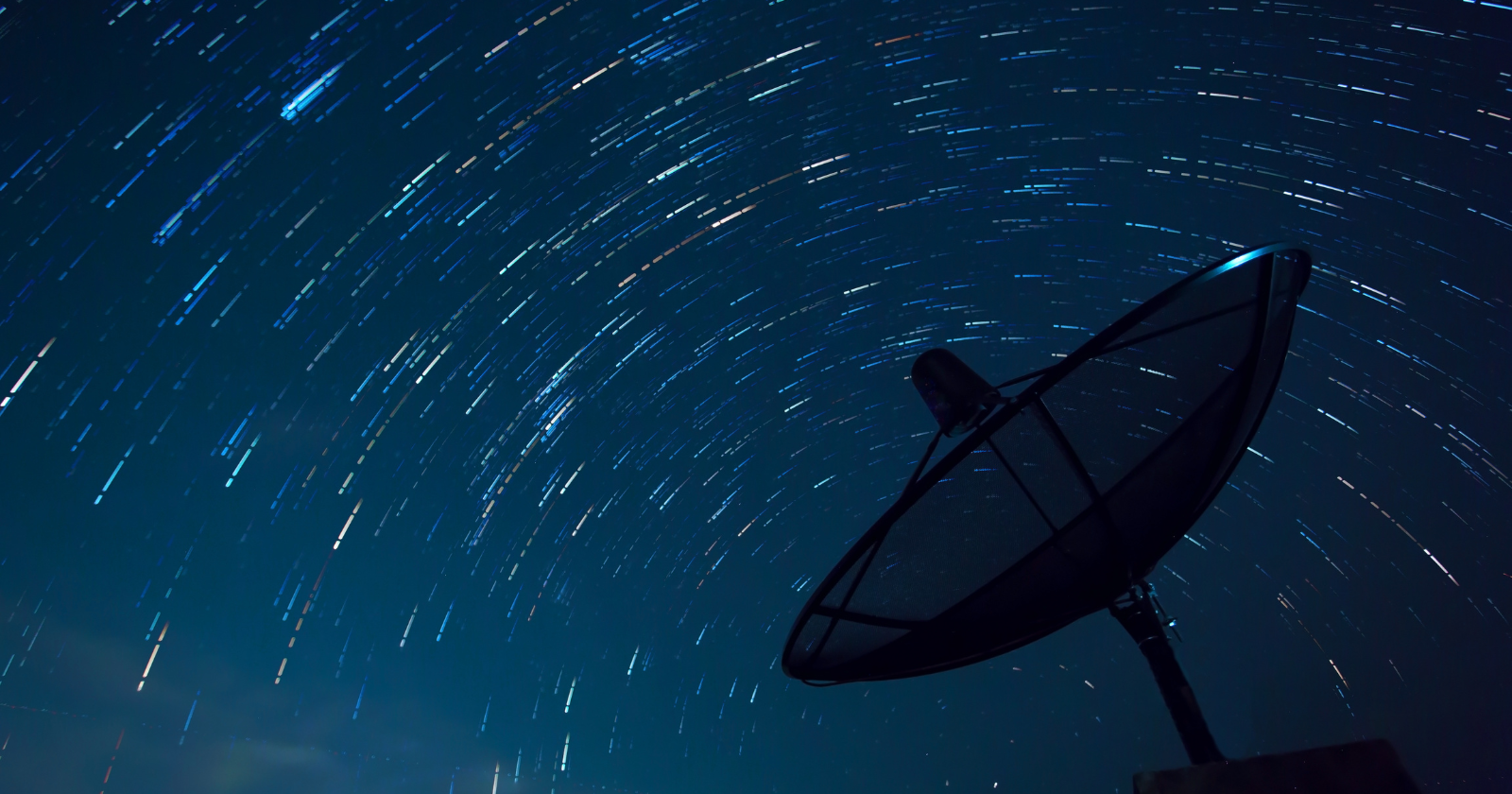
SpaceX’s first-generation AI data-center satellite is not a faint box in orbit. The reported AI1 design stretches about 70 meters across when deployed, carries a compute payload rated around 120 kilowatts on average and 150 kilowatts at peak, and uses up to 110 square meters of radiators to dump heat into space.
That geometry is why astronomers are watching the idea with such unease. A spacecraft that wide, reflective, and thermally exposed is not just a data-center proposal. It is a moving optical object, crossing the same dark sky that the Vera C. Rubin Observatory is about to scan with the largest digital camera ever built for astronomy.
The number attached to the plan is even stranger. SpaceX has been reported to have filed for or discussed a constellation that could eventually reach as many as 1 million orbital data-center satellites, a scale far beyond the roughly tens of thousands of satellites that already worry observatories.
The old version of this article used a stronger claim: that the full constellation would make the sky as bright as a half-moon everywhere on Earth. That claim is not used here because it could not be verified to a primary public source. The verified warning is narrower, but still severe: peer-reviewed and preprint modeling shows that very large or very bright satellite constellations can damage astronomical images through streaks, glints, detector saturation, false alerts, and added sky background.
A data center with wings wider than a jumbo jet
According to Tom’s Hardware’s report on SpaceX’s AI1 design, the first-generation craft would span about 70 meters when deployed, slightly wider than the 68.4-meter wingspan of a Boeing 747-8. The same report describes an average compute load of 120 kilowatts, a 150-kilowatt peak, and operation at roughly 600 kilometers altitude.
Those figures matter because optical astronomy is sensitive to surface area, altitude, attitude, and reflectivity. A satellite does not have to look bright to the unaided eye to be damaging to a long astronomical exposure. It only has to throw enough sunlight into a detector built to capture photons from objects billions of times fainter.
The radiator figure is the detail that turns a computing story into a sky story. On Earth, a rack-scale AI system can shed heat into circulating air and water. In orbit, there is no air and no water sink. Heat has to leave through radiators, which means a spacecraft built to compute at high power also has to carry surfaces designed to face cold space.
That does not automatically mean AI1 would be disastrously bright. Brightness depends on coating, orientation, phase angle, orbital altitude, and whether the spacecraft is in deployment, parking, or operational mode. But it does mean the relevant object is not a small Starlink-like box. It is a large deployed spacecraft with solar arrays, radiators, and thermal surfaces that astronomers would need to model before they could know how much sky it changes.
Why magnitude 7 became the line astronomers keep returning to
The most repeated technical threshold in the astronomy debate is magnitude 7. In the astronomical magnitude system, lower numbers mean brighter objects. Venus can appear around magnitude -4, bright stars sit near magnitude 0 or 1, and the unaided human eye under dark skies generally stops around magnitude 6 or a little fainter.
For modern survey telescopes, naked-eye visibility is the wrong test. A satellite can be invisible to a person and still saturate a scientific detector. In a 2025 Rubin Observatory LSST workshop report, participants reaffirmed the recommendation that tracked low-Earth-orbit satellites should be no brighter than 7th AB magnitude for the protection of Rubin-style optical survey work.
That recommendation came after years of Starlink mitigation work. A 2020 Rubin Observatory study on LEO satellite brightness and trail effects found that the original Starlink satellites were around g magnitude 4.5, while the experimental DarkSat reached about g magnitude 6.1. The authors wrote that future darkening might reach g magnitude 7, a level at which nonlinear image artifacts could be corrected far below background noise, though the trails would still remain.
A later study of Starlink Mini brightness distributions found that the sky area containing satellites brighter than magnitudes 6 and 7 is largest during twilight. That matters for surveys looking near the Sun’s direction, including searches for near-Earth asteroids and other objects that are hardest to observe in full darkness.
SpaceX has been credited by some astronomers for engaging on brightness mitigation more seriously than many operators. That history is real. It is also the reason AI1 is being judged against a known standard rather than a vague complaint about satellites looking ugly in long-exposure photographs.
Rubin Observatory is built to find faint things quickly
The Vera C. Rubin Observatory sits on Cerro Pachón in Chile, where its Legacy Survey of Space and Time is designed to scan the southern sky repeatedly for ten years. Its wide field, fast cadence, and enormous LSST Camera are what make it powerful. They are also what make it exposed.
Rubin is meant to catch things that move, flare, fade, or appear only once: supernovas, asteroids, distant Solar System bodies, variable stars, and optical counterparts to gravitational-wave events. A satellite trail is not just a line through a pretty picture. It can mask pixels, create residual noise, trigger false detections, and contaminate the statistical measurements that depend on clean repeated imaging.
In a 2022 Rubin satellite-avoidance study, researchers simulated Starlink and OneWeb constellations totaling about 40,000 satellites. They found that, with reasonably accurate orbit forecasts, sacrificing about 10 percent of LSST observing time could cut the fraction of visits with streaks by about half.
That is a mitigation, not a cure. The same paper noted that the need for avoidance depends on satellite brightness, glints, low-surface-brightness residuals, and the effect on alert purity and systematic errors. Those are exactly the unknowns that a very large orbital data-center constellation would multiply.
A million satellites would not behave like 40,000 satellites scaled up neatly on a spreadsheet. Launch cadence, parking orbits, orbit raising, failed units, replacements, attitude modes, and end-of-life disposal would all matter. The sky problem is not just the final architecture. It is the moving assembly line required to build and maintain it.
BlueWalker 3 showed what one large reflective spacecraft can do
Astronomers already have a warning case for large deployed satellites. AST SpaceMobile’s BlueWalker 3 unfolded a large phased-array antenna in 2022, and observers quickly found that it became one of the brighter artificial objects in the night sky.
In a 2023 photometric study of BlueWalker 3, Anthony Mallama, Richard E. Cole, Scott Tilley, Cees Bassa, and Scott Harrington reported that the satellite was most frequently between magnitudes 2.0 and 3.0, and about magnitude 1.4 when near zenith. That is bright enough to rival prominent stars.
A follow-up BlueWalker 3 Redux paper found that the spacecraft later faded, with the average maximum luminosity near zenith reduced from magnitude 1.0 to 2.2. Even after that improvement, the authors wrote that it remained usually bright enough to interfere with astronomical research.
The lesson is not that AI1 would necessarily match BlueWalker 3. The spacecraft are different. The lesson is that large deployed areas in low Earth orbit can become astronomy problems immediately, and mitigation may depend on details that are hard to judge from a promotional render: the underside coating, the solar-array angle, the radiator attitude, and the exact shape of the reflectance curve.
Space Daily has also covered the broader expansion of satellite constellations and radio astronomy concerns, a parallel problem in which optical glare is only one part of a larger fight over the usable sky.
Glints are a separate problem from streaks
Satellite streaks are the obvious signature. A spacecraft crosses a long exposure and draws a bright line across a frame. Glints are shorter and more deceptive: a flat surface briefly catches sunlight and flashes, sometimes for milliseconds, sometimes in a way that looks less like a moving satellite and more like a sudden astrophysical event.
A 2023 study of satellite glints in ZTF and LSST-style surveys found that artificial satellites and space debris can create false point-source alerts that hinder the search for rapid transients. Using more than three years of Zwicky Transient Facility data, the authors estimated that at least 20 percent of isolated single-frame events were related to artificial satellites, with an all-sky glint rate up to 80,000 per hour.
That is the kind of noise Rubin was not built to ignore casually. A survey that watches the sky for one-off flashes has to decide whether a bright pixel is a satellite reflection, a detector artifact, a supernova, a gamma-ray burst afterglow, a kilonova, or something nobody has classified before.
If an orbital data-center satellite has large radiators, solar arrays, and changing attitude states, its glint behavior matters as much as its average brightness. The most damaging moment may not be the average pass. It may be the rare angle where a thermal or power surface sends sunlight straight into the telescope.
The most defensible warning is not a half-moon, but a crowding limit
The strongest recent modeling does not need the unverified half-moon line. In a 2026 study of large and bright satellite constellations, European Southern Observatory astronomer Olivier Hainaut modeled direct trail losses, diffuse satellite light, and scattered sky brightness from proposed constellations.
The results separate dim satellites from bright ones. Hainaut found that a constellation of about 60,000 satellites kept fainter than the V 550-kilometer magnitude-7 recommendation would add only about one ten-thousandth of the natural dark-sky brightness. But the same study found that constellations with 1 million satellites make trails pervasive, and that extremely bright reflector-style constellations could raise the scattered sky background by 200 to 300 percent.
The study also recommended keeping the total satellite population below roughly 100,000 if field-of-view losses are to remain comparable to ordinary technical downtime. That figure is not a law of physics or an international regulation. It is a modeled guardrail for astronomy, and SpaceX’s discussed million-satellite scale sits an order of magnitude beyond it.
This is the defensible version of the warning: not that AI1 has already been proven to turn every sky into permanent moonlight, but that a million large spacecraft would push astronomy into a regime where the existing mitigation playbook was never designed to operate. At that scale, even individually managed satellites become a foreground population.
For now, the sky still changes the old way. Twilight lowers, satellites brighten and fade, and the dark between them returns. The question raised by orbital data centers is whether that darkness remains a background condition of astronomy, or becomes something telescopes have to chase between machines.
