

Starship Flight 13 crossed more than 16,000 kilometres from Texas to the Indian Ocean. Its upper stage deployed satellites, restarted an engine in space, survived atmospheric entry and reached the water intact. None of that answered the question that sits between Starship as a powerful launcher and Starship as a high-capacity Mars transport.
A Starship arriving in low Earth orbit has completed an extraordinary climb, but it has burned most of the propellant loaded before launch. To depart for Mars with the payloads SpaceX describes, the ship must be filled again above the atmosphere. That means separate tanker Starships must launch, rendezvous, dock and transfer very large quantities of liquid methane and liquid oxygen.
Spacecraft have refuelled other spacecraft for nearly half a century. What has not happened is the particular operation Starship requires: two independently launched, giant vehicles connecting in orbit and moving cryogenic propellant on a scale that may eventually reach hundreds of tonnes, then repeating the process across multiple tanker flights.
As of Flight 13 on 24 July 2026, SpaceX had not attempted it.
“Biggest” is a judgement, but not an arbitrary one
There is no official table ranking Starship’s unfinished technologies from largest to smallest. Repeated heat-shield reuse, rapid upper-stage recovery, long-duration life support and landing heavy cargo on Mars are all difficult. Any crewed mission would fail if even one indispensable link were missing.
Orbital refuelling stands apart because the published architecture does not close its deep-space propellant budget without it. More thrust at liftoff does not solve the problem. A larger ship also requires more energy to accelerate, and the upper stage spends most of its launch load simply reaching orbital speed.
NASA’s March 2026 inspector-general report called large-scale vehicle-to-vehicle cryogenic transfer one of the most significant technical challenges facing the Starship Human Landing System. The Government Accountability Office’s July assessment still listed cryogenic propellant management as a top programme risk.
Those judgements concern NASA’s lunar lander, not a completed SpaceX Mars design. The underlying capability is shared. If Starship cannot aggregate propellant in Earth orbit for the Moon, it cannot perform the much larger transport role proposed for Mars.
The first orbital refuelling happened in 1978
The history begins with Salyut 6, a Soviet space station designed for stays long enough to exhaust supplies brought at launch. The uncrewed Progress 1 cargo vehicle launched on 20 January 1978 and docked automatically two days later while cosmonauts Yuri Romanenko and Georgi Grechko were aboard.
According to NASA’s history of the mission, the first fuel transfer ran on 2 and 3 February. Progress carried roughly 1,000 kilograms of propellant and oxygen alongside food, equipment, mail and fresh fruit. After refuelling, pressurised nitrogen purged the lines so toxic residue would not spill around the docking hardware during separation.
A NASA technical history gives more engineering detail. Progress held about 870 kilograms of propellant in four tanks, two for nitrogen tetroxide oxidiser and two for a hydrazine-family fuel. High-pressure nitrogen pushed the fluids out while membranes kept liquid separated from pressurising gas. Fuel and oxidiser travelled one at a time through dedicated connections.
That architecture became routine. Progress vehicles refuelled Salyut, Mir and later the International Space Station. In 2008, Europe’s Jules Verne Automated Transfer Vehicle delivered 811 kilograms of propellant to the ISS in a single transfer.
It is therefore wrong to say no spacecraft has ever docked and transferred rocket propellant. The novelty lies in the state and quantity of Starship’s fluids, the scale of the vehicles and the repeated role refuelling plays in the mission.
Progress transferred storable chemicals, not cryogenic oxygen and methane
The propellants carried by Progress were unpleasant and toxic, but they could remain liquid at ordinary spacecraft temperatures. They are called storable propellants for a reason. A tanker could wait in orbit without continuously fighting to keep its cargo below the boiling point.
Starship uses liquid oxygen and liquid methane. Both must remain extremely cold. Heat leaks through insulation, structural supports, pipes and valves. Some liquid boils into gas, raising tank pressure. The system must control that pressure by cooling, recondensing, consuming or venting vapour.
Venting protects a tank but discards propellant. On a short demonstration, the loss may be manageable. During a multi-launch aggregation campaign, a depot or mission ship may wait days or weeks while later tankers launch. The rate of heat entry becomes part of the mission’s usable-payload calculation.
The cold also reaches the hardware. Transfer lines need to be chilled before steady liquid flow can begin. Initial propellant may flash into vapour as it cools warmer plumbing. Metals contract, seals change dimensions and valves must work without leaking. Methane and oxygen need separate paths, separate control and a connection that prevents the two from meeting anywhere except inside an engine.
In free fall, the tank has no reliable bottom
A propellant tank on the launch pad is conceptually easy to drain. Gravity holds liquid over the outlet and vapour rises above it. In orbit, the spacecraft and everything inside it are falling together. Liquid can spread along walls, gather in disconnected blobs and slosh as the vehicle turns.
If a transfer system opens while vapour covers the outlet, it can pull gas into the line. Flow becomes two-phase, pressure changes and the receiver may get much less liquid than the instruments appear to show. The same problem matters when an engine tries to restart.
Starship’s planned method uses a small sustained acceleration to settle propellant towards the desired end of the tank. Pressure in the source tank can then drive liquid through the connection. The acceleration does not need to resemble Earth gravity; it only needs to give the fluid a consistent direction long enough for a controlled transfer.
The receiving ship has its own work. It must make room for incoming liquid by managing gas pressure, avoid excessive splashing or heating, and approach a high fill level without overpressurising. NASA’s technology summary identifies tank-pressure control, propellant settling, line chill-down, two-phase flow and high-fill-fraction operation among the central risk areas.
Flight 3 completed a genuine cryogenic transfer
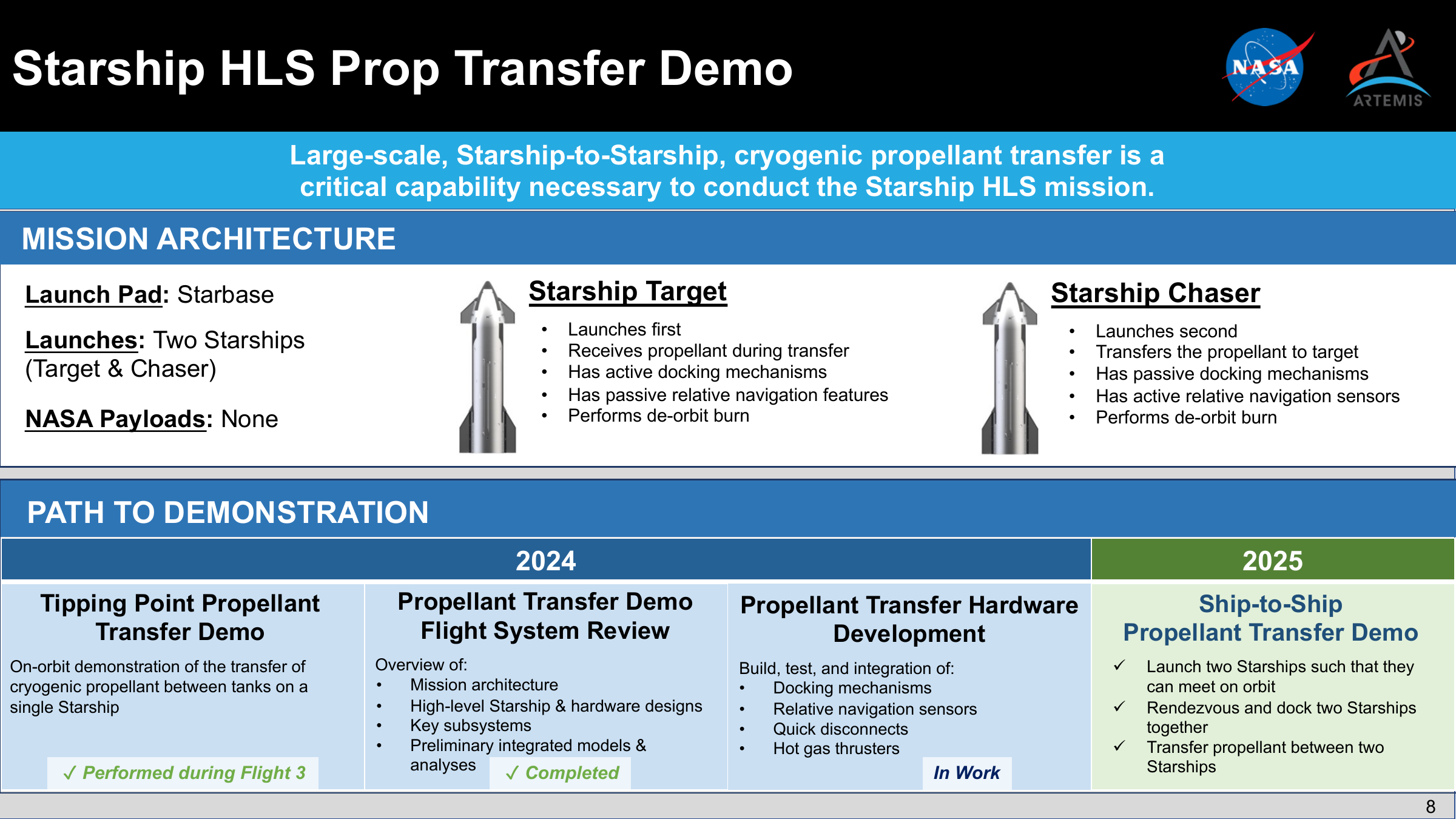
SpaceX has already performed one relevant experiment in flight. On 14 March 2024, the third integrated Starship moved more than three metric tonnes of liquid oxygen from a smaller header tank near the nose into the main oxygen tank lower in the same ship. NASA reviewed the result and marked its Tipping Point milestone complete.
A NASA engineering presentation explains that the vehicle applied a controlled milli-g acceleration to settle the liquid. Pressurising the header tank created most of the pressure difference that drove flow through a control valve and calibrated orifice. The operation began about 24 minutes and 35 seconds after launch and ended at 26 minutes and 10 seconds.
That is less than 100 seconds, but it was not a token laboratory trick. Multiple tonnes of cryogenic oxygen moved in low gravity inside a full-scale Starship. Models of fluid location, pressure and two-phase flow predicted the behaviour well enough for the experiment to meet NASA’s requirement.
The distinction is equally important. Both tanks and every connecting pipe were built into one vehicle and inspected before launch. No second ship had to reach orbit. No navigation system had to bring two 50-metre-class spacecraft together. No coupling had to mate after exposure to launch, vacuum and thermal cycling.
SpaceDaily’s earlier assessment of the refuelling gap after 13 flights treated Flight 3 as meaningful progress without confusing it with a tanker demonstration. That remains the right balance. Internal transfer retired part of the fluid-management risk. It did not retire rendezvous, docking or vehicle-to-vehicle plumbing.
Docking two Starships creates a different machine
NASA’s published demonstration architecture names the first vehicle the target and the second the chaser. The target carries active docking mechanisms and receives propellant. The chaser carries active relative-navigation sensors, approaches the target and supplies the fluid.
The two launches must first reach compatible orbits. Small timing or performance differences determine how much manoeuvring is needed before rendezvous. The chaser then has to measure range, closing speed and orientation accurately enough to approach without collision.
Docking is not merely touching noses. The interface must capture the vehicles, pull them into a firm alignment and carry structural loads. It must also create fluid connections tight enough for cryogenic methane and oxygen. Quick-disconnect hardware has to mate in orbit, remain sealed during transfer and separate without leaving hazardous residue around either ship.
Attitude control continues throughout. Settling thrusters accelerate the joined pair while tonnes of liquid move from one side of the docking interface to the other. The centre of mass shifts. Flexible structures and sloshing propellant can respond to control inputs. Guidance software must treat the connected ships as one changing vehicle.
A 2024 NASA briefing on the demonstration listed docking mechanisms, relative-navigation sensors, quick disconnects and hot-gas thrusters as hardware under development. Its chart placed the ship-to-ship test in 2025. That date is now useful as history, not as a current schedule.
Hundreds of tonnes is a different operational class
SpaceX does not publish enough current V3 mass and mission data to calculate a definitive Mars refill. An older federal environmental assessment placed the earlier Starship upper stage’s full propellant load at as much as 1,500 metric tonnes. Vehicle capacity, dry mass and performance have changed since then.
The title therefore says “hundreds of tonnes”, not a precise total. A high-payload departure need not receive every kilogram the tanks can hold, but it requires far more than the minimum three-tonne Flight 3 demonstration or the sub-tonne station-refuelling heritage.
How much one tanker can deliver is not the amount it carries at liftoff. The tanker burns most of that load reaching orbit and must retain reserves for its own operations and disposal or recovery. The useful delivery depends on launch performance, tanker dry mass, target orbit, residuals, boil-off and transfer efficiency.
This is why several tanker flights appear in every serious description of the architecture. In a 2021 bid-protest decision, the GAO disclosed that one early SpaceX lunar concept used fourteen tankers in a sixteen-launch sequence. That was an older proposal for a particular lunar mission, not a current Mars requirement. Quoting fourteen as a timeless answer would be misleading.
The number will move as the vehicle and mission change. The deeper requirement does not. Starship must turn propellant delivery into a repeatable orbital service rather than a rare experiment.
Knowing when the tank is full is its own problem
On Earth, a tank’s liquid level can be related to a stable up-and-down direction. In microgravity, the fluid arrangement depends on acceleration, surface tension, tank geometry and slosh. A level sensor placed at one height may be wet one moment and surrounded by vapour the next.
The transfer system can estimate delivered mass from pressure, temperature, flow and vehicle dynamics, but each measurement carries uncertainty. Radio-frequency techniques can infer fluid quantity from how the tank’s electromagnetic response changes. None removes the need for calibration across different fill states and operating conditions.
Too little propellant leaves the departure burn short of margin. Too much can reduce the vapour space needed to absorb thermal expansion and control pressure. A successful demonstration should therefore show not just that liquid flowed, but that the team can account for what left one tank and arrived in the other.
For Mars, small percentage errors become large masses. A two-percent uncertainty on a transfer of several hundred tonnes is itself several tonnes. Gauging is not the most cinematic part of refuelling, but it determines whether mission planners can trust the result.
A tanker campaign makes the launch pad part of the spacecraft
One target and one chaser can prove the connection. An operational refill needs a sequence. Tankers must be built or turned around, launched into the correct orbital plane and processed quickly enough that the receiving vehicle does not wait indefinitely.
The NASA inspector general noted that SpaceX had not demonstrated the 12- to 24-day pad turnover assumed for HLS propellant aggregation. That observation does not define Starship’s eventual cadence. It shows that flight rate and fluid storage are coupled risks.
If a tanker launch slips, the depot continues absorbing heat. If too much propellant boils off, an additional tanker may be needed. Adding a flight extends the schedule and introduces another rendezvous, docking and transfer. Ground weather, pad maintenance and vehicle inspections can therefore change the mass available for a burn in orbit.
Reliability compounds in the same way. A Mars departure does not merely require one successful Starship launch. It requires the mission ship, its tankers, the ground systems and the transfer sequence to succeed closely enough together that the campaign reaches the required load.
The Moon is paying to mature a Mars technology
NASA’s Human Landing System contract gives SpaceX a near-term customer for orbital refuelling. The lunar Starship is launched without crew, refilled in low Earth orbit and sent towards the Moon. Astronauts arrive separately in Orion and meet the lander in lunar orbit.
NASA’s fiscal 2026 technical supplement described a dedicated two-Starship propellant-transfer demonstration. One tanker would rendezvous and dock with another Starship before transferring propellant. A later uncrewed lunar demonstration would dock the lander with a depot, refill it and attempt the lunar sequence.
Schedules have moved. The inspector general said a vehicle-to-vehicle test originally planned for March 2025 had slipped to March 2026. GAO’s July 2026 assessment described both the long-duration and propellant-transfer tests as 2026 milestones. Flight 13 passed without either vehicle-to-vehicle transfer occurring.
SpaceX’s own August 2026 update continued to describe ship-to-ship transfer as a future HLS flight test targeted for 2026, with exact timing dependent on the V3 campaign. A target year is not a launch date, and another schedule change would not by itself prove the technology unworkable. It would leave the architectural risk open for longer.
Flight 13 advanced the platform, not the transfer
Flight 13 launched on 24 July 2026. SpaceX’s mission record describes an upper stage that completed ascent, deployed 20 Starlink V3 satellites, relit a Raptor engine, survived re-entry and performed its landing burn before splashing down in the Indian Ocean.
SpaceDaily’s comparison of Flight 1 and Flight 13 showed how much control the programme gained between April 2023 and July 2026. The first integrated vehicle damaged its pad and failed before stage separation. Flight 13’s ship completed a sequence lasting more than an hour and finished intact thousands of kilometres away.
That progress matters to refuelling because NASA and SpaceX expect the transfer demonstration to use the V3 architecture. A tanker mission cannot proceed until two suitable ships can reach and operate in orbit. Engine relight, navigation, power, communications and stable attitude control are enabling pieces.
Flight 13 did not fail a refuelling test. Its plan contained no second Starship, rendezvous or transfer. Describing the missing demonstration as a failure of Flight 13 would be unfair. The accurate statement is narrower: after thirteen integrated tests, the dedicated ship-to-ship milestone still lay ahead.
What a convincing first demonstration must do
The first threshold is visible: launch two Starships, place them in compatible orbits, rendezvous and dock. The less visible threshold begins when the valves open.
The system must chill the lines, settle the source fluid, control both tank pressures and establish stable flow. Instruments must distinguish liquid transfer from vapour movement and quantify the received mass. Guidance has to manage the joined vehicles while their mass distribution changes.
Afterwards, the system must close valves, isolate the fluids, vent or recover trapped material safely and release the docking mechanism. Both ships need enough control to separate and execute their planned disposal or return manoeuvres. A clean transfer followed by a dangerous undocking would not complete the demonstration.
NASA’s current in-space cryogenic transfer guidelines are deliberately broader than one contractor. They exist because independent spacecraft have never demonstrated cryogenic propellant transfer. Starship will be testing a new class of operation, even though docking and non-cryogenic refuelling separately have long histories.
A first mission may transfer one fluid and a limited amount to retire the highest uncertainties. An operational architecture eventually needs both methane and oxygen, high receiving-tank fill levels, useful storage duration and repetition. Demonstration is the beginning of qualification, not its end.
Mars adds another refuelling system on the surface
Earth-orbit aggregation solves the departure problem. It does not by itself provide a round trip. A Starship that lands on Mars needs propellant to leave the surface and begin the journey home.
SpaceX proposes making methane and oxygen on Mars, using carbon dioxide from the atmosphere and water obtained locally. The chemistry is understood. The unresolved task is building a remotely operated mine and chemical plant that can produce, purify, liquefy and store very large quantities before a crew depends on them.
Sending return propellant from Earth would itself demand more launch and transfer capacity. Producing it on Mars shifts mass away from Earth but creates reliance on surface power, water access, compressors, reactors, cryogenic storage and maintenance without a local industrial base.
The two refuelling problems are related but should not be collapsed into one. Orbital transfer is an immediate prerequisite for sending a heavily loaded ship outwards. Mars production is the proposed answer for bringing it back.
The title does not make every other problem small
Calling refuelling the biggest unproven technology is an assessment of the architecture, not a claim that the rocket is finished or that distance has become trivial.
No Starship upper stage has been caught by a launch tower, refurbished after spaceflight and flown again. SpaceDaily’s examination of the proposed upper-stage tower catch described a separate dependency: a system built around low-cost tanker flights needs the expensive ship hardware to return without ocean recovery and fly repeatedly.
A crewed Mars mission adds months of life support, radiation exposure, medical autonomy and communications delay. Entry and landing must work with a vehicle far heavier than anything landed on Mars. Surface power and habitats must survive before people arrive. The heat shield must remain reliable across Earth and Mars entries.
Even an uncrewed cargo mission needs departure accuracy, long-duration power, thermal control, autonomous fault response and a Mars landing. Refuelling does not solve these. It makes the mission’s mass and energy budget possible enough for the remaining systems to matter.
The operation is old; the regime is new
Progress 1 is a useful antidote to the idea that orbital refuelling belongs entirely to science fiction. In 1978, one spacecraft found a station, docked, connected propellant lines and replenished its tanks. Similar operations became part of ordinary station logistics.
Starship cannot simply scale that hardware. Progress moved less than a tonne of storable fuel and oxidiser into a station. Starship’s mission may require hundreds of tonnes of two cryogenic fluids, transferred between vehicles whose own movements, thermal state and changing mass must be controlled across repeated encounters.
Flight 3 showed that SpaceX can settle and move multiple tonnes of liquid oxygen inside one ship. Flight 13 showed that a V3 upper stage can complete a long sequence in space and return intact. Both are relevant. Neither connected a tanker to a receiver.
The next decisive image will probably look quieter than a launch. Two Starships will meet above Earth, hold still relative to one another and make an invisible mass move through cold pipes. If that works once, SpaceX will have crossed a threshold. If it can be repeated predictably, Starship begins to become the transport system its Mars plans require.