

The most conspicuous missing hardware on SpaceX’s Starship upper stage is not an oversight. There are no landing legs folded against its stainless-steel hull, no feet waiting to deploy and no prepared pad on which the returning spacecraft is supposed to settle. SpaceX intends the launch site itself to catch the vehicle.
On 20 August, Elon Musk gave that audacious plan its newest, still provisional timetable. “Looks like we will probably catch the ship with the tower in a few months,” he wrote on X. He added that if the tower had been standing where the most recent Starship splashed down, the spacecraft would have been caught.
That is a forecast, not a launch date. SpaceX has not named the flight that will make the attempt, and Musk’s new wording appears to supersede his 25 July suggestion that the catch could happen on the next flight unless the latest data revealed a problem. The reason for the apparent delay has not been publicly established. Technical readiness, the health of the chosen vehicle and tower, range safety and federal approval all have to align before a returning spacecraft is allowed anywhere near Starbase.
The rocket and the ship are easy to confuse
Starship is the name SpaceX uses for two related things: the complete two-stage launch vehicle and its upper stage. The lower stage is Super Heavy, the enormous booster that provides the first minutes of ascent. The upper stage, commonly shortened to Ship, continues toward space, carries payload and then faces the much harder thermal and navigational problem of coming home from orbital speed.
SpaceX’s current technical description of Starship V3 gives the complete vehicle a height of 124.4 metres and a launch mass of about 5,533 tonnes. Its 33 Raptor engines are expected to produce roughly 18 million pounds-force of thrust at liftoff. For comparison, NASA puts Saturn V thrust at 7.6 million pounds. By that measure, Starship generates about 2.4 times as much liftoff thrust as the rocket that carried Apollo crews to the Moon.
As SpaceDaily previously examined, extraordinary thrust does not mean the rest of the architecture is finished. Starship still needs to demonstrate major capabilities including orbital propellant transfer and upper-stage reuse. The tower catch belongs to that second category, and it is the upper stage, not the whole 124-metre stack, that would return to the arms after re-entry.
Why SpaceX removed the landing legs
Landing gear looks passive only after it has worked. Legs need hinges, actuators, locks, feet, plumbing or wiring, and reinforced load paths through the vehicle. They must absorb landing forces without collapsing, remain protected during launch, and deploy reliably after a flight through vacuum and plasma. Every kilogram of that equipment becomes dry mass that the rocket has to accelerate and decelerate on every mission.
Legs would be especially awkward on Ship. Much of its windward side is covered in ceramic heat-shield tiles, and its base is crowded with engines and plumbing. Adding deployable structures would create more interfaces to seal, shield and inspect. SpaceX’s alternative places much of the recovery mechanism on the ground, where its weight never has to reach space. The company’s Starship overview says its towers are designed to integrate, test, launch and catch both stages.
The tower also offers an operational advantage beyond mass. A vehicle caught beside its launch mount does not have to land on another pad, be secured to a transporter and make a slow journey back. In SpaceX’s intended system, the arms can hold the returning stage and eventually help move it into another inspection and stacking cycle. That is why the catch is central to the company’s ambition for aircraft-like operations rather than simply a dramatic way to finish a flight.
The bargain is dependence. A legged vehicle can tolerate some error within a landing zone and can, at least in principle, use more than one suitable pad. Ship must arrive at one precisely prepared tower. It needs that tower to be healthy, clear and ready at the end of its flight, while a failure close to the structure could damage the same equipment needed for later launches.
SpaceX has caught a booster, but never a ship
The catch is no longer just an animation. On 13 October 2024, Super Heavy returned to Starbase after Starship Flight 5, hovered between the tower’s two arms and was captured above the ground. SpaceDaily reported at the time that the first attempt succeeded while the upper stage continued across the Atlantic and Indian oceans.
That achievement proved the tower, the arms and the booster could cooperate in real flight. It did not prove the same sequence for Ship. Super Heavy separates only minutes after launch and follows a relatively short return. The upper stage travels far faster and farther, then survives sustained atmospheric heating behind thousands of heat-shield tiles before it can even begin a landing manoeuvre.
The two stages also approach the tower differently. The booster descends tail-first under engine power. Ship spends much of re-entry and descent in a high-drag, belly-first attitude, using two forward flaps and two aft flaps to control its path. Near the surface it must ignite its landing engines, rotate to vertical and arrest its remaining speed. That flip has been demonstrated over the ocean and by earlier prototypes, but combining it with a narrow tower capture is the new task.
Flight 13 supplied the strongest evidence yet
Starship Flight 13 on 24 July changed the catch discussion because Ship 40 did more than reach the Indian Ocean. According to SpaceX’s mission account, it completed its planned in-space objectives, survived re-entry and performed a landing burn before splashdown. Musk subsequently described its accuracy as sufficient for a tower catch.
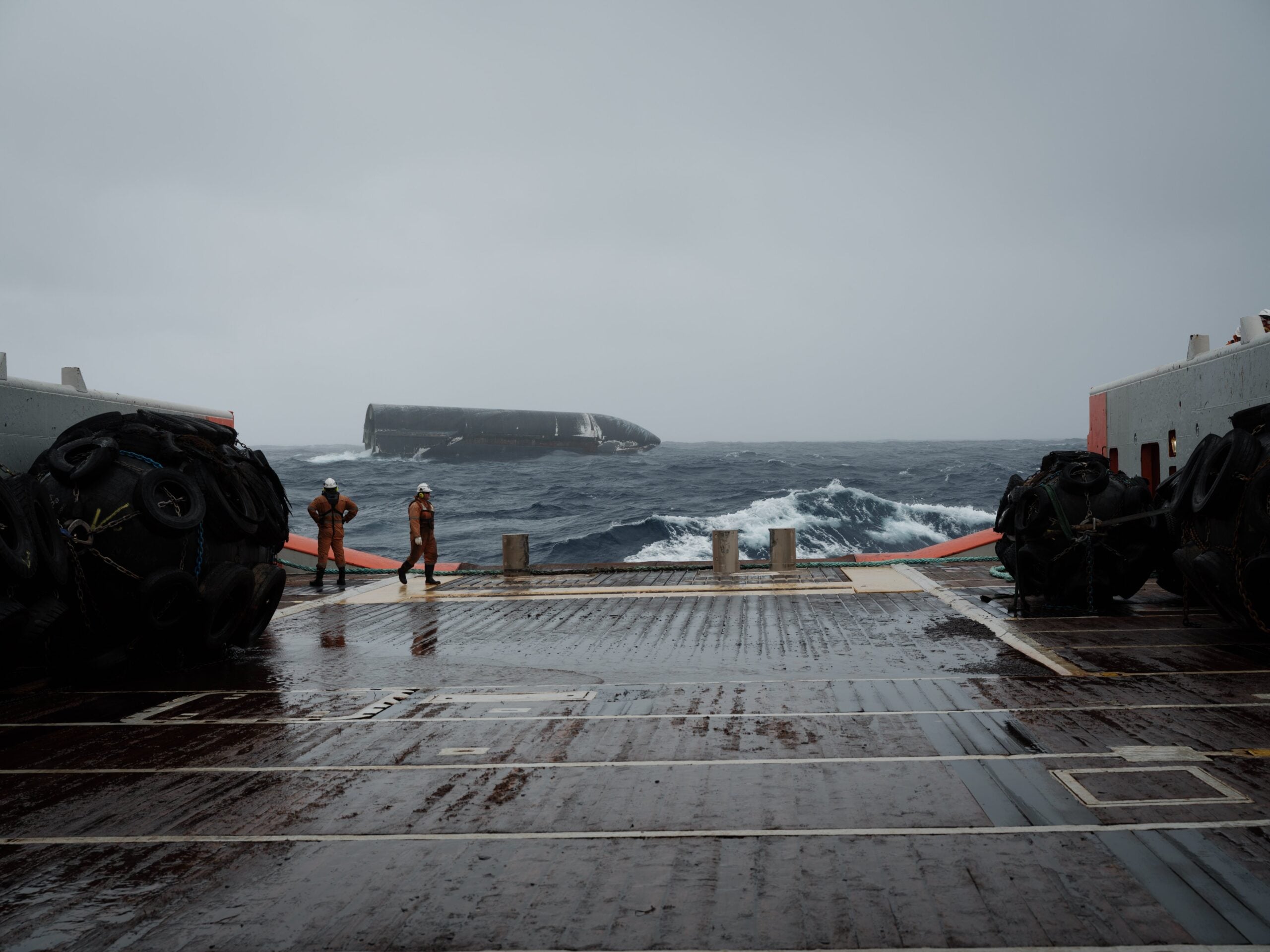
The physical spacecraft also lasted far longer than expected in the water. After roughly 24 days at sea, recovery crews brought it to calmer waters off Christmas Island for inspection. SpaceDaily covered Ship 40’s intact recovery as a rare opportunity for engineers to examine an upper stage after its full heating, landing and ocean exposure.
That result is encouraging, but an ocean target is not a steel tower. The splashdown zone was chosen to put distance between an experimental vehicle and people or valuable infrastructure. A real catch has a much smaller acceptable envelope. The ship has to control its position, orientation and velocity closely enough for the arms to take its load, while onboard software and ground systems retain the option to abort the approach if a parameter is wrong.
Ship 40’s saltwater ordeal also illustrates the difference between recovery and reuse. The vehicle survived as an inspectable test article, but weeks in the ocean and a difficult marine operation are almost the opposite of the planned turnaround system. A successful tower catch would keep the hardware out of seawater and deliver it directly to the place where SpaceX can assess whether it is fit to fly again.
A catch compresses several hard problems into seconds
Before the arms can do anything, the ship must survive the energy of re-entry. Its thermal-protection system has to keep the stainless-steel structure and internal equipment within acceptable temperatures despite damaged or missing tiles. Earlier SpaceDaily coverage of reusable heat shields explained why this remains one of the enabling technologies for spacecraft meant to fly repeatedly rather than be discarded.
The ship then has to manage a rapidly changing propellant environment. After a long coast and a belly-first fall, fuel and oxidiser must be in the right place for reliable engine ignition. The vehicle must execute its flip, establish a stable vertical descent and reach the capture corridor with little horizontal motion. Wind, engine performance and navigation error all have to remain inside the limits assumed by the flight software.
At the tower, the choreography becomes a joint decision. The arms must be positioned and ready; sensors and communications must be healthy; and the launch site must confirm that the approach is safe. SpaceX has generally described a system in which the vehicle presents reinforced capture points to the arms. The exact procedures and final hardware can still evolve, so public animations should not be mistaken for a complete operational manual.
The no-legs design makes the logic stark. If the tower cannot accept the spacecraft, Ship needs a safe contingency trajectory rather than a second way to stand on land. That is efficient when everything is available and a constraint when it is not.
The regulator is part of the flight sequence
A return to the launch site cannot be added to a test flight solely by company decision. The Federal Aviation Administration must determine that the licensed operation protects public safety, and environmental reviews help define the impacts and conditions associated with changed flight profiles.
The FAA’s Starship environmental review page says it completed an assessment for updated return-to-launch-site mission profiles at Boca Chica. A separate draft assessment has considered Pacific contingency areas and an additional return trajectory for cases in which the catch tower is unavailable or vehicle and safety conditions prevent a Starbase landing. Environmental completion and a mission-specific launch licence are related steps, but they are not the same approval.
Musk has previously made the first catch explicitly conditional on regulatory clearance. Nothing public establishes that regulation caused his timeline to move from the next flight to “a few months,” however. Starship schedules often change as hardware is tested and flight data is reviewed. The defensible conclusion is narrower: no catch flight has a publicly confirmed date, and a safe contingency route is part of making one licensable.
Being caught is not the same as being reusable
If Ship settles between the arms, the pictures will make it look like the end of the story. Operationally, it will be the beginning of a more important test. Engineers will inspect its tiles, flaps, tanks, engines, plumbing and structure. They will measure how much work is required before the stage can be trusted again. Musk has said the first reflight of a ship could occur near the end of 2026 or early in 2027, but that too remains a forecast rather than a commitment.
A catch would still be a consequential step. It would validate the choice to delete the legs, demonstrate terminal guidance beside the tower after an orbital-class re-entry and preserve a flight article without saltwater immersion. It would also give SpaceX the best opportunity yet to learn whether the upper stage can move from recovered hardware to reusable transport.
The distinction matters because the most powerful rocket in history was not designed merely to land for an audience. It was designed to fly often enough that recovering both stages becomes routine. The giant arms are the visible mechanism. The real objective begins after they close: inspect the ship, understand what the flight consumed and send the same vehicle back to space.