

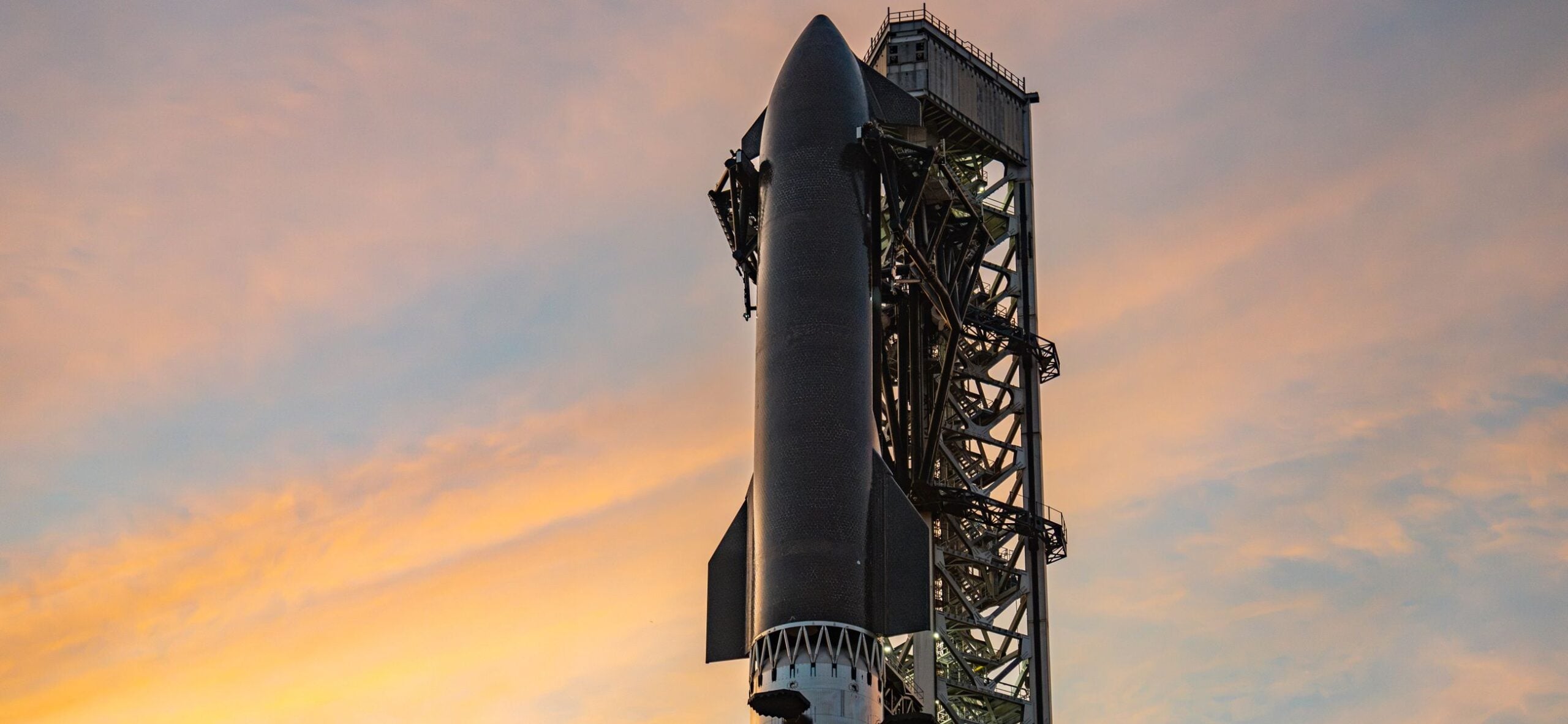
Starship’s first integrated flight test on 20 April 2023 tested far more than a rocket. Thirty-three engines ignited above a launch mount whose concrete foundation failed under the exhaust. The stack climbed away, but its departure sent sand, dust and fragments of the pad across the surrounding landscape.
Three years and three months later, Starship Flight 13 faced a much longer chain of events. Its upper stage left Texas, crossed towards the Indian Ocean, survived atmospheric entry, steered with four flaps, flipped upright and completed a soft splashdown. SpaceX reported that Ship 40 came to rest intact.
The distance between those tests is best measured in control. Flight 1 exposed an uncontrolled interaction among engines, concrete, vehicle hardware and a delayed flight-termination response. Flight 13 kept its upper stage working through a sequence lasting just over 65 minutes and finished more than 16,000 kilometres from Starbase as one recognisable spacecraft.
Flight 1 made the launch pad part of the mishap
SpaceX’s account of the first integrated test says the stack cleared its launch pad, reached an altitude of approximately 39 kilometres and began tumbling after multiple engines went out. Controllers commanded the flight-termination system on both stages. Starship broke apart over the Gulf of Mexico roughly four minutes after liftoff.
The rocket had already revealed a separate failure at ground level. In its September 2023 closure letter for the investigation, the Federal Aviation Administration recorded a structural failure of the pad-deck foundation that sent debris and sand into the air. The FAA said the mishap report produced 63 corrective actions covering launch infrastructure, vehicle hardware, safety-critical systems and engineering processes.
A later FAA environmental re-evaluation described the footprint in more detail. Concrete detritus, refractory material, vehicle debris and sand were deposited across an area of approximately 1,000 acres. Concrete pieces were found across roughly 20 acres outside the debris-impact area assessed before launch, while the document identified vegetation damage a few hundred feet from the mount and 3.5 acres of fire damage.
This is the evidence behind the headline’s “hundreds of metres”, rather than a claim that every fragment travelled the same distance. The record describes a broad deposit, with the heaviest material concentrated nearer the pad and dust dispersed farther. No public injury was reported, but the event demonstrated that launch infrastructure could become a source of debris before the vehicle had cleared the site.
A launch pad can look like scenery beside a 120-metre rocket. In engineering terms it is one of the vehicle’s first systems. It must carry thousands of tonnes before ignition, tolerate the acoustic and thermal load from dozens of engines, and give the rocket a predictable environment during the seconds when it has the least room to recover from a disturbance.
Flight 1 showed what happens when that boundary is treated too narrowly.
SpaceX rebuilt the ground before returning to flight
SpaceX deepened and strengthened the foundation with thicker concrete and additional piles, then placed steel plates beneath the launch mount. Those plates became a water-cooled flame-diverter surface. The FAA’s environmental documentation says the system was expected to apply about 132,000 gallons, or roughly 500,000 litres, of water during a launch, with a much larger maximum storage capacity available for analysis.
The water does several jobs in a few seconds. It cools the steel, helps absorb acoustic energy and heat, and reduces the direct attack of the exhaust on the material below the engines. The FAA documents estimated that most of the water present while the engines fired would vaporise. Gutters, retention basins, ponds and berms were intended to collect much of what remained.
By Flight 13, flame-diverter activation appeared in SpaceX’s official countdown at 17 seconds before liftoff. The launch site had become an active machine timed into the flight sequence, not simply a reinforced floor. Every later vehicle inherited a different departure environment because the pad failure had forced the ground design to mature with the rocket.
That change may be the clearest physical record of the first test.
The response extended above the concrete. The FAA’s 63 corrective actions included changes intended to prevent leaks and fires, further analysis of safety-critical components, a more robust launch pad and changes to engineering review and configuration control. Starship could not return merely because SpaceX had another booster. It had to show the regulator that the public-safety actions tied to the mishap had been implemented.
Progress arrived as separate pieces, with failures between them
The following flights did not trace a smooth line from explosion to success. Flight 2 introduced hot staging, in which the upper stage ignited while still attached to the booster through a vented interstage. Flight 3 reached space and attempted several in-flight demonstrations. Flight 4 produced the first controlled Starship ocean splashdown, which SpaceDaily covered in June 2024.
Flight 5 added control at the other end of the stack. Super Heavy returned to Starbase, settled between the launch tower’s arms and was caught above the ground on the first attempt. As our contemporary report on the booster catch noted, the upper stage continued across the Atlantic and Indian oceans while the tower handled the returning first stage.
Later tests lost ships during ascent or coast, encountered propulsion problems and missed recovery objectives. Vehicle generations changed, as did engines, tanks, flaps, heat-shield arrangements and ground equipment. A count of 13 flights therefore hides as much as it reveals. The relevant measure is which parts of the sequence have become repeatable, under what conditions, and how much work still separates a successful demonstration from an operational service.
Flight 13 was the second integrated test of the V3 configuration. On 24 July 2026, all 33 booster engines carried the stack away from Starbase. The booster completed the high-thrust portion of its boostback burn, but SpaceX said only some engines ignited for the landing attempt and Super Heavy hit the Gulf hard.
The upper stage had the cleaner result. According to SpaceX’s post-flight mission record, Ship 40 completed its full ascent burn on all six Raptor engines, deployed 20 next-generation Starlink V3 satellites and established communications with every one. The satellites were placed on a deliberately short-lived trajectory and were expected to burn up about 20 minutes later. Ship 40 then relit a single Raptor in space, demonstrating a capability needed for future orbital manoeuvres.
Flight 13 concentrated its hardest control work near the end
SpaceX’s timeline marks atmospheric entry at 47 minutes and 30 seconds after launch. The ship used its heat shield to survive deceleration and its two forward and two aft flaps to control attitude and direction. During the descent, it made a dynamic banking move intended to imitate part of the trajectory a future ship would use when returning to Starbase.
The stage became transonic at 62 minutes and 23 seconds, then subsonic 38 seconds later. At 65 minutes and one second, all three sea-level landing engines began firing. Ship 40 flipped from its belly-first descent to a vertical attitude, stepped down from three engines to two and then one, and reached the ocean at approximately 65 minutes and 21 seconds.
That final sequence compresses several different forms of control. The heat shield must keep the structure and machinery within workable temperatures. The flaps must manage a vehicle whose mass and aerodynamic behaviour change as it slows. Propellant that has coasted in low gravity and moved during a belly-first fall must be available at the engine inlets. Navigation has to deliver the ship to the planned patch of empty ocean, then the landing burn must remove its remaining vertical speed without leaving the vehicle to fall or hover wastefully.
The headline’s distance is a geographic comparison. The straight great-circle separation between Starbase and the Indian Ocean region west of Australia exceeds 16,000 kilometres. Ship 40’s actual path was longer because the spacecraft followed a high arc through space. Flight 13 also did not complete a circuit of Earth. It flew a suborbital, orbital-class trajectory selected to end over remote water.
SpaceX said the ship came to rest intact and provided the first direct post-entry views of a complete Starship heat shield. “Intact” does not mean pristine. The stage had crossed plasma, engine burns and salt water, and photographs later showed missing or abraded tiles. The useful distinction is that the vehicle did not break into scattered wreckage at splashdown.
An intact ship supplied evidence that telemetry cannot
Previous successful water landings ended with the stage sinking or becoming unavailable. Ship 40 remained afloat and continued transmitting. That was not an original requirement of the test, but it changed the engineering value of the result. Telemetry can record temperature, pressure, vibration and acceleration at chosen sensors. A surviving vehicle lets engineers inspect damage between those points and compare the physical pattern with what the instruments reported.
The ocean then turned a flight test into a salvage problem. After about 24 days at sea, recovery crews brought the stage to calmer water near Christmas Island. SpaceDaily’s report on that operation separated two easily blurred ideas: the ship had been recovered intact enough to examine, but it had not been recovered in the manner required for reuse.
A stage soaked and battered in the Indian Ocean is a poor candidate for another launch. Salt water can reach engines, valves, electronics, joints and tile interfaces. Towing a 52-metre spacecraft for weeks also bears little resemblance to the short turnaround SpaceX proposes. The hardware’s value lies in allowing a closer post-flight examination, particularly of its heat shield, flaps and structure.
The intended system avoids the ocean. SpaceX plans to return the upper stage to its launch site and catch it with the same kind of tower arms already used for Super Heavy. Our recent examination of the proposed ship catch explains why that approach removes landing legs from the spacecraft but transfers precision, mass and risk to the ground. Flight 13’s splashdown showed terminal guidance over an empty zone. A tower approach leaves a much narrower margin beside infrastructure and people.
Flight 13 did not make Starship operational
The comparison with Flight 1 is dramatic because the programme moved from destroying part of its own launch base to placing an upper stage gently into a distant ocean. That does not turn the thirteenth test into proof of full reusability. On the same flight, the booster’s landing sequence ended hard. No Starship upper stage has been caught at a tower, refurbished after spaceflight or flown for a second time.
Other work sits beyond recovery. The architecture for the Moon and Mars requires separate Starships to rendezvous, dock and transfer large quantities of liquid methane and oxygen in orbit. Flight 13 did not attempt that. SpaceDaily’s earlier account of the orbital-refuelling gap examined why liftoff thrust and accurate entry do not by themselves create a deep-space transport system.
The flight nevertheless joins several previously separate achievements in one vehicle: complete ascent, payload deployment, an engine restart in space, controlled entry, a deliberate banking manoeuvre, a multi-engine landing burn and an intact splashdown. The first integrated test did not complete stage separation. The thirteenth upper stage controlled events from the Texas coast to the water west of Australia.
The next evidence will have to come from land.
SpaceX must bring a ship back to a launch tower, catch it without damaging the stage or site, determine how much inspection and repair it needs, and then fly that same hardware again. Until those steps occur, Flight 13 remains the programme’s most complete upper-stage return test, not the arrival of routine reuse.