

Enceladus presents planetary scientists with an unusual offer. Its ocean is buried beneath ice, but some of that ocean is already carried upward through fractures at the moon’s south pole and sprayed into space as water vapour and frozen grains. A mission may not need to build the entire route down if it can meet the material coming up.
That inversion is the heart of LEAP, or Legged Exploration Across the Plume, a concept led by Justin Yim of the University of Illinois Urbana-Champaign. NASA selected it in January 2025 for a Phase I study through the NASA Innovative Advanced Concepts programme. The machine would use a powerful leg to bound across Enceladus and pass through individual jets, gathering samples and measurements before landing again.
It is a lovely idea. It is also much earlier in development than the phrase “NASA robot” can imply. NASA funded an investigation of LEAP’s feasibility, not construction of a flight vehicle. The agency’s announcement of the 2025 selections explicitly says NIAC studies are early concepts and are not official NASA missions.
The ocean is buried, but its material is not
Enceladus is only about 500 kilometres wide. From a distance it looks like a bright, frozen moon. Cassini changed that picture in 2005 when it found jets of gas and ice erupting from long fractures near the south pole. NASA says the material leaves the surface at roughly 400 metres per second, and much of it eventually falls back as a fine snow.
Years of imaging allowed researchers to identify 101 distinct geysers associated with four prominent fractures known as tiger stripes. Gravity measurements and the moon’s slight orbital wobble indicate that the source is a global saltwater ocean, rather than a small isolated pocket.
The ice is still formidable. NASA’s current Enceladus overview gives an estimated average shell thickness of 20 to 25 kilometres, thinning to perhaps one to five kilometres at the south pole. Even the lower end is far beyond anything humans have drilled on another world.
But access is not set by thickness alone. A recent SpaceDaily comparison of Enceladus and Europa described the active plume as the feature that makes Enceladus unusually accessible. The moon has, in effect, built its own sample-delivery system. LEAP asks whether a robot can move through the delivery stream close to its source.
What NASA actually funded in 2025
The original NASA description of LEAP proposed a multi-jet sampling system based on Salto, an agile one-legged jumping robot developed for work on Earth. Yim’s team included researchers from the University of Illinois, NASA’s Jet Propulsion Laboratory and Glenn Research Center.
Phase I was meant to test the central premise and expose the obstacles. Could a small leg generate a useful jump in Enceladus’s gravity? Could the robot right itself, point its instruments during flight and land on granular ice? What materials, batteries and sensors could function in the cold? Could its measurements distinguish one jet from another?
By the time the team presented its Phase I progress poster, LEAP had become more specific. The illustrated robot was about 30 centimetres tall and one kilogram in mass. A possible mission would carry four of them. Each would combine a large foot, a powerful series-elastic leg and two angled reaction wheels.
None of those numbers is a locked flight specification. NIAC studies explore a design space; their dimensions and architectures can change as engineers find the difficult parts. The value of the progress report lies partly in showing where the concept had acquired engineering detail and where it still carried question marks.
One leg becomes surprisingly capable in weak gravity
On Earth, the Salto-1P robot can jump about 1.15 metres high and cover roughly two metres in a long jump. Enceladus’s surface gravity is about 80 times weaker. A launch that is brief and modest here can become a long, slow ballistic flight there.
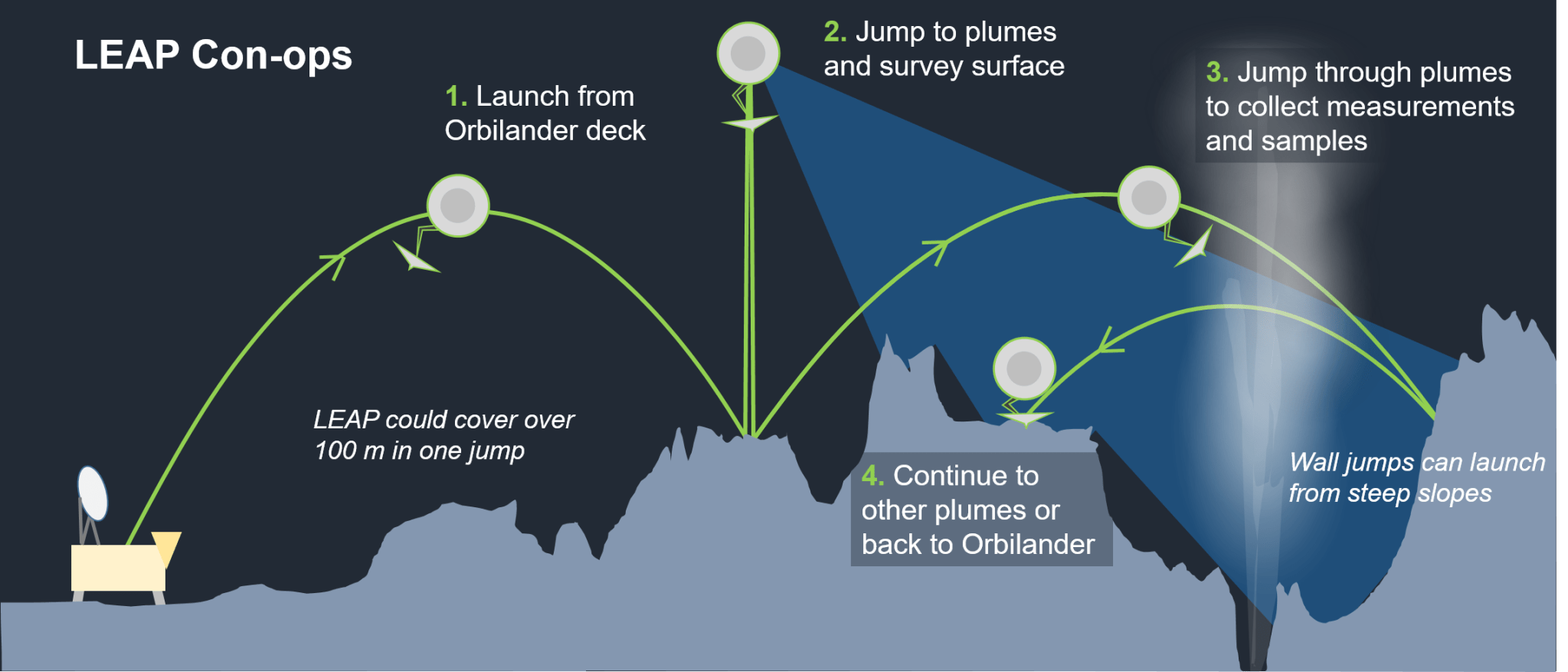
NASA’s early LEAP page estimated that existing jumping performance could translate into about 90 metres vertically or 170 metres horizontally. The later poster used more conservative shorthand, listing more than 80 metres of height and more than 100 metres of distance. These should be read as concept estimates under assumed launch conditions, not demonstrated ranges on Enceladus.
The leg works by storing energy before releasing it quickly. A series-elastic mechanism can reduce the peak electrical power demanded from the motor, which matters on a battery-powered robot. The price is large force inside the linkage. Springs, bearings and structural members must survive that loading repeatedly without becoming too heavy.
The foot is deliberately broad. Enceladus’s south-polar surface may include loose deposits of plume particles, so a narrow contact could sink or slip instead of producing a clean launch. A larger foot spreads the force. The team also considered changing the launch-force profile to work more efficiently on granular material.
The reaction wheels do almost everything except steer
Two angled reaction wheels give LEAP more than aerial balance. By spinning them in controlled ways, the robot can rotate its body during a jump, point an instrument toward the surface or arrange its foot for landing. On the ground, the same wheels can help it roll and can bring it back to an upright jumping posture after a fall.
The Earth testbed has demonstrated aimed jumps, controllable rolling, self-righting and aerial orientation. The concept even includes wall jumps from steep slopes, a useful possibility around the fractured terrain where the plume emerges.
There is an important limit. Reaction wheels change orientation; they do not create a large sideways force. Enceladus has essentially no atmosphere for fins or rotors to push against. Once the foot leaves the ground, most of the trajectory has already been decided by launch speed and direction.
That makes accuracy a central problem. The progress poster reported centimetre-scale targeting for testbed jumps on Earth but marked the corresponding Enceladus long-jump accuracy as unknown. A small error at launch can grow during a hundred-metre arc. The robot must land somewhere safe enough to jump again, not merely pass through the desired patch of plume.
A leap through a geyser is a moving laboratory
The concept of operations begins on the deck of a proposed host spacecraft. A LEAP unit launches toward the active terrain, surveys the surface, then crosses a jet while its collector and instruments are exposed. It can continue toward another emission site or attempt to return to the host. Four robots could spread the measurements across several locations.
The suggested sensor set is compact but purposeful: a particle-flux sensor, an optical aerosol counter, a small mass spectrometer, a pressure sensor and a temperature sensor. Together they could measure how many grains pass the robot, how large those grains are, how fast gas is moving and which volatile compounds are present.
The study’s measurement plan calls for comparing at least three areas of diffuse emission with at least two narrow jets along a tiger stripe. It would look for water, carbon dioxide, methane, ammonia and molecular hydrogen, while also measuring the ratio of vapour to particles. Repeating observations through Enceladus’s 32.9-hour orbit could show how Saturn’s tides modulate the system.
This spatial context is the part a memorable robot animation can obscure. LEAP is not simply a flying cup. It is intended to connect each collected sample with a location, a style of emission, a local temperature and a particle distribution. A broad plume fly-through can reveal composition; a transect close to the surface may help explain how that composition was produced.
Why not use wheels, a helicopter or thrusters?
The south pole is not an inviting rover park. It contains ridges, troughs, fractured slopes and blocks, with active vents cutting through the terrain. Freshly deposited grains may create surfaces that are soft in one place and firm in another. Wheels that perform well on a plain could become trapped near the scientifically valuable fissures.
A helicopter has the opposite problem. There is no meaningful Enceladus atmosphere in which a rotor can produce lift. The LEAP team notes that its avionics sit in roughly the same mass and power class as Ingenuity’s, so some Mars-helicopter heritage may be useful, but LEAP cannot borrow Ingenuity’s way of moving.
Small rocket thrusters could hop or hover in vacuum, but their exhaust introduces heat, gases and residue near a sample site. The closer a mission comes to measuring faint chemical signals from a potentially habitable ocean, the less attractive it is to fire a chemical propulsion system through the sampling volume.
A mechanical leg avoids that exhaust and uses weak gravity as an asset. It also carries no promise of hovering. The robot follows an arc, meets the plume for a limited interval and returns to the surface. In that sense LEAP is less like an aircraft than a scientific projectile designed to survive its own repeated landings.
The landing may be harder than the jump
Weak gravity makes distance cheap, but it does not tell engineers what the foot will hit. Cassini images cannot resolve the mechanical behaviour of a small patch of plume snow. Grains may be bonded into a crust, loosely packed or arranged over voids. Slopes and blocks visible from orbit add a different class of hazard.
A 2023 study of Enceladus landing behaviour modelled how a footpad might interact with uncertain surface materials. The LEAP team used related preliminary models for a one-kilogram robot landing at 1.4 metres per second in a lightweight granular simulant, while stating plainly that the models had not been validated for LEAP’s jumping-speed regime.
Tests in NASA Glenn’s granular-material laboratory were intended to explore foot shape, launch profiles and accuracy in a high-sinkage simulant. That work can narrow the design choices. It cannot reproduce the entire Enceladus environment: vacuum, extreme cold, low gravity, unfamiliar grain shapes and an active plume operating together.
This is where an appealing concept meets the patient work of engineering. The robot needs enough force to leave the surface, but not so much that its foot excavates a hole. It must absorb landing energy without bouncing into a fissure. After landing sideways, it must recover without contaminating its sample or exhausting its battery.
“Direct ocean material” still passes through a filter
The title’s central shortcut is real: a spacecraft can reach ocean-derived material without drilling through kilometres of ice. SpaceDaily’s earlier article on Enceladus giving spacecraft a free plume sample followed the evidence Cassini extracted from water vapour and grains available above the surface.
But LEAP would not catch a bead of seawater in the state it had beneath the crust. Ocean material rises through a fissure as pressure and temperature change. Water can boil or freeze. Vapour condenses on cold walls. Dissolved gases separate from liquid. Different compounds prefer the gas, the ice or salt-rich grains.
That sorting is called fractionation. It means the abundance measured in a jet cannot always be copied directly into a model of the ocean. The LEAP plan therefore treats eruption physics as science in its own right. By comparing diffuse and concentrated emissions, vapour and particles, it may help identify whether boiling, sublimation, volatile exsolution, clathrate breakdown or another process drives the plume.
Sampling near the vent could also reduce some of the mixing that occurs farther from the surface, but “near” does not mean unaltered. The most honest description is ocean-derived material caught close to its exit. Understanding the exit is part of understanding the sample.
Slow, local collection could preserve information Cassini lost
Cassini’s plume encounters were fly-bys at kilometres per second. When an ice grain strikes an instrument at those speeds, large molecules can fragment. Scientists can reconstruct a great deal from the fragments, but the collision itself limits what survives for measurement.
SpaceDaily previously examined the long scientific afterlife of Cassini’s brief 2008 passage through the plume. Laboratory work conducted years later was still needed to understand what its mass spectra meant.
A surface robot would cross a local jet far more slowly relative to the moon. In principle, gentler collection could preserve larger or more delicate structures and allow individual grains to be related to a specific source. The present LEAP material does not demonstrate a complete life-detection sampler, however. The concept’s stated science concentrates on plume activity, volatile composition and eruption mechanisms.
That is not a lesser goal. Before a mission can interpret an unusual molecule as chemistry occurring in the ocean, it needs to know whether the plume created, destroyed or concentrated that molecule on the way out. LEAP could supply that missing physical context.
Cold, power and time govern the design
NASA gives Enceladus’s average surface temperature as about minus 201 degrees Celsius. Active fissures contain local thermal anomalies, but this is still a cryogenic machine. Battery performance falls, lubricant choices narrow, polymers change behaviour and some metals become brittle.
The study considered flight-qualified aluminium, titanium and stainless steels for the structure, specialised alloys for the leg spring, graphite-metal bearings and multilayer insulation or aerogel around the electronics. Candidate batteries were on the order of 40 watt-hours. Every gram devoted to keeping the machine warm competes with instruments, communications and landing structure.
Commands also cannot come from Earth in time to correct a jump. Depending on the positions of Earth and Saturn, a radio signal takes well over an hour each way. LEAP must assess terrain, select a launch direction, manage the leg, orient itself and recover from a poor landing autonomously.
The progress work points toward cameras, lidar or event cameras for navigation. Those sensors need processing power and must operate in difficult lighting near a brilliant icy surface. A robot might see a landing area only while already committed to its ballistic path. Useful autonomy will have to recognise not only obstacles but uncertainty.
The host spacecraft is another concept
LEAP was proposed as an addition to Enceladus Orbilander, a flagship study in which one spacecraft first orbits the moon and later lands. The Orbilander concept report describes roughly a year and a half of orbital observations and plume sampling followed by about two years on the surface with a suite of complementary life-detection instruments.
The 2023–2032 planetary science decadal survey ranked Orbilander as the second-highest-priority new flagship mission, behind a Uranus orbiter and probe. That scientific endorsement matters. It is not the same as a funded project, a completed design or a booked launch.
Orbilander studies have considered seven- to ten-year cruises to Saturn followed by a multi-year tour before reaching Enceladus. LEAP would have to survive that journey, then justify its mass, power and communication demands against the host’s core instruments. Four mobile robots also create deployment and planetary-protection questions that a stationary lander does not face.
Other concepts choose different trade-offs. JPL’s snake-like EELS robot was inspired by the possibility of descending into an Enceladus vent. A fly-through mission could avoid landing altogether. LEAP occupies an interesting middle ground: remain outside the fissure, but move close enough to compare individual outlets.
This is not yet a mission to announce life
Enceladus’s plume contains water, salts, silica, organic chemistry, molecular hydrogen and phosphorus. Those observations support a serious case for habitability and water-rock interaction. They are not evidence that a cell exists in the ocean.
A convincing life-detection result would require complementary measurements, controls against terrestrial contamination and a strong account of non-biological chemistry. Even a sophisticated mass spectrum can be ambiguous. A useful instrument suite would look for patterns across molecules, possible cellular structures and environmental context rather than treating one compound as a verdict.
Mobility could still be decisive. If different vents carry different grain populations or volatile ratios, a single stationary collector may not obtain a representative sample. LEAP could identify which emissions are freshest, which are most particle-rich and how composition changes with location and tidal phase. That map would help a larger laboratory decide what it is actually analysing.
It would also increase the obligation to keep the hardware clean. SpaceDaily’s account of Cassini’s deliberate destruction in Saturn explained why NASA chose not to leave a future accidental impact with Enceladus to chance. A robot intentionally visiting active terrain would need stringent biological cleanliness both to protect the moon and to protect the credibility of its own measurements.
What the 2025 study achieved
The achievement of Phase I is not that LEAP is ready to board a spacecraft. It is that a memorable sketch has been forced into contact with mass, force, power, terrain and measurement requirements.
The testbed can jump, roll, right itself and orient in flight. Candidate materials and avionics have been identified. A notional route links deployment, surface survey, jet sampling and travel to additional sites. The science team has described which comparisons would help connect the plume to the ocean.
The unresolved list is equally valuable. Long-jump accuracy on Enceladus is unknown. Surface interaction models need validation. Thermal performance, autonomy, sampling hardware and the scaled leg need deeper work. The proposed host mission does not exist, and no launch date can honestly be attached to LEAP.
That is what early funding is for. It gives an unusual idea enough structure that people can discover whether its elegance survives the environment.
The appeal remains beautifully simple because the moon does part of the journey itself. Enceladus lifts ocean-derived material through its ice and throws it above the surface. LEAP would try to place a small laboratory in that stream for a few seconds, land, and do it again somewhere else.
No drill has to reach the sea. Almost everything around that shortcut is still difficult.