

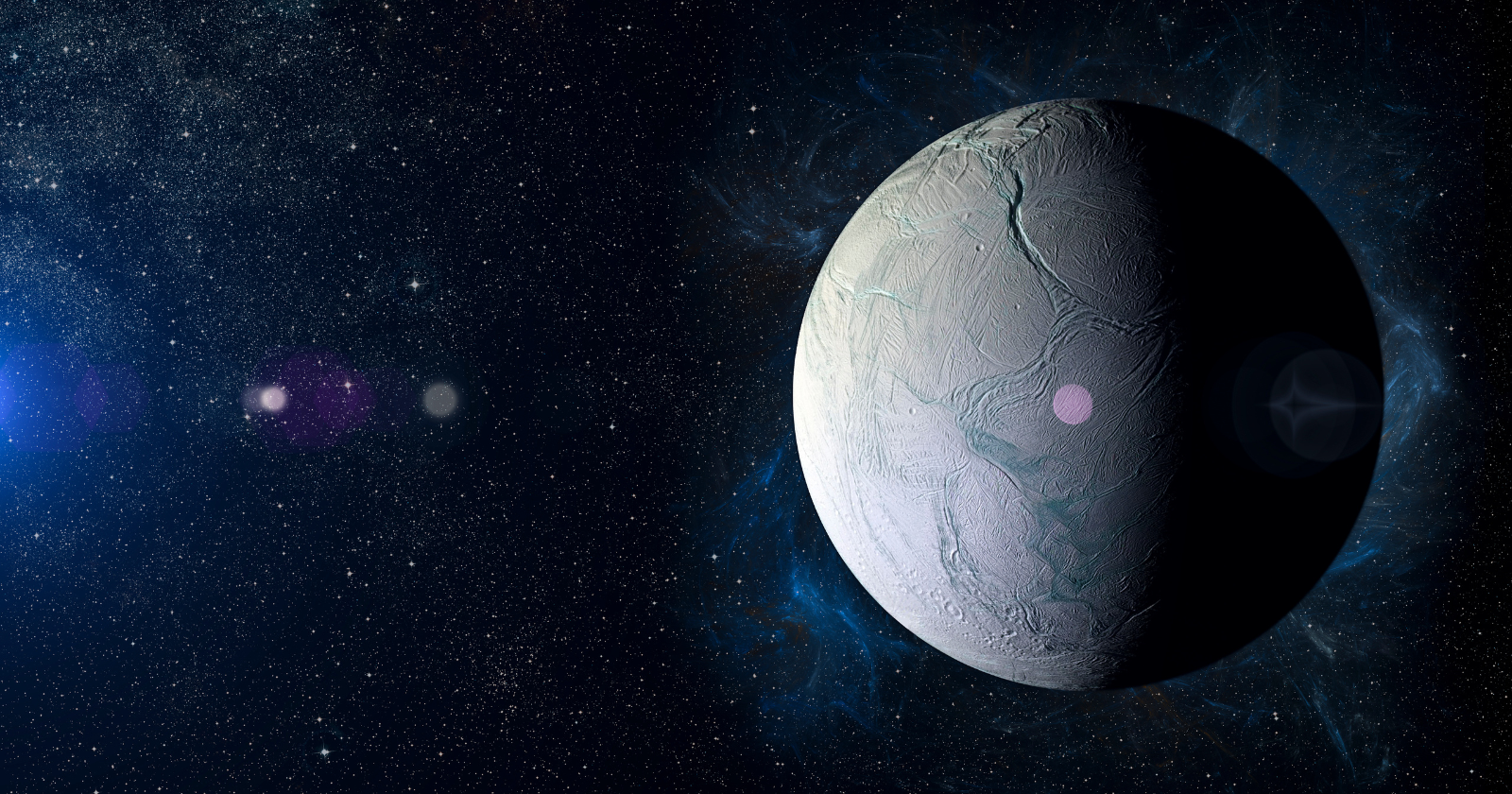
Cassini’s 2008 pass through Enceladus’s south polar plume lasted only minutes. The spacecraft was moving too fast and the moon was too small for anything like a landing or a long survey. It crossed a stream of ice grains and vapour erupting from cracks near the south pole, took what measurements it could, and kept going around Saturn.
That brief encounter is still producing science nearly two decades later. In 2025, researchers reported in Nature Astronomy that data from fresh ice grains sampled during that 2008 plume crossing revealed additional organic compounds, strengthening the case that complex chemistry is present in material coming from Enceladus’s hidden ocean.
The result should be read carefully. It is not a detection of life. It is not evidence of cells, metabolism or biology. It is evidence that the chemical inventory of Enceladus is richer than earlier readings could show, and that at least some of that chemistry appears in freshly ejected ocean material rather than only in older grains altered by space exposure.
NASA’s Enceladus overview explains why the moon has become such a strong target in astrobiology: its geysers vent water vapour and ice particles into space, and those jets are thought to come from a subsurface saltwater ocean. The unusual gift of Enceladus is access. Its ocean is buried beneath ice, but the moon throws pieces of that ocean into space where spacecraft can sample them.
A moon that sends its ocean upward
Enceladus is only about 500 kilometres across, small enough that it once seemed unlikely to be geologically active. Voyager images in the early 1980s hinted that something was odd, because parts of the surface looked unusually smooth and young. Cassini turned that suspicion into a new picture of the moon.
In 2005, Cassini observed jets of water-rich material erupting from the south polar region. The fractures feeding the jets became known informally as tiger stripes. The plumes supply material to Saturn’s E ring, coating space around the moon with ice grains. Later Cassini measurements pointed to salts, silica particles, organics, molecular hydrogen and a global ocean beneath the ice shell.
This made Enceladus different from many ocean worlds. Europa may hide a global ocean too, but its ocean is not as easily sampled. Enceladus, by contrast, performs its own sample release. A spacecraft does not need to drill through kilometres of ice to touch material connected to the ocean. It can fly through the plume.
That is what Cassini did more than once. The most important detail for the new chemistry work is that the 2008 event sampled grains fresh from the plume, not grains that had spent long periods orbiting in Saturn’s E ring.
Why freshness matters
Ice grains in the E ring are useful, but they are not pristine in the same way. Once material leaves Enceladus and spends months or years in Saturn’s radiation environment, its chemistry can be modified. Radiation, collisions and time can alter the molecules embedded in the grains. That makes interpretation harder.
The 2008 plume crossing was different. The ice grains had just been ejected. Reporting on the Nature Astronomy work, The Guardian noted that Nozair Khawaja and colleagues analysed Cassini data from ice grains found within the plume itself, and that Khawaja described them as only minutes old. That age matters because it makes the grains a closer snapshot of the subsurface source.
The spacecraft’s CDA instrument did not scoop up a snowball and bring it home. The grains hit the detector at high speed, creating impact spectra that researchers could later interpret. That makes the analysis indirect. Scientists are reconstructing chemistry from the signals generated when tiny particles struck a detector moving through the plume.
But the high-speed impact also had an advantage. As Live Science reported, the grains hit at about 18 kilometres per second, producing signals that helped reveal chemical features previously hidden in slower or older samples. The 2025 analysis used those signatures to identify organic molecules in freshly ejected material.
What the new chemistry adds
Organic molecules are carbon-bearing compounds. The term does not mean biological. Many organic compounds form without life, including in interstellar clouds, meteorites, comets and planetary atmospheres. But organic chemistry is relevant to habitability because life as we know it uses carbon chemistry, and because complex prebiotic chemistry requires a supply of suitable building blocks.
The new study reported organic compounds in the fresh ice grains, including categories that may contain nitrogen and oxygen. Earlier studies had found complex organics in Saturn’s E ring material and identified other important compounds in Enceladus plume data. The new work helps connect that chemistry more directly to freshly ejected plume grains, reducing the concern that some of the signal was created or heavily modified after the grains left the moon.
That distinction is subtle but important. If complex organics were found only in older E-ring grains, it would remain harder to say how much of the chemistry belonged to Enceladus’s ocean and how much had been changed by space. Finding organic signatures in minutes-old plume grains strengthens the case that the chemistry is present in material coming from inside the moon.
The finding does not show whether the compounds formed in the ocean, in the ice shell, near hydrothermal vents, during ascent through cracks, or during ejection. It does show that the material leaving Enceladus carries more chemical variety than a simple water-ice plume.
The archive kept getting better
One of the quiet lessons of Cassini is that a mission does not end when the spacecraft stops transmitting. Cassini plunged into Saturn in 2017, but its data remain a scientific archive. Instruments designed decades earlier collected measurements that can be reanalysed with new statistical methods, new laboratory calibrations and new questions.
The Enceladus plume work is a good example. At the time of the 2008 flyby, Cassini had already changed the story of the moon by detecting water, carbon dioxide and hydrocarbons, and by showing that the south polar region was active. Later work added evidence for a global ocean, salts, molecular hydrogen, silica grains and phosphates. Each step turned the same moon into a more chemically complete environment.
The archive matters because Enceladus has not been revisited by a dedicated mission since Cassini. There is no spacecraft currently flying through its plume. For now, the best direct samples of that plume are still Cassini’s measurements. New chemistry therefore comes from looking harder at old encounters.
This is not unusual in planetary science. Data from flybys and orbiters often outlive their original questions. When instruments record more detail than early analysis can fully use, later researchers can return with better models and extract signals that were previously ambiguous.
Enceladus now has several habitability ingredients
The case for Enceladus as a habitable environment rests on a convergence of ingredients. There is liquid water in a subsurface ocean. There is evidence for water-rock interaction at the seafloor, including silica particles and molecular hydrogen, which point toward hydrothermal activity. There are salts and organic molecules in plume material. Phosphates have also been reported from Enceladus’s ocean material, adding another important element to the chemical inventory.
NASA summarises the broader picture by noting that Enceladus has most of the chemical ingredients needed for life and likely has hydrothermal vents releasing hot, mineral-rich water into its ocean. That does not mean the ocean is inhabited. It means Enceladus is unusually well supplied with the kinds of conditions that make the question worth asking.
The new organic detections make that question sharper. If biologically relevant chemistry is present in fresh plume grains, a future spacecraft could target the plume directly with instruments built for life-detection and detailed organic analysis. Cassini was not designed as a dedicated Enceladus life mission. It discovered the moon’s importance after launch.
A future mission would not have that excuse. It could carry instruments tuned specifically to distinguish abiotic organic chemistry from possible biological patterns, measure molecular structures more precisely, and sample the plume repeatedly at different times and locations.
The missing step is direct follow-up
The 2025 work also shows why Enceladus is frustrating. It is one of the most accessible ocean worlds in the Solar System, but only in a relative sense. The ocean is hidden, the moon is far away, and every sample is a high-speed encounter with material escaping into space.
A lander near the south pole could study fresh deposits on the surface. An orbiter could fly through the plume many times. A more ambitious mission might return samples to Earth. Each option would answer different questions, and each would face hard engineering and planetary-protection requirements.
For now, the archive is doing what it can. The 2008 flyby was not designed to carry a twenty-year scientific story by itself, but it has. A few minutes inside a plume have become a long record of discovery because the plume was connected to an ocean and the detector caught enough of the chemistry to keep being reinterpreted.
A brief crossing with a long afterlife
The image is still striking: a spacecraft built on Earth skimming past a small moon of Saturn and flying straight through material from an ocean no human eye has seen. The encounter was brief. The implications were not.
What Cassini sampled in 2008 was not proof of life, and the new organic chemistry should not be inflated into that claim. It was evidence of an active ocean world throwing its chemistry into space. Nearly two decades later, those recorded impacts are still speaking.
That is the strange afterlife of a good flyby. Cassini is gone, Enceladus is still erupting, and the hidden ocean is still beyond reach. But the minutes Cassini spent in the plume continue to lengthen, one reanalysis at a time.