
The shortest plausible route to an alien ocean does not begin with a drill. It begins above the south pole of a moon only about 500 kilometres wide, where ocean-derived vapour and ice grains are already travelling in the opposite direction.
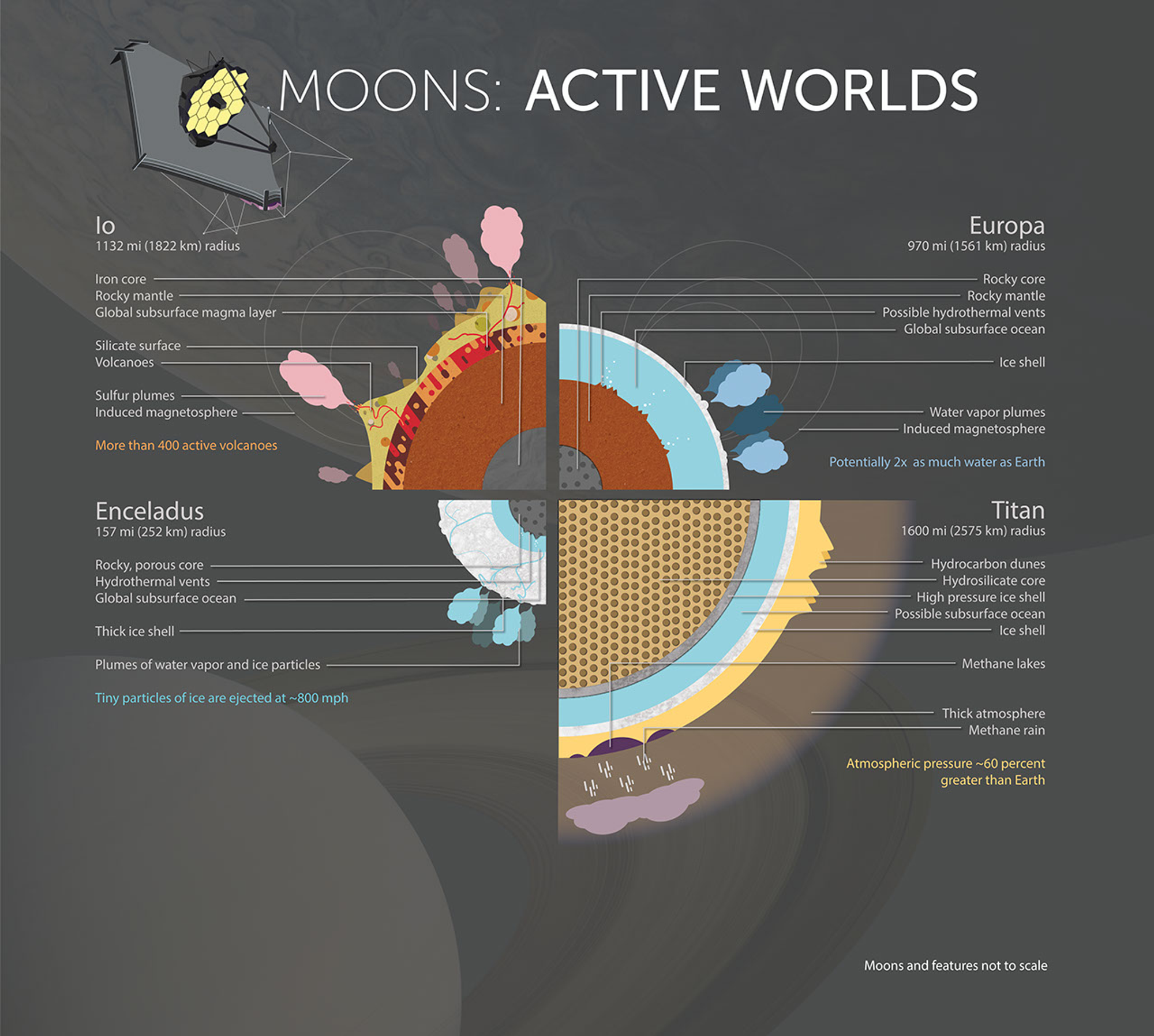
Enceladus, one of Saturn’s smaller major moons, ejects material through four long fractures in its southern ice. Cassini repeatedly flew through the resulting plume and analysed both gas and grains. That makes the moon unusual even among worlds now thought to contain buried oceans: its sea remains hidden, but some of its chemistry does not.
The comparison with Europa is useful because Europa’s ocean may be much larger and Jupiter is closer to Earth than Saturn, yet its ice appears formidable. An analysis of Juno observations placed the cold conductive part of Europa’s shell at 29 plus or minus 10 kilometres in the region measured. One influential Cassini-based model of Enceladus instead produced just 1.5 to 5 kilometres of ice at the active south pole.
Those numbers were not obtained with equivalent instruments, and neither is the result of drilling down to liquid water. Their real value is not in declaring a winner in a contest for the thinnest ice. It is in showing how local structure and ongoing geology can turn one buried ocean into a sample source while another remains largely an object of remote inference.
The one-to-five-kilometre figure is local and model-dependent
Enceladus does not carry a uniformly thin rind. The 1.5-to-5-kilometre range comes from a 2016 study in Geophysical Research Letters led by Ondřej Čadek. The team combined Cassini measurements of the moon’s gravity, shape and physical libration, the slight rocking visible as Enceladus moves around Saturn.
Libration matters because a shell floating over liquid can move differently from one locked directly to a solid interior. Gravity and shape add information about how mass is distributed. The researchers built three-layer models containing a rocky core, global ocean and ice shell, then asked which combinations could satisfy all three sets of observations.
For assumed ocean densities between 1,030 and 1,050 kilograms per cubic metre, acceptable models gave average shell thicknesses of 18 to 22 kilometres. The modelled ice became much thinner at the poles, reaching between 1.5 and 5 kilometres across the south polar terrain. The title’s one-to-five-kilometre wording is a sensible rounding of that specific result, not a direct measurement and not a global value.
Another 2016 geophysical model by Mikael Beuthe and colleagues estimated a mean shell thickness of 23 plus or minus 4 kilometres and a south-polar thickness of 7 plus or minus 4 kilometres. That range overlaps a shell only a few kilometres thick, but its central value is higher. Assumptions about isostatic compensation, ice density, ocean density and the strength of the outer elastic layer all matter.
The careful conclusion is that several Cassini-based models favour a dramatically thinned shell at Enceladus’s south pole. They do not amount to a completed high-resolution map, and they do not show one to five kilometres of ice everywhere on the moon.
Europa’s 29 kilometres came from a different kind of experiment
Juno was designed to investigate Jupiter, but its microwave radiometer observed Europa during a 360-kilometre fly-by on 29 September 2022. Six radio channels measured microwave brightness at frequencies from 0.6 to 22 gigahertz. Lower frequencies can receive thermal emission from deeper ice than higher frequencies, although the exact depth depends on temperature, purity and internal scattering.
The result published in Nature Astronomy used the brightness-temperature difference between the two deepest-sounding channels to constrain the temperature gradient. Its best-fitting model gave a 29-kilometre conductive shell in the observed region. After allowing for unmodelled regional variation, the authors reported an uncertainty of 10 kilometres.
This is the cold outer ice through which heat moves mainly by conduction. The model assumed pure water ice and no deeper convecting layer. Widespread salt could increase microwave opacity and reduce the thickness estimate, by roughly five kilometres under one salinity case considered in the paper. A warmer convecting layer below the conductive lid would instead make the full solid barrier between surface and ocean thicker.
The observations covered a limited swath, roughly from 10 degrees south to 30 degrees north and across about 100 degrees of longitude. The model treated that terrain as laterally uniform even though Europa’s surface plainly is not. Space Daily’s earlier examination of the 29-kilometre result therefore described it as a regional estimate with strong assumptions, not a finished global depth map.
The comparison is revealing but not strictly like-for-like. Enceladus’s few-kilometre figure is a local thickness inferred by fitting whole-moon gravity, shape and motion. Europa’s 29 kilometres is a regional estimate of a conductive layer inferred from microwave temperature structure. The uncertainty belongs in the comparison, not below it as an afterthought.
A thin shell helps, but the fractures are the real shortcut
If Enceladus merely had thinner ice, its ocean would still be beyond any drilling system flown to another world. One kilometre is an enormous depth for a robotic cryobot. Five kilometres is worse. A machine would have to carry or generate enough energy to melt downward, keep a passage or communications relay functioning, navigate without human intervention and prevent organisms from Earth contaminating a potentially habitable environment.
The decisive feature is not simply thinness. Fractures already cross the south-polar ice. Cassini found jets emerging along four roughly parallel troughs called the tiger stripes, each about 130 kilometres long. Their output forms a plume over the pole. Some grains fall back as snow; some escape Enceladus’s weak gravity and become part of Saturn’s broad E ring.
NASA’s Cassini summary of Enceladus traces how the case developed from warm fractures and water vapour to a global ocean. Salts in the ice grains indicate liquid water interacting with rock. Silica nanoparticles point to warm water-rock reactions, while molecular hydrogen provides evidence for continuing chemical energy.
A previous Space Daily report described the plume as the moon doing the lifting for a spacecraft. That remains the engineering insight. The thin polar shell probably helps concentrate tidal stress and heat, but accessibility comes from an active transport system linking ocean, fissure and space.
The plume is a sample stream, not bottled ocean water
“Direct access” is convenient shorthand, but it can give the wrong picture. A fly-through does not fill a sterile bottle with unchanged water from the seafloor. Material has travelled tens of kilometres through the ocean, entered narrow slots in the ice, crossed a pressure gradient, separated into gas and droplets, frozen or condensed and then spent some time in space.
Those stages can sort the sample. Dissolved gases leave liquid at different rates. Water vapour can condense on the cold walls of a fissure. Salts tend to remain with droplets that freeze into grains, while volatile compounds are more readily represented in gas. Grains of different sizes and compositions may also follow different trajectories after eruption.
A 2022 Planetary Science Journal model by Lucas Fifer, David Catling and Jonathan Toner explicitly reconstructed this chemical fractionation. The study used Cassini plume measurements to constrain the likely ocean, but only after modelling gas exsolution and the condensation of water inside the fissures. The proportions measured above the surface cannot simply be copied into a table and relabelled “ocean composition”.
This complication does not erase the advantage. It defines the work a dedicated mission must do. Gas and ice grains carry complementary information. Measurements at different altitudes, orbital phases and locations could test how the plume changes. Sampling many individual grains would help avoid diluting rare organic-rich particles into an uninformative bulk average.
Enceladus has removed the need to cross the whole shell before collecting a sample. It has not removed the need to reconstruct the sample’s journey.
Cassini proved the experiment before anyone designed the mission
Cassini launched in 1997, eight years before its cameras discovered the active plume. No instrument was selected to determine whether an Enceladus ocean contained cells, complex biological polymers or a self-sustaining metabolism. Once the jets were found, the mission team adapted later encounters to exploit a scientific opportunity the spacecraft had not been built around.
The Ion and Neutral Mass Spectrometer examined gases. The Cosmic Dust Analyzer recorded the charged fragments created when individual ice grains struck its metal target at high speed. Together and through years of laboratory work, those instruments revealed water, salts, silica, molecular hydrogen and a wide range of carbon-bearing chemistry.
The word “organic” means carbon-bearing here, not biological. Geochemistry can build complex organic molecules without life. Phosphorus, detected as phosphates in salt-rich grains and reported in NASA’s account of a 2023 Nature study, is an essential element for life on Earth but is not itself a biosignature.
One 2008 pass, called E5, took Cassini through freshly ejected grains at nearly 18 kilometres per second. The collisions destroyed the grains and converted their contents into fragment patterns. A 2025 Nature Astronomy reanalysis used those unusually high-speed impacts to identify further organic chemical groups in material only minutes removed from the moon.
Space Daily previously followed the long scientific afterlife of that brief encounter. It is a useful warning against imagining “sampling” as one simple act. At high speed, the sample becomes a plasma of fragments, and interpretation depends on calibration experiments that may continue long after the spacecraft is gone.
A purpose-built orbiter could cross the plume more slowly than a Saturn-orbiting fly-by spacecraft, collect more material over repeated passes and carry instruments chosen for biological as well as chemical questions. Slower is not automatically better for every mass-spectrometry mode, but mission designers would be able to choose the encounter conditions rather than inherit them.
Accessible does not mean nearby, intact or easy
Europa orbits Jupiter. Enceladus lies much farther away at Saturn. A mission to the latter faces a longer cruise, weaker sunlight, greater communications delay and a difficult transition from arrival at Saturn to useful operations around a moon with very little gravity.
The phrase “most accessible alien sea” should therefore be read narrowly. Enceladus is not the quickest ocean world to reach, and no spacecraft can descend into its sea today. It is the most accessible known subsurface ocean for acquiring ocean-linked material because a persistent natural process moves that material into space.
Even then, abundance matters. A spacecraft passing through the plume collects tiny quantities. Any hypothetical cells may be rare, unevenly distributed or poorly represented in grains that reach the sampling altitude. Fragile large molecules can be broken during capture. Terrestrial contamination must be low enough that one amino acid, lipid-like signal or cell-shaped object does not create a false claim.
That makes repeated, independent evidence essential. One instrument might look for molecular mass patterns, another for chirality, another for cell-like structures and another for isotopic relationships difficult to explain without biology. Geological and geochemical measurements would establish whether the environment could support the proposed metabolism. A positive result would have to survive non-biological alternatives. A negative result would need a stated detection limit and enough sampled material to mean anything.
The mission scientists want is more than a plume fly-through
The 2023–2032 planetary science decadal survey made an Enceladus Orbilander its second-highest-priority new flagship concept, after a Uranus orbiter and probe. The National Academies’ strategy envisages studying freshly ejected material from well-characterised locations, then landing where plume fallout accumulates.
The concept is deliberately more patient than Cassini. A study mission would spend about a year and a half in orbit, repeatedly crossing the plume while mapping the vents and evaluating landing sites. It would then descend to the surface and analyse grains that had fallen nearby, allowing longer measurements without turning each encounter into a high-speed impact.
Orbiting and landing provide context a one-off fly-by cannot. Which tiger stripe produced a sample? How did output change around Enceladus’s orbit? Are organics concentrated in particular jets or grain sizes? Does deposited material preserve fragile structures better than material collected in flight?
Orbilander remains a mission concept, not an approved spacecraft with a funded launch date. Its priority in the decadal survey shows how highly the scientific community values Enceladus’s natural sample stream. It does not guarantee that the mission will be built on the proposed schedule.
Europa remains essential precisely because it is different
Calling Enceladus more accessible does not make Europa scientifically secondary. Europa is larger, may contain more than twice the water in all Earth’s oceans, and experiences a different balance of tidal energy, radiation processing and material exchange. Its surface may manufacture oxidants that could provide chemical energy if they move down through the ice, a pathway unlike the water-rock chemistry emphasised at Enceladus.
Europa Clipper is already travelling to Jupiter. It is not designed to drill through 29 kilometres of ice or to detect life. Its mission is to assess habitability using repeated close fly-bys, ice-penetrating radar, magnetic and gravity measurements, cameras, spectrometers, thermal imaging and instruments that analyse surrounding gas and dust.
Europa may contain local melt pockets, regions of thinner ice or material exchanged between depth and surface. The Juno result does not rule those out. Nor does an Enceladus plume guarantee that every important part of its ocean is well represented above the pole.
The two moons expose different portions of the same problem. Europa offers an immense sea behind a difficult and radiation-processed shell. Enceladus offers a smaller global ocean with a natural outlet and evidence for contact with a porous rocky core. Comparing them can test whether potentially habitable ocean chemistry is common or whether each moon followed a singular path.
The shortest route is the one the moon has already opened
The contrast between one to five kilometres and 29 kilometres is memorable, but shell thickness is not the decisive engineering fact. Even the thinnest plausible Enceladus ice is far beyond current drilling experience on another world. A two-kilometre shell without an active fracture would still be a severe barrier.
What changes the problem is movement. Enceladus continuously carries material upward through warm, tidally worked fissures and releases it beyond the surface. A spacecraft still has to cross the Solar System, gather a small and altered sample, understand how eruption sorted it, and exclude contamination and abiotic chemistry. Those are formidable tasks, but they are tasks for spacecraft and instruments we can plausibly design.
Europa asks us to infer an ocean through kilometres of ice. Enceladus allows us to intercept what the ocean has sent out. The sea remains alien and physically unreachable, yet its sample stream has already crossed the hardest boundary on our behalf.