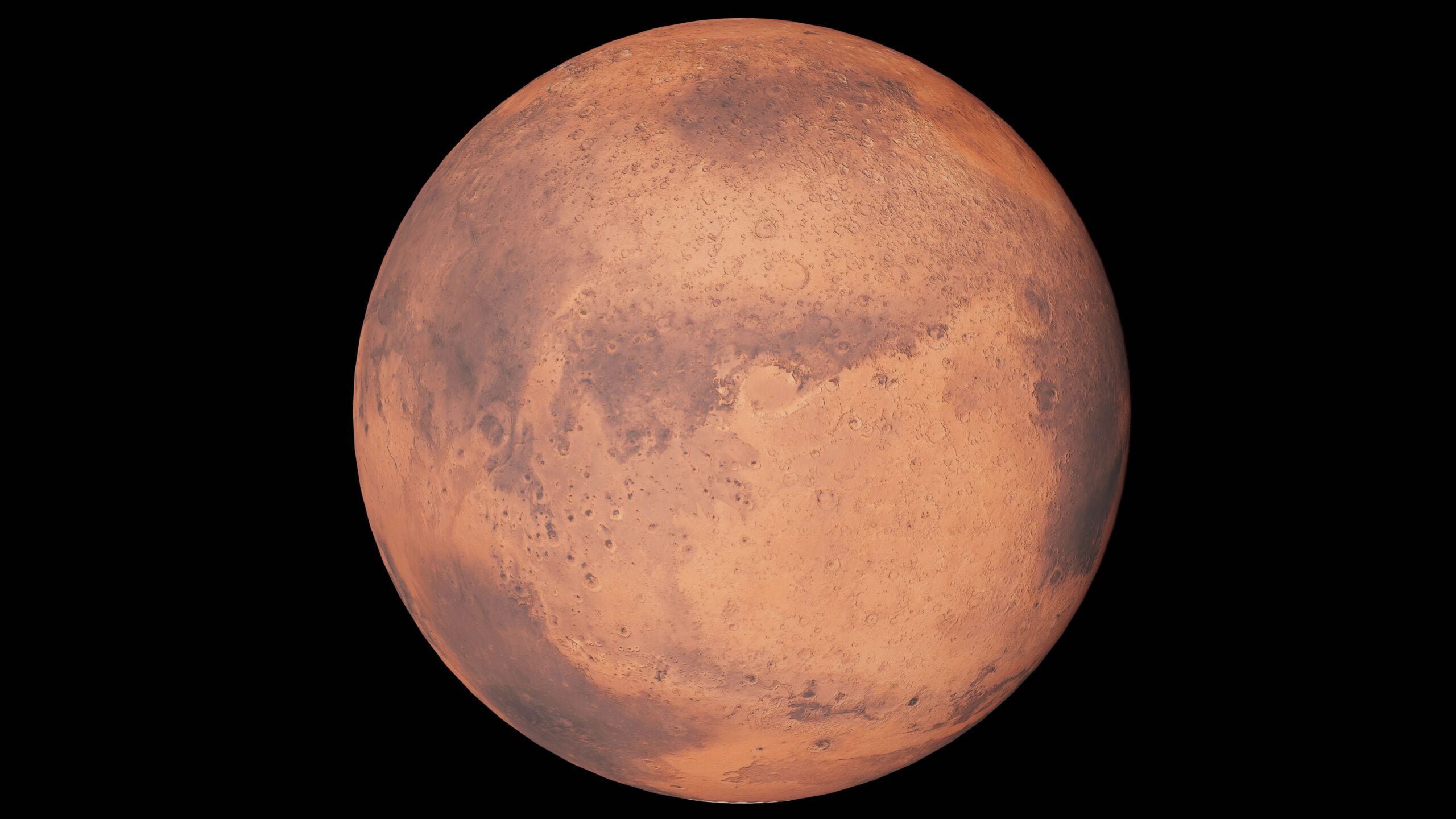
Mars is one of those subjects that can sound simple if you stand far enough away from it. It becomes the red next place, the next human destination, the world waiting just beyond the Moon.
The closer I look, the less Mars feels like a single destination and the more it feels like a test of patience. It is a planet being approached through geology, weather, engineering, budgets, politics, and a great deal of humility.
That is the part I find easiest to miss. Mars does not simply ask whether we can get there. It asks whether our institutions can keep a promise across decades, whether our machines can survive dust and cold, and whether our language can stay honest while our ambitions keep getting larger.
Perseverance has gone a long way, but the hard part is still unresolved
In June 2026, NASA’s Mars Reconnaissance Orbiter photographed Perseverance from above as a small green speck on the surface. According to NASA’s HiRISE photojournal note, the rover had just reached a full marathon of driving on Mars: 26.2 miles, or 42.195 kilometres, after five years and four months on the planet.
That is a wonderful fact, but it is not only a distance record. It also says something about the pace of Mars exploration. A rover can spend years crossing terrain that looks small from orbit, stopping to examine rocks, plan routes, avoid trouble, and preserve itself for the next sol.
Perseverance has also been caching drilled samples from Jezero Crater, the ancient lake basin where NASA is looking for clues about whether Mars once had conditions suitable for life. The rover has done the local work. The unfinished question is whether those samples will ever make the longer trip home.
I wrote recently about how uncertain Perseverance’s cached samples have become, and I still think that uncertainty is the honest centre of the Mars story right now. The tubes exist. The geology exists. The mission to bring them back is the part still being fought over in design rooms, budget lines, and policy documents.
Sample return has become a lesson in restraint
NASA still describes Mars Sample Return as an ambitious campaign to bring carefully selected Martian samples to Earth for the first time. That scientific case remains strong. Some measurements can only be done properly in laboratories on Earth, using instruments too large or too specialised to send to Mars.
The engineering case is harder. A sample-return mission is not one spacecraft doing one job. It means landing a platform, getting tubes into a launch system, lifting a container from Mars, capturing it in orbit, sealing it for return, and bringing it safely to Earth.
NASA’s January 2025 update made the redesign plain. The agency said it would examine two landing options: one based on proven sky-crane heritage from Curiosity and Perseverance, and another using new commercial capabilities. Both versions would use a smaller Mars Ascent Vehicle and a radioisotope power system for the landed platform.
That is not a failure of imagination. It is almost the opposite. It is what happens when a mission gets too difficult to carry on rhetoric alone.
There is a quiet discipline in admitting that the original plan needs to be simplified. Space exploration is full of inspiring language, but Mars usually rewards the less glamorous habit: reduce the number of moving parts, state what is not yet decided, and stop pretending a desired timeline is the same as a funded one.
Mars weather is still basic mission infrastructure
The other current Mars story is not as dramatic as bringing rocks home, but it may turn out to be just as practical. In June 2026, NASA announced a public-private partnership with Relativity Space to deliver Aeolus, a suite of atmospheric-science instruments, to Mars.
According to NASA’s announcement, Aeolus is scheduled to launch in 2028. NASA would provide four instruments to measure Martian winds, temperatures, dust, clouds, surface energy balance, and global atmospheric activity, while Relativity Space would supply the spacecraft, rocket, and cruise operations.
The plain importance of that work is easy to understate. Landing on Mars means passing through an atmosphere that is thin, dusty, seasonal, and not as forgiving as the word “atmosphere” makes it sound. Better weather data is not decoration around the mission. It is part of how future landers avoid being surprised on arrival.
This is where Mars resists the heroic version of itself. Before humans can live there, before laboratories can handle returned samples, before any large surface operation becomes routine, engineers need better knowledge of the air a spacecraft has to cross.
Not the myth of Mars. The weather of Mars.
The planet keeps pushing back against simple stories
Part of the difficulty is that Mars invites large claims. It has dry riverbeds, polar ice, old lake deposits, dust storms, volcanoes, canyons, and enough cultural weight to make almost any sentence about it sound bigger than it is.
But Mars is not a symbol first. It is a place with constraints.
I have been trying to keep that in mind across the recent Mars pieces here. In one article, I looked at the split story of Mars’ lost water: some of it stripped away into space, some of it likely stored in the crust. In another, I wrote about why terraforming Mars is not something present technology can do. The same pattern keeps returning. Mars is fascinating because it is specific, not because it bends neatly into our preferred story.
That matters for how I read the current mission landscape. Perseverance’s marathon drive is real. The sample tubes are real. NASA’s redesign work is real. Aeolus, if it flies as planned, would add useful atmospheric data. None of that means Mars exploration has become easy, cheap, settled, or inevitable.
The honest version is more interesting anyway.
The next Mars era may be less theatrical and more useful
There is a tendency to judge Mars progress by the largest promise on offer: a human landing date, a sample-return date, a city under domes, a future where the planet has become a second home.
I understand the appeal. Those promises make Mars feel close. They give the public a shape to hold.
But the more useful progress may be quieter: a rover still driving after years on the surface, a sample-return plan being redesigned instead of oversold, a weather mission designed to make future landings less uncertain, and a growing willingness to use commercial capability without pretending commercial capability removes the physics.
That is not a smaller Mars story. It is a more adult one.
Mars is still there, still hard, still scientifically rich, and still resistant to tidy claims. The work now is to keep learning it at the scale the planet allows.